49 works in this view — arrow keys or swipe to move between them.
Dance in Art
Marie Taglioni
Unknown artist
- Collection:
- Prints depicting dance
- Source:
- New York Public Library
- Rights:
- Public domain — free to use, share and adapt.
- Recorded as:
- Public Domain
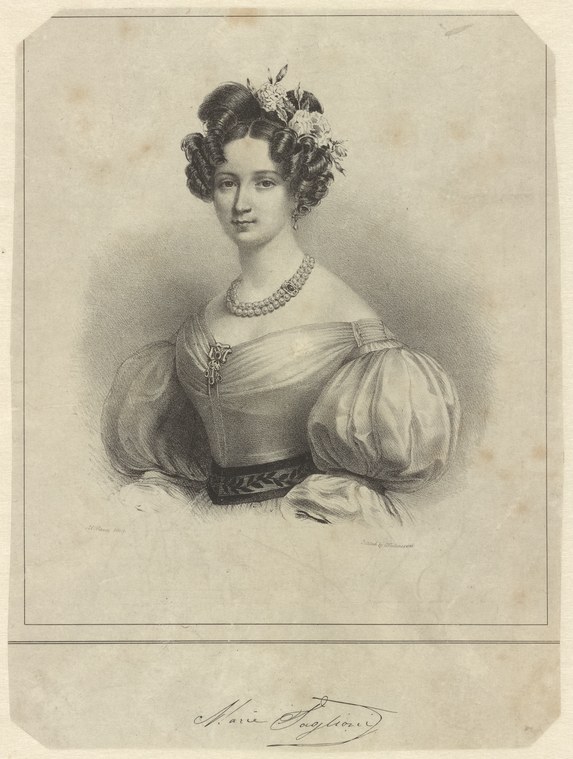
Marie Taglioni was the ballerina who most shaped the visual and technical language of Romantic ballet, and her image became synonymous with that era. This engraving is one of many contemporary portraits that created and reinforced her celebrity, and studying such prints reveals what audiences valued in her appearance and persona—refinement, ethereality, fashionable elegance—qualities that aligned with the Romantic ideals she embodied on stage.
What you are looking at
A half-length portrait of a young woman in formal early-nineteenth-century dress, shown against a plain background. She wears an off-shoulder gown of white or cream silk with voluminous puffed sleeves gathered at the wrists, and a dark belt or sash at the waist. A pearl or beaded necklace encircles her neck. Her dark hair is arranged in the fashionable ringlets of the 1830s–1840s, adorned with flowers or feathers at the crown. Her shoulders are relaxed, her gaze soft and direct toward the viewer, her expression serene. The work is a finely executed engraving or lithograph in black and white, with delicate stippling and line work creating volume and shadow across the fabric and face. The signature at the lower margin reads "Marie Taglioni."
The dancing
A single figure in a three-quarter pose, shown from the waist up. The body is at rest, not in motion or a dance position. The shoulders are dropped and square, the arms hanging naturally at the sides with one hand just visible at the lower edge. The posture conveys ease and composure rather than the tension or lift demanded by any specific dance technique. This is portraiture, not a representation of the body in performance.
The dance depicted
This is a portrait of Marie Taglioni, the Swedish dancer who became the most celebrated ballerina of the Romantic era. The image itself does not depict her dancing; it is a formal portrait of her as a social and artistic celebrity. However, we know from her historical significance that Taglioni was the defining dancer of Romantic ballet, celebrated for her lightness, grace, and technical refinement in works such as *La Sylphide* (1832). The portrait's careful execution and wide circulation as a print suggest her status as a major public figure whose image was in demand.
How it was made
This is an engraving or finely executed lithograph, rendered in black ink on paper. The technique employed is consistent with mid-nineteenth-century portrait reproduction: careful stippling and line work create modulation of tone, shadow falling subtly across the face and the folds of fabric, and the decorative linear border frames the composition. Such prints were the primary means of circulating celebrity images before photography; their relative affordability made them accessible to a wide middle-class and theatregoing audience. This work would have been produced in multiple impressions for sale or distribution.
About this work
This is a formal portrait engraving of Marie Taglioni, the Romantic-era ballerina, bearing her signature at the base. The work does not depict her dancing but rather captures her as a public figure and celebrity during the height of her fame in the 1830s–1840s. It is valuable to a dance archive not as a document of choreography or technique, but as evidence of how Taglioni was visualised and marketed—the care with which her image was composed and reproduced speaks to her iconic status. The print circulated widely in nineteenth-century Europe and America as a souvenir of one of ballet's defining figures.
How to look at it
This portrait is posed in the tradition of early-nineteenth-century society portraiture: a three-quarter view, at rest, with attention to the fashionable silhouette and fabrics of the moment. The viewer should attend to the delicate execution of the drapery and the soft rendering of the face—qualities that convey refinement rather than physical power. The signature at the base authenticates this as a portrait of the named subject, not a generalized image. The absence of any theatrical props, stage setting, or dance pose is itself significant: it presents Taglioni as a woman of fashion and social consequence, not primarily as a dancer's body.
The artist
The artist is not recorded in the catalogue. The quality and finish of the engraving suggest a professional reproductive engraver working in the mid-nineteenth century, likely in Paris or London, where Taglioni's image would have been in high commercial demand. Such portrait engravings were often unsigned or credited only to the publisher, and the same image might be reproduced by multiple houses across Europe.
The period
Marie Taglioni danced during the height of the Romantic ballet period (roughly 1832–1847), an era that celebrated ethereality, supernatural themes, and the illusion of weightlessness achieved through pointe work and refined technique. In the same decades, lithography and engraving techniques had become highly refined, making celebrity portraiture a major commercial genre. The circulation of Taglioni's image in print form was part of a broader culture of theatrical celebrity that prefigured modern fan culture; fans could own an engraved portrait as a memento or display it in their homes. The formal, dignified pose and contemporary dress in this portrait reflect Taglioni's status not merely as an entertainer but as a refined, educated woman of considerable social standing.
Where it lives
The work is held in the Prints collection of the New York Public Library. It is catalogued as a print depicting dance, though more accurately it is a print that documents a major figure in dance history rather than representing dance itself. The NYPL holds a large collection of nineteenth-century theatrical prints and celebrity portraits, of which this is one example.
Questions about this work
Did Marie Taglioni actually dance in the clothes shown here?
No. This is a formal portrait in contemporary fashion dress, not a stage costume. Taglioni would have worn a Romantic tutu, tights, and pointe shoes when performing. This image shows how she wished to be seen in polite society—as a fashionable, refined woman of her era.
Why is this in a dance art collection if she is not dancing?
Because it is a primary historical document of one of ballet's most important figures. The image reveals how a major Romantic-era ballerina was marketed and perceived by the public. Print portraits like this shaped celebrity culture and public memory of dance history.
Who made this engraving?
The artist is not recorded. Mid-nineteenth-century reproductive engravings were often produced anonymously or credited only to the publisher. Multiple engravers might reproduce the same portrait for different publishers, making individual attribution difficult without further research.
How many copies of this print exist?
Unknown. Engravings of Taglioni circulated widely in Europe and North America during her lifetime and after. Different printings and variants likely exist in museum and private collections worldwide.
More dance artwork





