49 works in this view — arrow keys or swipe to move between them.
Dance in Art
Folk dancing
Unknown artist
- Collection:
- Prints depicting dance
- Source:
- New York Public Library
- Rights:
- Public domain — free to use, share and adapt.
- Recorded as:
- Public Domain
This work documents Renaissance artists' engagement with classical sources and their imagination of ancient movement practices—a crucial context for understanding how dance history was constructed and what European elites thought 'authentic' or 'primitive' movement looked like. It also reveals the visual and conceptual gap between the controlled, geometric dances of Renaissance courts (themselves staged as classical revivals) and the chaotic, ecstatic movement associated with the lower classes or with imagined antiquity.
What you are looking at
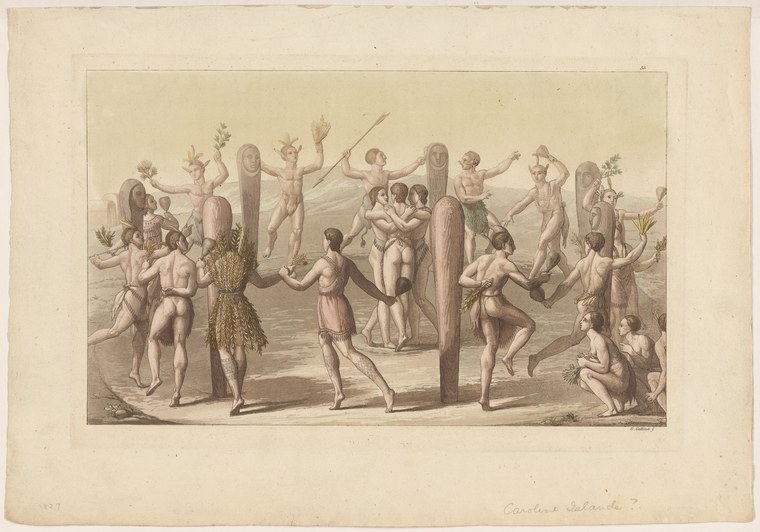
This engraving depicts a large gathering of nude and lightly draped figures engaged in dancing and revelry around what appear to be monumental stone structures or altars. The composition is densely populated, with figures arranged across the foreground and middle ground in varied poses of movement and celebration. Some hold aloft branches or garlands, others gesture expansively with raised arms. The figures range from fully nude to wearing minimal drapery or leaf skirts. The setting appears arcadian or classical, with a distant landscape visible. The print's pale tone and fine linear hatching are characteristic of early modern engraving technique. The scene suggests a bacchanal or fertility rite rather than a courtly or theatrical dance, with the energy dispersed across the entire composition rather than organized into formal patterns.
The dancing
The dancers display a range of uninhibited postures: some leap or stride with one leg extended, others reach skyward with both arms, still others move in pairs or small groups with arms linked or embracing. The figures appear to be in spontaneous, ecstatic movement rather than executing codified steps. Weight shifts fluidly between legs; the bodies are elongated in a manner typical of Renaissance printmaking rather than anatomically precise. There is no evident formation dancing or closed holds; instead, the emphasis is on individual expression and abandon, with bodies oriented in multiple directions across the composition.
The dance depicted
This appears to be a Renaissance or early modern depiction of ancient pagan revelry, most likely inspired by classical texts describing Bacchic or fertility celebrations. The style and density suggest the influence of sixteenth-century prints of mythological subjects, possibly referencing imagery from Ovid's Metamorphoses or similar classical sources. The dance itself—if it can be called organized dance—is ecstatic and non-ritual in character, emphasizing joy, intoxication, and sensuality rather than formal technique. The monumental architecture and architectural framing devices suggest this is an imaginative reconstruction of an antique scene rather than a contemporary folk dance, though the title 'Folk dancing' may indicate the cataloguer's reading of it as a depiction of popular or rural celebration.
How it was made
This is an engraving, identifiable from the parallel hatching lines used to create tone and shadow, the fine linear quality of the marks, and the characteristic pale cream paper support. The technique allowed the artist to achieve considerable detail and tonal range despite the linear medium, creating a sense of volume and movement through accumulated marks. Such engravings were relatively expensive to produce but could be printed in multiple impressions, making them important for the circulation of artistic ideas across Renaissance and early modern Europe. The medium's precision also allowed the artist to render numerous figures with distinct gestures and expressions across a crowded composition.
About this work
This is a Renaissance or early modern engraving depicting a classical bacchanal or pagan fertility celebration, with dozens of nude and draped figures dancing, leaping, and gesturing in ecstatic celebration around monumental structures. The work belongs in a history of dance imagery because it represents how artists of this period imagined and reconstructed ancient ritual movement, and because it shows the contrast between the ordered geometries of courtly dance (which dominated contemporary artistic representation) and the imagined wildness of antique or folk celebration. The dense, multi-directional composition and the emphasis on uninhibited bodily expression mark a fascination with dance as spontaneous, embodied joy rather than as a codified social practice.
How to look at it
Attend first to the architectural framing—the monumental stones or altars that structure the composition and suggest this is a reconstruction of an ancient sacred or ceremonial site. Then trace the movement of individual figures from foreground to background, noting how the artist has varied each dancer's gesture and orientation to suggest spontaneous, non-repetitive motion. The raised arms, extended legs, and turning torsos create a sense of continuous, diffuse energy rather than the synchronized patterns of courtly dance. Notice also the costume choices—the minimal drapery, leaf skirts, and nudity—which signal to the viewer that this is 'other' and ancient, removed from contemporary social norms.
The period
This engraving was made during or shortly after the Renaissance, a period of intense antiquarian interest in classical texts and visual sources. Artists were engaged in reconstructing imagined scenes of classical life based on literary descriptions, archaeological fragments, and earlier artistic representations. At the same time, Renaissance courts were developing and codifying formal dance practices—choreographed ballets, pavanes, and galliards performed in aristocratic settings. The contrast between the ordered court dances and this imagined chaos of antique revelry reflects contemporary anxieties and fantasies about class, gender, embodiment, and the 'natural' versus the civilized. Prints like this circulated ideas about movement across Europe and influenced how artists and intellectuals thought about the body in motion.
Where it lives
This work is held in the New York Public Library's collection of prints depicting dance. The collection assembles works across centuries and media united by their subject matter rather than by artistic school or period, reflecting a modern, thematic approach to organizing visual culture.
Dance in this work
Questions about this work
Is this a real dance, or is the artist inventing?
The artist is almost certainly inventing, based on classical literary sources and artistic imagination. Renaissance printmakers did not have direct access to ancient dances; instead, they created visual fantasies of what antique ritual or celebration might have looked like. The abundance of figures, the architectural setting, and the emphasis on uninhibited movement are all conventions of Renaissance artistic representation rather than evidence of an actual dance practice.
Why would this be called 'folk dancing'?
The cataloguer may have used 'folk dancing' to distinguish this image of spontaneous, joyful, uninhibited movement from the courtly or theatrical dances that dominated Renaissance artistic output. The term may also reflect a nineteenth- or twentieth-century modern perspective that associates 'folk' culture with the imagined natural, ancient, or non-European Other. It is not a contemporary category that would have been used to describe the work when it was made.
What do the stone structures mean?
The monumental columns or altar-like forms are architectural devices that frame the composition and signal to the viewer that this is a scene of ancient or sacred significance. They may be derived from architectural descriptions in classical texts, or they may be the artist's invention. Either way, they serve to legitimize the scene as a reconstruction of antiquity and to create a sense of ritual or ceremonial importance.
More dance artwork





