49 works in this view — arrow keys or swipe to move between them.
Dance in Art
London bridge
Unknown artist
- Collection:
- Prints depicting dance
- Source:
- New York Public Library
- Rights:
- Public domain — free to use, share and adapt.
- Recorded as:
- Public Domain
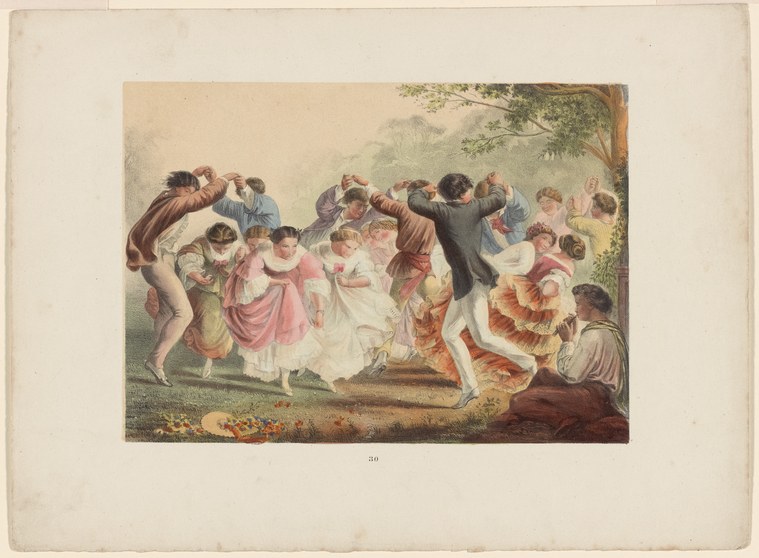
This image is the only surviving contemporary visual documentation of how the London Bridge game was performed in the 19th century, showing the actual formation, costume, and adult supervision involved. For dance historians and folklorists, it provides evidence that the game was understood as a significant enough cultural practice to merit artistic representation, and that adults were actively engaged in teaching and monitoring children's movement in organized settings. It also reveals how childhood itself—and children's physical play—became subjects worthy of aesthetic attention during the Victorian period.
What you are looking at
A lively outdoor scene of children and young people dancing in a circle or ring formation beneath a large tree. The composition centers on a group of perhaps a dozen figures in white and pastel-colored dresses and light clothing, arranged around a central space. Two adult figures—one in brown on the left, one in dark clothing on the right—appear to be leading or supervising the dance. The setting is pastoral, with a grassy ground, flowering plants visible in the foreground, and foliage overhead suggesting an idyllic garden or park. The light is warm and diffused, creating soft shadows. The mood is innocent and playful, with the figures captured mid-motion in what appears to be a traditional children's game or dance, possibly the game referenced in the title where children form a circle or line.
The dancing
The dancers are arranged in a loose ring or chain formation, their bodies turned inward toward the center of the group. Most wear light, flowing skirts that suggest movement and constraint-free motion typical of children's wear. The figures' postures are upright and animated—some with arms raised or extended, others with hands clasped to neighbors' hands or arms. The two supervising adults stand at opposite edges, bent slightly forward in postures of engagement or encouragement. The overall impression is of coordinated but informal movement, without the rigid holds or precise positioning of ballroom or classical dance.
The dance depicted
This appears to depict a children's circle game or round dance, most likely the English nursery game 'London Bridge is Falling Down,' in which children form a line or circle and move through physical play involving arches and captures. The game was documented throughout the 19th century as both a street game and a supervised activity in schools and parks. The presence of adult supervisors, the outdoor setting, and the mixture of older children and younger ones in light dress is consistent with Victorian-era organized recreation for children. The dance is entirely vernacular—a folk game played by children rather than a trained or theatrical form, though it was captured here by an artist valuing its charm and social significance.
How it was made
This is a hand-colored engraving or lithograph, likely 19th-century, in which the image has been printed and then selectively tinted with watercolor or colored inks. The technique required an artist to draw or engrave the image in line, then either hand-color each impression or apply color through additional stone or plate work. The soft palette—pale pinks, creams, greens, and flesh tones—and the way color sits gently over the underlying line work are characteristic of this period's popular prints. The technique was widely used for domestic and pedagogical subjects, allowing the image to be reproduced in multiple copies while retaining the appeal of painted work. This suggests the work was intended for a middle-class audience interested in childhood, education, or sentimental domestic scenes.
About this work
This is a record of children's play captured as fine art, documenting a timeless street game in an idealized garden setting. It belongs in a dance collection not because it shows trained technique but because it preserves the movement vocabulary of a specific cultural practice—the game of London Bridge—that has been danced by children in English-speaking communities for centuries. The work sits at the intersection of social history, children's culture, and art practice: it shows how 19th-century printmakers found aesthetic and moral value in childhood play, and it offers visual evidence of how the game was actually performed and supervised in that period. The image has no signature and limited provenance information, but it is part of a larger body of 19th-century prints on similar subjects—childhood, gardens, and innocent amusement—that were commercially produced and widely distributed.
How to look at it
Focus on the two supervising adults and how they position themselves relative to the children—they are engaged but not dominating, suggesting the pedagogical philosophy of the period, which valued guided rather than coercive play. Notice the variety of the children's poses: some are clearly mid-stride, others stationary, suggesting the artist captured a moment of active motion rather than a formal pose. The circle formation is loose and organic rather than geometric, which is how children actually play; a less observant artist might have made it too neat. Pay attention to the costume details—the girls' light, full skirts and the boys' simple suits—which date the work and show what children of different classes wore for outdoor activity in this period.
The period
This work dates to the 19th century, when childhood and children's education became increasingly professionalized and sentimentalized in European and North American culture. The growing middle class invested in specialized children's literature, toys, and supervised outdoor play as part of rational child-rearing theory. At the same time, printmaking technology (especially lithography, which became widely available after 1815) allowed artists and publishers to produce affordable, hand-colored images for domestic consumption. Prints showing children at play, in gardens, or engaged in 'improving' activities were enormously popular, serving both as entertainment and as models of ideal childhood. The game of London Bridge itself had been documented in written form since at least the 16th century, but visual representation of it was rare; its inclusion here suggests the artist saw documentary and sentimental value in capturing a living tradition.
Where it lives
The work is held in the New York Public Library's collection of prints depicting dance. It is part of a larger body of 19th-century popular prints and is catalogued with minimal attribution information; the artist is not recorded.
Dance in this work
Questions about this work
Is this actually London Bridge the game, or could it be another children's circle game?
The title in the catalogue is 'London bridge,' and the formation—a circle or arch under which children pass—is consistent with the game documented in English and American sources from this period. Without a signature or publication information, we cannot rule out that the title was assigned later or refers to another similar game, but the visual evidence supports the London Bridge identification. Other popular games like 'Ring Around the Rosie' had similar formations, so some ambiguity remains.
Why is this in a dance collection if it's just children playing?
Children's games are a form of vernacular dance—movement that is learned, transmitted, and valued within a community, without formal training or theatrical context. Dance history has traditionally focused on elite forms (ballet, ballroom) or documented folk traditions, but children's games are equally valid subjects of study. They preserve movement vocabularies, teach social coordination, and carry cultural meaning. This image documents one specific example of how such games were performed and taught in a particular time and place.
Who are the two adults supervising?
They are not identified in the work. They appear to be teachers, nannies, or parents overseeing organized play in what looks like a private garden or park. The formality of their dress and their positioning suggest they are responsible adults, not participants in the game. Their presence reflects Victorian attitudes toward children's play as something that should be supervised and morally guided.
What technique was used to make this print?
The work is most likely an engraving or lithograph that was then hand-colored with watercolor or tinted inks. The fine line work visible in the figures and details suggests an engraved or drawn original, while the soft, varied color application is characteristic of hand-coloring or early color printing. This was the standard technique for popular 19th-century prints and allowed the publisher to produce multiple copies while maintaining the appeal of painted work.
More dance artwork





