49 works in this view — arrow keys or swipe to move between them.
Dance in Art
Men dancers and choreographers in prints
Unknown artist
- Collection:
- Prints depicting dance
- Source:
- New York Public Library
- Rights:
- Public domain — free to use, share and adapt.
- Recorded as:
- Public Domain
This print is a primary document of early 19th-century theatrical dance culture, showing how male dancers were marketed and remembered. It preserves the name and likeness of a performer who would otherwise have left no trace, and reveals the conventions of professional male dance costume and formal self-presentation during this period.
What you are looking at
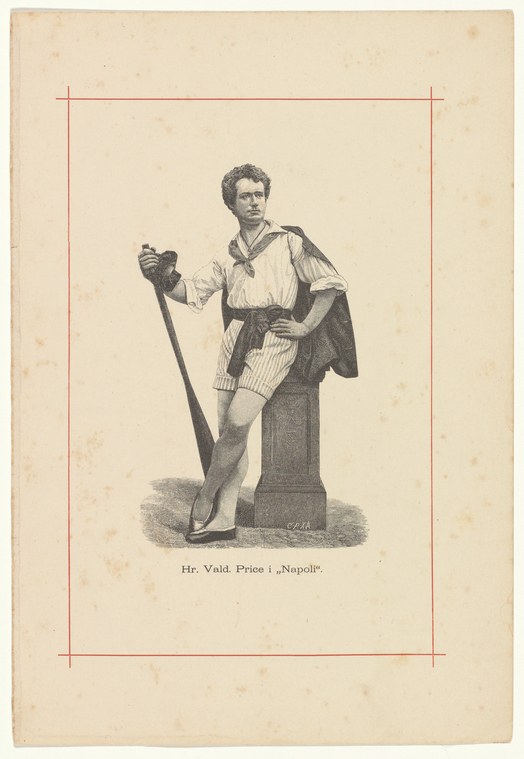
A young male dancer stands alone against a plain background, positioned slightly to the left of center. He wears a loose white linen shirt with short, voluminous sleeves and dark breeches that end above the knee, a costume typical of early 19th-century theatrical practice. His weight is distributed evenly on both feet, his posture upright and composed. In his left hand he holds what appears to be a decorative mask or fan—a flat object rendered in dark lines—while his right arm hangs naturally at his side. A dark cloak or cape drapes loosely from his shoulders. The figure is rendered in fine engraved line work, with careful cross-hatching to suggest the fall of fabric and the modeling of his face and limbs. The setting is entirely abstract, with only a rectangular frame and a single flat base or platform suggested beneath his feet.
The dancing
The dancer's stance is formally presented and static rather than captured mid-movement. Both feet remain planted on the ground, the legs straight and unturned, the torso erect. The arms are lowered and relaxed, neither extended nor in any recognizable dance frame. The face is turned slightly toward the viewer, with a serious or neutral expression. This is a portrait of a dancer at rest or in a conventional pose, not an image of dynamic action or technique.
The dance depicted
The print records a male dancer, identified in the caption as Hr. Vald. Price from 'Napoli' (likely referring to a Neapolitan or Italian theatre, or possibly a role or company). The costume—loose shirt, knee breeches, cape—and the formal portrait mode suggest theatrical dance of the early 19th century, possibly pantomime or a character role from comic or dramatic opera. The object in his hand may be a stage property rather than a dance implement. Without additional context, the specific dance form cannot be determined, but the presentation is consistent with printed publicity or documentation of theatrical performers from this era.
How it was made
This is a copper engraving, identifiable by the fine parallel lines (hatching) used to create tone and shadow, the precise linear definition, and the characteristic appearance of printed copper plate work. The technique allowed for wide distribution and multiple impressions, suggesting this was a publicity or documentation print—likely a souvenir or record of a performer known to theatre audiences. The careful attention to fabric texture and facial likeness indicates a professional workshop production, though the artist remains unrecorded.
About this work
This engraving documents a named male dancer of the early 19th century in theatrical costume, presented as a formal portrait rather than a scene of performance. It belongs to a tradition of printed theater publicity and performance documentation that flourished in the 19th century, when such engravings circulated among theatre patrons, collectors, and the print-buying public. The work records both a specific performer and the conventions of male theatrical dress and presentation during this period—capturing not the dance itself but the dancer as a named individual and public figure.
How to look at it
Attend to the costume details—the shirt construction, the breeches, the cape—which are rendered with precision to show how a stage dancer actually dressed. Note the static, frontal presentation: this is not a moment of action but a formal introduction of a named performer. The mask or property object in the dancer's hand may indicate a specific role or dramatic context, but without documentation it remains uncertain. The engraving's fine line work allows the viewer to see both the fabric texture and the facial likeness with clarity.
The period
This engraving dates to the early decades of the 19th century, a period when theatrical dance was professionalized and increasingly documented through printed images. Male dancers at this time typically wore simple linen shirts and knee breeches for comic or character roles, distinct from the weightless, ethereal costume that was becoming standard for female Romantic dancers. Theatre prints were a significant commercial product, sold to audiences as souvenirs and collectibles. The formal portrait mode reflects the status of successful performers as named artists rather than anonymous ensemble members.
Where it lives
This work is held within the New York Public Library's collection of prints depicting dance. It appears to be a single-sheet theatrical publicity or documentation engraving, the kind that would have been sold or distributed to theatre audiences.
Questions about this work
Who was Hr. Vald. Price?
The caption identifies him as a performer from 'Napoli,' but further biographical information is not available from the image alone. Hr. (Herr) is a German or Scandinavian courtesy title, suggesting he may have performed in Northern or Central European theatres. The name and engraved portrait suggest he was a known and named performer, but detailed records of his career are not documented here.
What kind of dance is he performing?
The static pose and costume suggest theatrical dance, likely pantomime, comic opera, or a character role rather than ballet. The loose shirt and knee breeches were standard male theatrical dress of the early 19th century. Without additional documentation or a record of the specific role, the precise genre cannot be determined from the image alone.
What is he holding in his hand?
The object appears to be a mask, fan, or stage property. Given the context and the dark, flat appearance, it could be a prop associated with a specific dramatic role. Such objects were common in theatrical dance and pantomime of this era.
More dance artwork





