49 works in this view — arrow keys or swipe to move between them.
Dance in Art
Men dancers and choreographers in prints
Unknown artist
- Collection:
- Prints depicting dance
- Source:
- New York Public Library
- Rights:
- Public domain — free to use, share and adapt.
- Recorded as:
- Public Domain
The work is a rare primary document of a dance master's professional identity and self-presentation in the antebellum American republic. It names a specific person and a specific dance (however difficult to parse), and it is dated and localized, making it valuable evidence for social dance history and the professionalization of dance instruction in New York. The print's existence suggests Saracco was prominent and marketable enough to warrant commercial portraiture—information that would otherwise be lost.
What you are looking at
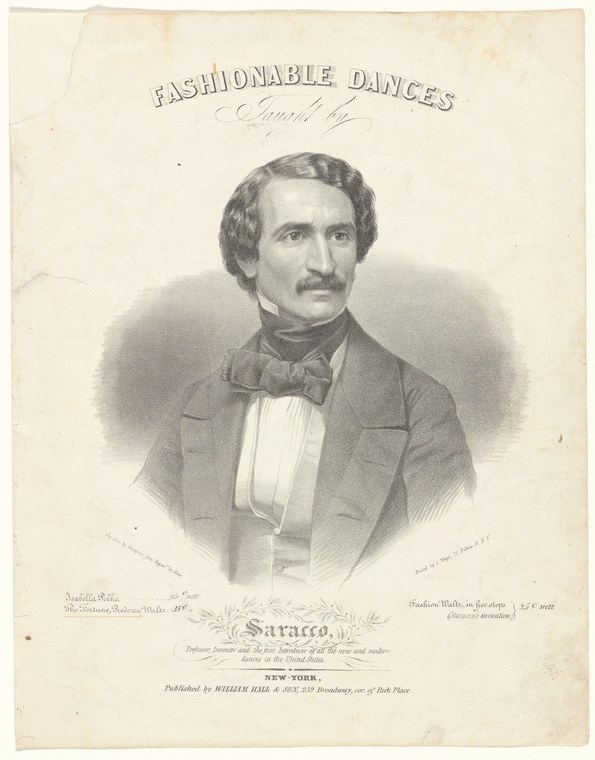
A bust-length portrait of a man in formal evening dress, rendered as a lithographic print. He wears a dark coat with silk lapels, a white dress shirt with pleated front, and a black silk bow tie, the standard uniform of a mid-nineteenth-century gentleman of rank. His hair is dark and wavy, parted to the side, and he wears a distinctive drooping moustache in the fashion of the 1850s–60s. The background is a soft grey wash that throws the figure into relief. Below the portrait, ornamental flourishes frame the name "Saracco" and a subtitle identifying him as "Maestro and the first introduced of the New and under-dance to the United States." The print was published in New York by William Hall & Son of 823 Broadway.
The dancing
The subject is shown in repose, a three-quarter bust view with the body angled slightly to the left and the head turned to face the viewer. His expression is calm and dignified. There is no active gesture or dance posture; this is a portrait of a dancing master in his professional identity rather than a depiction of movement or technique. The formal dress and composed bearing suggest authority and social standing.
The dance depicted
Saracco is identified as the first master to introduce a dance called "Saracco" to the United States. The inscription is partially obscured and difficult to read with certainty, but the phrase "new and under-dance" or similar suggests this was a novelty or a specific named choreographic form. The portrait serves as a celebrity endorsement or publicity image for a dance master rather than an instruction in technique or a record of performance. Without clearer reading of the subtitle or independent documentation, the specific identity and character of the dance cannot be established from the image alone.
How it was made
This is a lithographic print, identified by the fine tonal gradations in the background wash, the crisp rendering of the subject's features, and the characteristic line work of mid-nineteenth-century commercial portraiture. Lithography allowed rapid and relatively inexpensive production of multiple copies, making it the standard medium for celebrity portraits and theatrical publicity in the 1850s–60s. The quality of the work and the New York publisher suggest this was a commercial product for distribution, likely sold as a souvenir or advertisement in connection with Saracco's teaching or performances.
About this work
This is a celebrity portrait of a dance master named Saracco, printed in New York in the mid-nineteenth century and distributed as a commercial lithograph. The work documents both the man and his claim to fame—the introduction to America of a dance named for himself. The portrait follows the conventions of mid-Victorian professional portraiture: formal dress, dignified bearing, and careful attention to the sitter's appearance as a mark of status and expertise. It belongs in a gallery of dance imagery because it captures a moment when dance instruction was becoming a commercial and socially aspirational enterprise in the United States, and because it preserves the name and likeness of a figure now largely forgotten, whose contribution to American dance is now difficult to trace.
How to look at it
Look at the sitter's dress and bearing as evidence of professional status: the formal coat, the careful grooming, the composed expression all signal a man of expertise and authority. The inscription below is the key to understanding the image—it is not simply a portrait of a notable person, but a advertisement for a specific dance. The ornamental flourishes around the name give it prominence and dignity. The style of the print itself—the soft modeling, the commercial finish—tells you this was a mass-produced image meant for broad circulation, not a unique artistic statement. The image works as publicity.
The artist
The print is credited to "W. Schaus" (lower left) and published by William Hall & Son. William Hall was a major New York music and dance publisher of the mid-nineteenth century; the firm's imprint on a dance master's portrait suggests Saracco's fame was tied to the music and dance publishing industry. Schaus was likely a lithographic artist working on commission for Hall. The names have not been further researched.
The period
This portrait dates to the era when ballroom dancing was becoming formalized and commercialized in America, and when dance masters were increasingly visible as professional celebrities and pedagogues. The 1850s–60s saw the rise of the waltz, polka, and galop as fashionable social dances, and the emergence of named dances tied to individual masters or performers. Lithographic portraiture was at its height as a means of publicizing theatrical and musical celebrities. The New York publisher's address (823 Broadway) places Saracco in the commercial and cultural heart of the city.
Where it lives
The work is held in the prints collection of the New York Public Library as part of a broader holding of dance-related prints. It is catalogued as a lithograph published in New York, but the NYPL record does not include medium or date information. The work is identifiable from the inscriptions on the print itself.
Questions about this work
What dance did Saracco introduce?
The subtitle is difficult to read in full, but identifies it as a new dance bearing Saracco's name. Without access to clearer documentation or Saracco's own publications, the specific character and steps of the dance cannot be determined from the portrait alone. Contemporary dance manuals or notices may clarify what the 'Saracco' dance entailed.
Who was Saracco?
He was a dance master active in New York in the mid-nineteenth century, prominent enough to warrant commercial portraiture and publication. Beyond what the print tells us—his name, his profession, and his claim to have introduced a named dance to America—biographical information has not been located in the available sources.
Why is he shown in street dress, not dancing?
This is a professional portrait, not a depiction of performance or technique. In the mid-nineteenth century, celebrity portraits of musicians, actors, and dance masters typically showed the subject in formal daytime or evening dress, presenting them as respectable professional men (or women) rather than in the moment of performance. The authority of the profession is asserted through dress and bearing, not through action.
What does the publisher's imprint tell us?
William Hall & Son was a major New York publisher of music and dance materials. Their imprint suggests that Saracco's fame was tied to the commercial music and dance trade, and that his portrait was considered marketable as a souvenir or advertisement. The Broadway address places him in the heart of the city's theatrical district.
More dance artwork





