49 works in this view — arrow keys or swipe to move between them.
Dance in Art
Men dancers and choreographers in prints
Unknown artist
- Collection:
- Prints depicting dance
- Source:
- New York Public Library
- Rights:
- Public domain — free to use, share and adapt.
- Recorded as:
- Public Domain
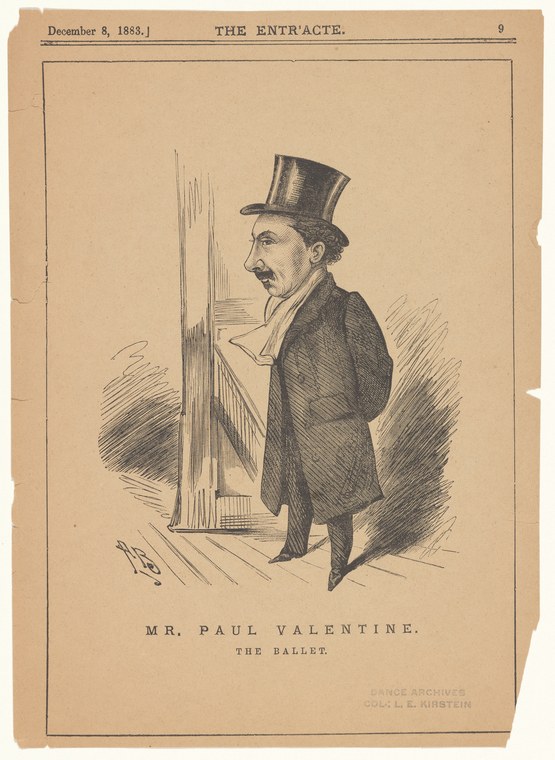
This image is a rare document of a male ballet dancer's public persona in an era when male ballet was in significant decline in Britain, particularly after the romantic era had passed. The careful rendering and placement in a prestigious theatrical periodical indicates the respect accorded to Valentine as a performer and choreographer, offering evidence of the social and professional status of male ballet artists in the 1880s. For historians studying late 19th-century British dance, this portrait provides a tangible record of an individual whose contributions to ballet survive primarily through such images and scattered references.
What you are looking at
A single male figure stands in three-quarter profile against a plain background, dressed in formal Victorian-era attire: a dark coat with a high collar, bow tie, and a top hat. The man has a distinctive thin mustache and gaunt features. His posture is slightly stooped, with one arm hanging naturally at his side while the other is positioned near his torso in a gesture that suggests either restraint or contemplation. A vertical line or pole is visible behind him, integrated into the composition to create spatial depth. The figure occupies the center-left of the frame, rendered in pen or ink with careful crosshatching and line work that gives the form volume and presence. The overall mood is one of studied formality tinged with theatrical melancholy or irony—the pose and expression convey both dignity and a subtle comedic element typical of period caricature.
The dancing
This is a portrait rather than a depiction of active dance movement. The single figure adopts an upright but slightly withdrawn posture, with the torso turned slightly and the arms held in a manner suggesting either nervousness or theatrical presentation. There is no dynamic movement, no partner, no hold, and no visible footwork or weight shift. The body position is one of presentation—a performer or subject posed for examination rather than engaged in balletic or social dance movement.
The dance depicted
This image does not depict dance movement in the conventional sense. The notation 'MR. PAUL VALENTINE. THE BALLET.' beneath the print indicates that this is a portrait of Paul Valentine, a male dancer or choreographer associated with ballet in the late 19th century. The pose and formal dress suggest this is a character portrait or caricature of a theatrical personality, likely created for a periodical devoted to theater and the performing arts. The stance may reference a particular ballet character or role, but the image itself captures a static moment of presentation rather than choreography or movement.
How it was made
This is a wood engraving or pen-and-ink drawing, characterized by fine cross-hatching and linear detail typical of periodical illustration in the 1880s. The technique allows for precise rendering of costume and facial features while maintaining the crisp, reproducible quality necessary for newspaper or magazine publication. The date 'December 8, 1883' and the publication mark 'THE ENTR'ACTE' at the top indicate this is a page from a theatrical periodical, suggesting a mass-produced print designed for a theater-going readership. The skill evident in the rendering of fabric texture and facial expression indicates professional theatrical illustration.
About this work
This is a portrait engraving of Paul Valentine, a ballet figure from the London theatrical scene of 1883, published in The Entr'acte, a weekly periodical devoted to theater, music hall, and dance. The image captures not a moment of choreography but a formal presentation of a performer in his professional identity—dressed in evening wear, poised for the stage or for public recognition. It belongs in a gallery of dance imagery because it documents the cultural standing of male ballet dancers in the late Victorian era and preserves a recognizable portrait of an artist whose work and life were central to London's theater world. The work is a record of dance culture and personalities as much as it is an artistic artifact.
How to look at it
Examine the posture and costume closely: the formal evening dress and top hat signal that this is not a costume portrait but a presentation of the man himself as a public figure. The slight restraint in the pose, the thin mustache, and the gaunt features all suggest a figure of some age and experience. The vertical line behind him may reference the wings of a stage or simply frame him as a subject for scrutiny. The engraving technique—the careful crosshatching that builds form—reflects the high standards of Victorian theatrical publication and invites close examination of the artist's skill.
The artist
The artist is not recorded in the catalogue, but the technique and style are consistent with professional theatrical illustration of the 1880s. The work appeared in The Entr'acte, a leading British theatrical weekly founded in 1870, which regularly commissioned portrait engravings of performers and personalities. The publication employed skilled illustrators who specialized in theatrical subjects, and this engraving reflects the high standard of theatrical journalism of the period. The artist's approach—combining precise anatomical accuracy with subtle caricature—was typical of the best theatrical portraiture of the era.
The period
The early 1880s saw English ballet in a transitional phase. The Romantic era had ended, and the dominance of Italian and Russian ballet was growing. Male ballet dancers in Britain occupied an uncertain position: respected as professionals in the theater but increasingly sidelined in favor of elaborate spectacle, music hall, and the growing prestige of Russian Imperial ballet. The Entr'acte itself, founded in 1870, reflected a new kind of theatrical journalism that celebrated performers as celebrities and personalities, not merely as dancers. This portrait sits within that context—Valentine is presented as a man of distinction and professional accomplishment, a figure worthy of attention from the theater-going public.
Where it lives
This engraving is from The Entr'acte, a British weekly periodical devoted to theater, music hall, opera, and dance, held by the New York Public Library. The publication was a leading source of theatrical news, gossip, and portraiture in London from 1870 onward, and its illustrated pages provide a rich archive of late Victorian theatrical personalities.
Questions about this work
Who was Paul Valentine?
Paul Valentine was a ballet dancer and choreographer active in London in the mid-to-late 19th century. Beyond this portrait and scattered references in theatrical periodicals, detailed biographical information is scarce. He appears to have held a position of some prominence in English ballet, warranting a portrait in The Entr'acte. He may be the same Paul Valentine associated with pantomime and ballet productions in the 1870s and 1880s.
What is The Entr'acte?
The Entr'acte (1870–1936) was a British weekly periodical devoted to theater, music hall, opera, and dance. It was known for lively criticism, gossip, and high-quality theatrical engravings and illustrations. Each issue included portraits of performers, making it a valuable source for understanding theatrical celebrities and dance culture of the era.
Why is this in a dance collection if there is no dancing?
This portrait documents an important figure in late 19th-century British ballet and preserves his likeness at a moment when English male ballet was in decline. Dance history is not only about movement; it includes the lives, careers, and cultural standing of dancers. This image is evidence of how male ballet artists were perceived and celebrated in their own time.
What technique was used to make this engraving?
This appears to be a wood engraving or pen-and-ink drawing rendered for reproduction in a periodical. The fine crosshatching and linear precision are characteristic of wood-engraved illustration. The technique allowed for the crisp, detailed reproduction necessary for mass-market publication while capturing both likeness and character.
More dance artwork





