49 works in this view — arrow keys or swipe to move between them.
Dance in Art
Photogravures after paintings by Jean Léon Gérôme
Unknown artist
- Collection:
- Prints depicting dance
- Source:
- New York Public Library
- Rights:
- Public domain — free to use, share and adapt.
- Recorded as:
- Public Domain
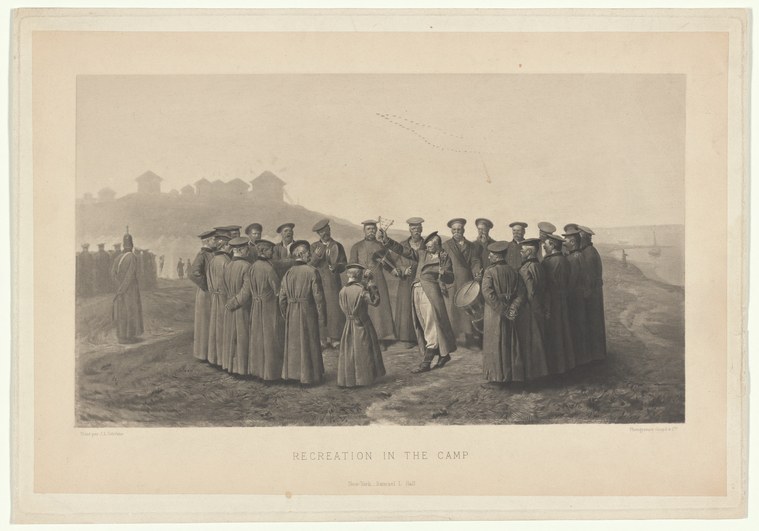
The work offers rare evidence of informal social dance or movement practices within military communities of the late 19th century, a subject rarely preserved in high art. It also illustrates how photogravure disseminated images of life and leisure to audiences far beyond those who saw Gérôme's original paintings, shaping visual understanding of military and colonial experience.
What you are looking at
A large group of soldiers in long military overcoats and caps stands in a loose circle or gathering in a barren, flat landscape under hazy light. In the background, a fortified structure with crenellated walls and multiple turrets rises above the horizon. The foreground is bare earth, and the composition suggests a moment of rest or leisure during a military campaign. The figures are densely packed, facing inward toward an unseen center, their postures relaxed compared to the formality of parade drill. The atmosphere is muted and austere, with soft modeling of light across the uniforms.
The dancing
The soldiers stand in an informal circle, weight distributed casually on both feet, arms at ease. Several figures in the center appear to be engaged in movement or demonstration—the central group shows looser, less rigid postures than those at the perimeter. The dress is uniform: long military greatcoats and military caps, consistent with late 19th-century European armies. The gathering suggests observation of an activity or performance rather than military formation.
The dance depicted
The title *Recreation in the Camp* indicates this depicts leisure activity among soldiers, possibly including dance or entertainment. The circular formation and the relaxed, inward-facing postures of the gathered figures are consistent with soldiers watching a performance or participating informally in social movement. However, the image does not clearly show recognizable dance steps, holds, or technique. Without more specific visual markers of ballroom, folk, or theatrical dance forms, the work documents social recreation rather than a named dance genre. The setting and the era suggest this may record regimental entertainment practices of the Gilded Age.
How it was made
This is a photogravure, a photomechanical reproduction process that combined photography with intaglio printing to achieve fine detail and tonal subtlety. Photogravure allowed large-scale distribution of images derived from paintings or drawings without loss of nuance. The softness and tonal range visible here—the modeling of cloth, the atmospheric haze, the gradations across the landscape—are characteristic of the medium. As a reproduction of a painting by Jean-Léon Gérôme, it would have circulated among collectors, illustrated magazines, and institutions in the late 19th or early 20th century, reaching a far wider audience than the original canvas.
About this work
This photogravure reproduces a painting by Jean-Léon Gérôme depicting soldiers at leisure in a military camp, gathered in a circle as if watching or participating in entertainment or recreation. The work documents a moment of social and possibly choreographic activity within military life during the Gilded Age. Gérôme was celebrated for his orientalist scenes and historical subjects; his interest in capturing moments of social life within exotic or distant settings is evident here. The photogravure process ensured wide circulation of the image, making it a significant document of how leisure, recreation, and implicit dance were represented to educated audiences of the period.
How to look at it
Observe the circular arrangement and the inward orientation of the figures, which suggests a performance or demonstration is taking place at the center. Notice the relaxation of military posture and the casualness of stance—the artist has chosen to show soldiers at rest rather than in formal drill. The hazy, atmospheric quality of the photogravure and the vast, empty landscape work together to isolate this moment of human gathering from the surrounding desolation. The fortified structure in the background anchors the scene in a specific colonial or military setting, likely intended to suggest campaigns in North Africa or the Near East.
The artist
Jean-Léon Gérôme (1824–1904) was a dominant figure in French academic painting, celebrated for large-scale historical, orientalist, and genre scenes. Known for meticulous draughtsmanship and a commitment to historical accuracy in costume and setting, Gérôme produced works intended to educate and elevate viewers morally and intellectually. His orientalist paintings—depicting North African and Middle Eastern scenes—were enormously popular and widely reproduced through photogravure, colour lithography, and other mechanical processes. His interest in exotic or distant subjects often extended to the documentation of daily life, including recreation and social customs.
The period
This work dates to an era when photomechanical reproduction had revolutionized art publishing. Photogravure, perfected in the 1870s, allowed museums, collectors, and publishers to distribute high-quality reproductions of paintings globally. Gérôme's paintings were among the most frequently reproduced. In military contexts, the Gilded Age saw increased documentation of colonial campaigns and garrison life, often with romanticized or picturesque intent. Dance and recreation in military camps were understood as markers of unit cohesion, morale, and civilization—particularly important in representations of European armies stationed in colonial territories.
Where it lives
This photogravure is held in the New York Public Library's collection of prints depicting dance. Photogravures of this type were published both as separate prints for collectors and as illustrations in portfolios, exhibition catalogues, and art journals. The NYPL's classification under 'prints depicting dance' suggests institutional recognition of the work's relevance to the history of dance documentation and representation.
Questions about this work
Did Gérôme actually witness this scene?
Gérôme was known for extensive travel and observation, particularly in North Africa and the Ottoman Empire. Whether he sketched this specific gathering or composed it from multiple observations is unclear; his paintings often combined observed detail with imaginative arrangement. The topographical specificity of the fortification and landscape suggests research, but the composition is artistic rather than documentary.
What kind of dance or entertainment might soldiers have performed?
Military camps of the period typically featured informal music, social dancing, and folk entertainment reflecting the soldiers' regional origins. Without more specific visual evidence of steps or music, the image does not identify a particular genre. The circular formation could indicate anything from social circle dances to folk traditions common in European armies of the era.
Why reproduce this painting as a photogravure?
Gérôme's paintings were enormously popular and commercially valuable. Photogravure was the highest-quality reproduction technology available in the 1880s–1900s, capable of capturing the subtlety of his tonal work. Publishers issued photogravures as collectible prints, museum reproductions, and illustrations in art periodicals, extending the painting's reach far beyond those who could see the original.
More dance artwork





