49 works in this view — arrow keys or swipe to move between them.
Dance in Art
Photogravures after paintings by Jean Léon Gérôme
Unknown artist
- Collection:
- Prints depicting dance
- Source:
- New York Public Library
- Rights:
- Public domain — free to use, share and adapt.
- Recorded as:
- Public Domain
The work documents Gérôme's influence on visual culture and the appetite for orientalist and historical scenes in the later 19th century, but it does not itself document dance practice or convention. It is valuable to the Gallery primarily as evidence of how performance and the theatrical body were imagined and circulated in mass-reproducible form.
What you are looking at
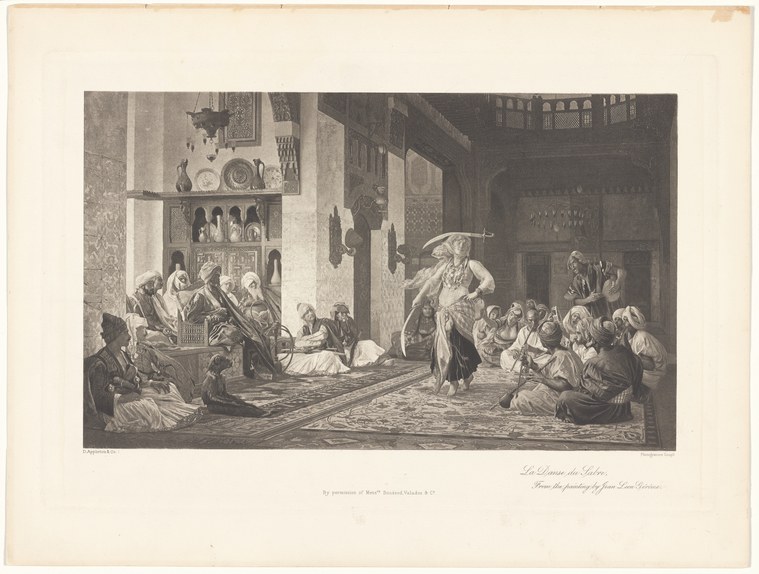
A crowded interior scene set in what appears to be a palatial hall with classical architecture: columns, a coffered ceiling, and ornate wall niches holding vessels and amphoras. The composition divides into two distinct spatial zones. On the left, figures in draped classical garments sit and recline on the floor around what may be a cushioned seat or low platform. On the right, a standing figure in a pointed hat (possibly a Phrygian cap) gestures expansively toward a larger assembly of seated onlookers arranged in a semicircle. The floor is patterned with geometric designs. The lighting is dramatic, with strong shadows defining the volumetric forms of the figures and architecture. The scene captures a moment of performance or oration rather than coordinated group movement: this is a commanded attention, not a synchronized dance.
The dancing
The standing central figure dominates through posture and gesture, with one arm raised and extended in an orator's or actor's command. The surrounding figures are predominantly seated or reclining, their bodies angled inward toward the performer, their postures passive and receptive rather than kinetic. No two figures share a coordinated frame or hold. The dress is classical drapery, ungirded and loose. There is no evidence of the physical coordination, shared weight, or mutual frame that would indicate partnered or ensemble dance.
The dance depicted
This does not depict dance in the modern sense. The image shows what appears to be a classical dramatic recitation, theatrical oration, or possibly a scene from Greek or Roman theatrical tradition. The pointing figure and commanding gesture suggest declamation rather than movement. If this derives from Gérôme's orientalist practice, it may represent an imagined scene of ancient ceremony or entertainment, but the bodies do not perform dance—they perform spectatorship and attention to a speaker or actor.
How it was made
This is a photogravure, a photomechanical printing process that translates a photograph or artwork into an intaglio plate, allowing reproduction of fine tonal gradation and detail. The process was widely used from the 1870s onward to reproduce paintings and drawings in books and periodicals, making artworks accessible to a broad audience without the labor of hand-engraving. The rich blacks, fine halftone modeling of drapery, and precision of architectural detail are characteristic of high-quality photogravure work. The process allowed Gérôme's paintings—often large and in private collections—to circulate as affordable prints.
About this work
This print reproduces a classical or orientalist theatrical scene by the 19th-century French painter Jean Léon Gérôme. Rather than depicting dance proper, it captures a moment of dramatic performance or oratory in an imagined ancient setting, with a commanding central figure addressing a seated assembly. The work exemplifies Gérôme's practice of reconstructing historical and exotic scenes with archaeological attention to costume and setting. As a photogravure, it represents the 19th-century ambition to make museum-quality imagery available to educated middle-class viewers. Though it portrays human movement, it does so in the context of theater and gesture rather than the patterned, coordinated bodily practice that constitutes dance.
How to look at it
Attend to the compositional hierarchy: the standing figure's gesture commands the entire interior space, and every other body is oriented toward this central point of attention. Notice the architectural setting, which grounds the scene in a specific (if imagined) cultural moment. The photogravure's tonal range allows fine discrimination of shadow and drapery, creating a sense of material presence and spatial depth. The scene is not frozen mid-movement but rather staged as a moment of utterance or command, capturing theater rather than dance.
The artist
Jean Léon Gérôme (1824–1904) was a dominant figure in French academic painting, celebrated for meticulously researched historical and orientalist scenes. He worked in a tradition of academic realism that prized anatomical correctness and archaeological plausibility. His large historical canvases were translated into prints and engravings that reached international audiences; photogravure reproductions of his work became widespread in the late 19th century. Gérôme's orientalism, while immensely popular, drew on fantasy and invention as much as scholarly research.
The period
In the late 19th century, European academic painters competed to produce monumental historical and orientalist scenes that satisfied bourgeois appetite for edifying and exotic imagery. Theater and classical antiquity were favored subjects. Simultaneously, photomechanical reproduction technologies—including photogravure—democratized access to such images, making high art available as affordable portfolio prints and book illustrations. This period saw the height of orientalism as a visual discourse, driven partly by colonial expansion and partly by antiquarian fascination with non-European pasts, both real and imagined.
Where it lives
This photogravure is held in the New York Public Library's Prints collection, part of its holdings of reproductions after paintings by Gérôme and his contemporaries. Such reproductions were produced in large editions for sale and distribution, making them relatively common in institutional collections.
Questions about this work
Is this actually a dance scene?
No. The image shows a theatrical or oratorical moment in a classical setting, with one standing figure gesturing toward a seated audience. There is no coordinated bodily movement, synchronized action, or the rhythmic patterning that characterizes dance. It is included in the Gallery to illustrate the distinction between performance, gesture, and dance proper.
Who painted the original and when?
The catalogue record attributes the photogravure to reproductions after Jean Léon Gérôme but does not record the date of either the original painting or the print. Gérôme was most productive in historical and orientalist subjects between 1850 and 1900.
What does the figure in the pointed hat represent?
The hat resembles a Phrygian cap, associated in classical iconography with the East, antiquity, and liberty. It signals that Gérôme intended the scene to evoke a historical or exotic moment, though the exact narrative is not identified in the catalogue.
More dance artwork





