49 works in this view — arrow keys or swipe to move between them.
Dance in Art
Miss Nancy Dawson
Unknown artist
- Collection:
- Prints depicting dance
- Source:
- New York Public Library
- Rights:
- Public domain — free to use, share and adapt.
- Recorded as:
- Public Domain
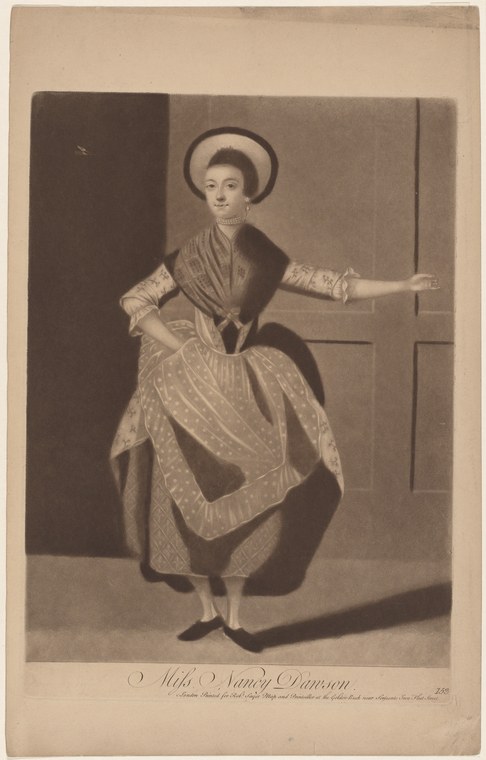
This print is evidence of how individual dancers—particularly women in popular entertainment—were marketed, costumed, and commemorated in the 18th century. It shows that dancers were understood as celebrities worthy of portraiture and commercial reproduction, and it preserves visual information about the actual dress, posture, and presentation styles of the period that would otherwise be lost to historical records.
What you are looking at
A woman in 18th-century dress stands alone in a sparse interior, her body caught mid-gesture with one arm extended outward and the other across her torso. She wears a fitted bodice with long sleeves ending in decorative ruffles, a full skirt with a patterned overgarment or apron draped across it, and a wide-brimmed hat with a halo-like rim. Her posture is upright and her weight appears to be on one leg, creating a sense of momentary pause or transition. The setting is minimal: a plain wall behind her with a simple door or panel, and dark shadow on the left. The composition is frontal and theatrical, with the figure isolated against the muted background. The engraving technique renders her in warm sepia tones with careful attention to the texture and fall of her garments.
The dancing
A single female figure in a standing position with asymmetrical arm placement: one arm raised and extended to the side at approximately shoulder height, the other held lower and across the body. Her weight distribution suggests a pose held for presentation rather than captured mid-motion. The body is turned slightly, and her gaze is directed forward. The pose is formal and self-aware—this is a portrait of a dancer in costume rather than a snapshot of performance.
The dance depicted
The figure's dress, pose, and the theatrical quality of the presentation suggest this is a representation of a dancer in late 18th-century entertainment, most likely from English popular or comic theater or ballroom context. The hat, ruffled sleeves, patterned skirts, and the overall style of dress are consistent with the fashionable dress of the 1780s–90s. The title identifies her as Miss Nancy Dawson, a name associated with 18th-century English popular entertainment, though without additional documentation the specific dance form cannot be confirmed. The pose does not display the turned-out legs, pointed feet, or lifted carriage of ballet technique, and is instead characteristic of the lighter, more grounded movement vocabulary of comic or popular dance of the period.
How it was made
This is an engraving or mezzotint, evident from the fine cross-hatching and the tonal range achieved through careful manipulation of the plate surface. The technique allows for delicate rendering of fabric texture and the subtle modeling of the figure's form through gradations of light and shadow. The size and presentation suggest this is a print for circulation and sale—likely a theatrical souvenir or popular print that would have been affordable and widely distributed. The inscription at the bottom indicates this was a published work with a named subject, confirming its status as a commercial theatrical print.
About this work
This is a theatrical portrait print of a named 18th-century entertainer, Miss Nancy Dawson, rendered in engraving. The work documents both a performer and the visual conventions of how dancers were presented to the public at a moment when theater, fashion, and popular entertainment were closely intertwined. The print preserves not only the likeness of a specific performer but also the costume, posture, and theatrical idiom of late 18th-century entertainment dance—capturing how such dancers wished to be seen and remembered.
As a theatrical print, this work belongs to a broader category of popular ephemera that circulated alongside performances and served as advertisements, souvenirs, and records of celebrated performers. Its presence in a dance collection reflects the importance of such prints in documenting performance culture and the public personae of dancers before photography.
How to look at it
Observe the artist's choice to present the figure in a pose of pause or presentation rather than in the midst of active movement—this is a theatrical portrait, not an action scene. Note the careful rendering of the costume, particularly the ruffled sleeves and the patterned skirt drapery; these details are as important as the figure itself, as they document what an 18th-century entertainer actually wore. The frontal pose and forward gaze create an intimacy with the viewer, suggesting this was meant to create a connection between the performer and the print-buying public. The sparse setting and the isolation of the figure emphasize the performer's individuality and presence.
The artist
The artist is not recorded in the catalogue. The engraving or mezzotint style and the quality of execution suggest a skilled printmaker working in London's commercial theater print trade, where portraits of celebrated performers were a profitable specialty. Many such prints were produced anonymously or with variable attribution, particularly for popular rather than fine-art subjects.
The period
This print dates to the late 18th century, an era when theatrical entertainment was booming in England and performers—especially women in comic or popular roles—had achieved genuine celebrity status. The fashion visible in the engraving (the ruffled sleeves, the style of hat, the cut of the dress) places it in the 1780s–90s. This period predates the dominance of ballet technique in English theaters; entertainment dance, country dances, comic theatrical pieces, and ballroom-derived forms were the dominant modes. The circulation of theatrical prints documenting named performers was a major form of popular visual culture and fan memorabilia.
Where it lives
This print is held in the New York Public Library's collection of prints depicting dance. It is an example of popular theatrical ephemera from the period of English theater and entertainment.
Dance in this work
Questions about this work
Who was Nancy Dawson?
The catalogue provides no biographical information beyond the name. Nancy Dawson was a performer in 18th-century English entertainment, celebrated enough to warrant a commercial portrait print. Without additional research, her specific roles, venues, and career trajectory cannot be established from the print alone. The name suggests she was a real, named performer rather than a generic figure of a dancer.
What dance form is this?
The pose and costume do not display the technical markers of ballet (turned-out legs, pointed shoes, lifted carriage). The style of dress and the informal posture suggest comic or popular entertainment dance, possibly including ballroom-derived forms, rather than formal ballet. The specific dance cannot be determined from the image alone.
How was this print made?
This is an engraving or mezzotint, a printmaking technique that allowed for fine detail and tonal range. Such prints were manufactured in quantity and sold as theatrical souvenirs, advertisements, and popular memorabilia. They were affordable and widely circulated, making them a significant form of visual documentation of performance culture before photography.
Why is a print of a single dancer important?
Named theatrical prints document real performers and their public presentation. They preserve visual information about costume, posture, and performance style that helps historians understand how entertainment and dance were actually practiced, rather than how they were described in written sources. They also show that individual dancers—especially women—achieved celebrity status and were commemorated commercially.
More dance artwork





