49 works in this view — arrow keys or swipe to move between them.
Dance in Art
Pauline Leroux
Unknown artist
- Collection:
- Prints depicting dance
- Source:
- New York Public Library
- Rights:
- Public domain — free to use, share and adapt.
- Recorded as:
- Public Domain
The image documents how dancers and theatrical performers were presented and circulated to the public during the mid-19th century—not as action or technique, but as objects of aesthetic contemplation and social interest. It reveals the conventions of theatrical celebrity and the role of commercial print culture in creating and maintaining the public profile of stage performers.
What you are looking at
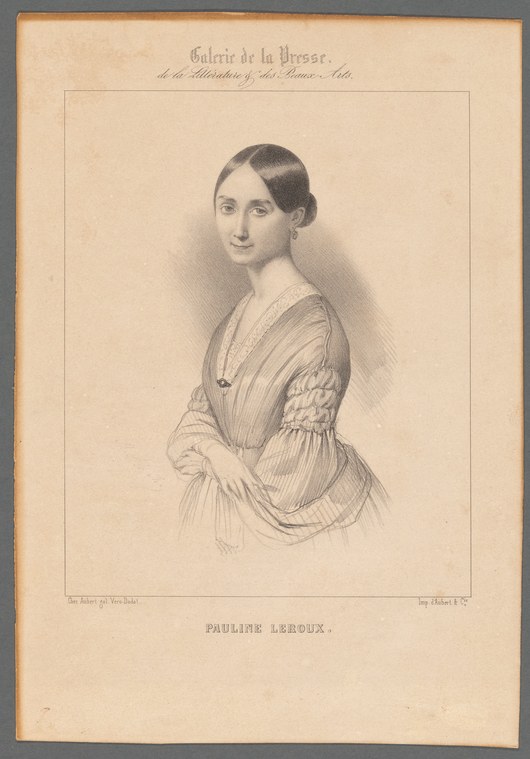
A three-quarter length portrait of a young woman, identified as Pauline Leroux, shown against a plain background. She is positioned in a seated or reclining pose, turned slightly to her right, with her body angled toward the viewer. Her dark hair is parted in the center and arranged in a simple style typical of the mid-19th century. She wears a light-colored dress with vertical ribbing or pleating, and the sleeves are gathered or puffed at the shoulders, tapering at the forearm. Her left arm rests across her lap while her right arm is extended, her hand holding what appears to be a fan or similar accessory. The dress has a soft, fluid quality rendered through careful shading that suggests silk or fine cotton. The portrait is executed in a refined neoclassical style, with subtle modeling of the face and carefully articulated drapery. The overall effect is intimate and contemplative rather than a formal presentation—the sitter's gaze is directed slightly away from the viewer, creating a sense of quiet introspection.
The dancing
A single female figure occupies the composition. Her posture is relaxed and supported, neither standing nor actively moving—the pose suggests repose or momentary stillness. Her shoulders are relaxed and level, her spine gently curved. The extended arm and hand position, with the fan or similar object, suggests a moment of social pause or casual elegance rather than active dance. The figure's frame and bearing convey refinement and propriety of upper-class mid-19th-century deportment.
The dance depicted
This is not a depiction of dance. It is a portrait of an individual identified as Pauline Leroux, rendered in a style common for theatrical or artistic personalities of the mid-19th century. The pose and dress are consistent with how dancers, particularly ballerinas, were portrayed in refined prints of this era—emphasizing grace, beauty, and social status rather than capturing a moment of actual performance. The image documents the sitter's appearance and bearing, not a dance movement or technique.
How it was made
This is an engraving or fine lithographic print, as evidenced by the fine linear hatching used for shading, the crisp outlines, and the overall graphic quality. The inscription at lower left reads 'Galerie de la Presse' (Gallery of the Press) with a date notation, and the lower right indicates this is from the 'Galerie de la Presse, à la Bibliothèque du Palais Royal' collection. The technique allows for precise rendering of facial features and the delicate textural detail of the dress fabric. Such prints were widely distributed for public consumption and likely appeared in contemporary periodicals or collected series. The quality of execution suggests this was created for circulation among educated audiences interested in theatrical, artistic, or social figures.
About this work
This is a mid-19th-century engraved or lithographic portrait of Pauline Leroux, a figure associated with performance or the arts, presented in the refined graphic style typical of French theatrical portraiture. The work belongs to a 'Galerie de la Presse' series—a commercial portrait collection published in Paris for public distribution. Rather than documenting a dance, the image presents an idealized likeness of a performer, emphasizing grace and elegance of bearing. It is included in the dance collection because Leroux was likely a dancer or theatrical performer of the period, and the portrait reflects the visual culture through which dancers were presented to the public.
How to look at it
Attend to the conventions of mid-19th-century theatrical portraiture: the subtle emphasis on the sitter's bearing and elegance, the rendering of fine fabrics and accessories that signal wealth and taste, and the careful attention to the face as the site of personality and allure. The pose—neither stiff nor actively performative—was a standard way of presenting performers as refined social beings rather than as acrobats or entertainers. The artist has chosen a moment of repose that emphasizes the sitter's beauty and grace rather than physical virtuosity.
The artist
The artist is not recorded in the catalogue. The print is attributed only to the 'Galerie de la Presse' publishing enterprise. Given the style and quality, this was likely executed by a professional engraver or lithographer working for the collection rather than a named artist of independent reputation.
The period
This portrait dates to the mid-19th century, a period when ballet was at the height of its cultural prestige in France and across Europe. The Romantic ballet era (roughly 1830–1860) elevated dancers—particularly female dancers—to the status of public celebrities. Commercial print series like the 'Galerie de la Presse' capitalized on public interest in theatrical personalities by producing and selling affordable engravings. Such portraits served multiple functions: they were collected as mementos, circulated in periodicals, and displayed in homes of the educated and culturally engaged. The refined style and careful execution reflect the status accorded to dancers during this period.
Where it lives
The work is held in the New York Public Library's collection of prints depicting dance. It is part of the 'Galerie de la Presse' series, a commercial French publication associated with the Bibliothèque du Palais Royal in Paris. The series appears in the collection as a resource for understanding the visual and cultural history of theatrical performance.
Questions about this work
Was Pauline Leroux a famous dancer?
The catalogue does not provide biographical information about Pauline Leroux. Her inclusion in the 'Galerie de la Presse' and its association with theatrical personalities suggests she was a performer of some public note during the mid-19th century. The refined quality of the portrait indicates she held sufficient cultural status to merit inclusion in a commercial portrait collection.
Why is this in the dance collection if it is not showing a dance?
This is an artifact of dance history rather than a depiction of dance. It documents how dancers were presented to the public, the visual culture of theatrical celebrity, and the role of commercial print media in shaping the public image of performers. Understanding how dancers were seen and circulated culturally is an important part of dance history.
Who made this print?
The artist is not recorded. The work was published by the 'Galerie de la Presse' series, likely executed by a professional engraver or lithographer working for the collection. The attribution of individual prints in such commercial series was often suppressed in favor of the collection's brand.
More dance artwork





