49 works in this view — arrow keys or swipe to move between them.
Dance in Art
Military nonchalance
Unknown artist
- Collection:
- Prints depicting dance
- Source:
- New York Public Library
- Rights:
- Public domain — free to use, share and adapt.
- Recorded as:
- Public Domain
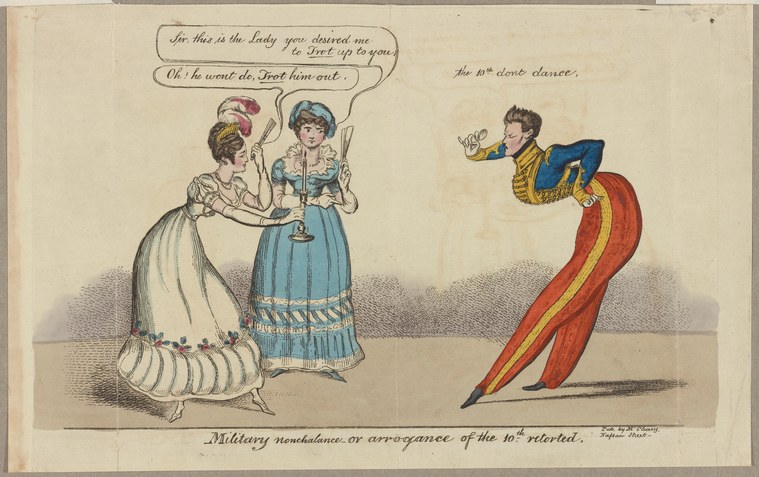
The work reveals how balletic or theatrical codes of bodily display were understood and deployed in everyday social performance, and how they could be mocked. It demonstrates that Regency audiences recognized and could laugh at affectation in movement—the officer's pose is legible as ridiculous only if viewers understood the conventions of genteel or theatrical movement it exaggerates.
What you are looking at
A colored engraving depicting a scene of military courtship or flirtation, likely from the early 19th century. Two fashionably dressed women on the left engage in animated conversation; the woman in the foreground wears a high-waisted white gown with a voluminous skirt decorated with horizontal stripes or pleating, while her companion is dressed in a blue muslin gown with matching bonnet. Between them they hold a parasol. On the right, a young military officer in a blue coat with gold trim and a red cloak or cape is shown mid-stride in a dramatically exaggerated pose of nonchalance or swagger, with one arm raised in an affected gesture. The pose is theatrical and almost caricatural—the figure leans back with an exaggerated tilt. The setting is minimal: a flat ground with simple shading. The title and dialogue establish this as social satire on military affectation.
The dancing
The officer's posture is the visual focus: he stands with his weight thrown back, one knee bent, torso arched, and arm raised in a studied gesture of indifference. His body is held in an almost balletic S-curve—feet pointed, legs arranged for display rather than function. The two women are upright and engaged with one another, their postures conventional for the period. There is no partnered dance hold or embrace; the figures do not touch across the composition.
The dance depicted
This is not a depiction of ballroom dance or a recognizable social dance form. Rather, it satirizes the performative posturing and affected movement of military fashion during the Regency or post-Napoleonic era. The officer's exaggerated stance and gestures are a caricature of masculine display and courtship theatricality. While the women's postures are consistent with the upright, composed bearing expected of ladies in formal social settings, the work as a whole is a commentary on artifice and pretense in movement and appearance rather than a record of actual dance practice.
How it was made
This is a hand-colored engraving, likely from a satirical print series. The fine line work of the engraved outlines is visible, and the coloring is applied in flat washes—reds, blues, and flesh tones applied over the printed image. The technique allowed for relatively inexpensive mass reproduction, making satirical commentary widely accessible. The style of line work and hand-coloring is consistent with English satirical prints of the 1810s-1820s.
About this work
A Regency-era satirical engraving mocking the affectations of military masculinity and courtship display. The work belongs in a dance collection not because it depicts a dance form, but because it captures the performative movement and bodily display conventions of a specific historical moment in social interaction. The exaggerated pose of the officer—his arched back, raised arm, and pointed foot—draws on balletic or theatrical codes of genteel movement to comic effect. This is a valuable document of how movement, dress, and social performance intersected in early 19th-century British culture, and of how satirical artists used exaggerated bodily posture as a vehicle for social critique.
How to look at it
Focus on the officer's body: the arch of his back, the position of his legs, the raised arm. This pose is impossible to hold during functional movement; it is pure display. Compare it to the women's upright, balanced postures. The exaggeration works as satire precisely because it pushes the conventions of genteel movement beyond their normal bounds. The artist has frozen a moment of performative stillness rather than actual dance or locomotion.
The period
This work dates to the Regency era (c. 1811–1820) or the immediate post-Napoleonic period, a moment of intense interest in military dress, masculine display, and social satire in British visual culture. Satirical prints were a major form of political and social commentary, and physical affectation—whether in dance, fashion, or deportment—was a frequent target. The work's mockery of military swagger sits alongside contemporary interest in ballroom dance, which was at its height during this period; the officer's pose draws on theatrical and balletic language that upper-class society associated with gentility and refinement.
Where it lives
Held in the New York Public Library's collection of satirical prints and dance-related imagery. The work is catalogued as an example of social satire and courtship imagery rather than as a dance document proper, though it circulated among the same audiences and in the same visual culture as dance prints.
Questions about this work
Is this a dance?
Not formally. The officer is struck a pose of studied nonchalance rather than executing a dance step or figure. However, his exaggerated posture draws on the theatrical and balletic codes of movement that governed genteel social behavior in the Regency era, making it valuable evidence of how contemporaries understood movement, display, and courtship.
What is the joke?
The officer's affected pose—his arched back, raised arm, and exaggerated tilt—is a caricature of military vanity and the affected manner in which young officers attempted to display gentility and charm. The women's composed bearing contrasts sharply with his theatrical swagger, and the title emphasizes the 'nonchalance' or pretended indifference he affects.
Why does this matter for dance history?
It documents the intersection of balletic movement vocabulary, social performance, and masculine display in the early 19th century. Satirical exaggeration reveals what the artist and audience considered normal, recognizable, and ridiculous about movement and posture in courtship—showing us what 'genteel' movement looked like and how it could be mocked.
More dance artwork





