49 works in this view — arrow keys or swipe to move between them.
Dance in Art
Folk and ethnic dancing in wood engravings
Unknown artist
- Collection:
- Prints depicting dance
- Source:
- New York Public Library
- Rights:
- Public domain — free to use, share and adapt.
- Recorded as:
- Public Domain
This image is one of the few surviving visual records of Melanesian dance from the period before intensive European colonization disrupted traditional practice. It demonstrates that nineteenth-century Western graphic artists were capable of detailed observation of non-Western movement, and it raises important questions about how ethnographic imagery both documents and distorts the cultures it depicts. For dancers studying Pacific traditions today, it offers a point of historical reference and a reminder of the continuity (or loss) of their own cultural inheritance.
What you are looking at
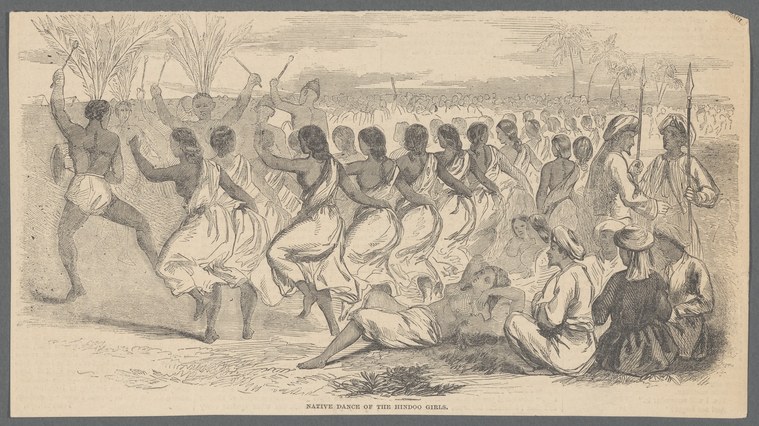
A wood engraving depicting a large group of Indigenous dancers from what the title identifies as the Bismarck Archipelago (now part of Papua New Guinea). The composition is arranged in two registers: the foreground shows a dense, animated line of dancers moving dynamically across the picture plane, their bodies bent and twisted in vigorous motion, while the background suggests a vast assembled crowd extending to the horizon. The dancers wear minimal clothing—loincloths or wrapped skirts—and many have elaborate headdresses of feathered or woven construction rising dramatically above their heads. Some figures brandish spears or ceremonial objects. The landscape is sparse, with a few scattered palms and minimal detail, emphasizing the dancers as the work's focus. The engraving's fine cross-hatching creates strong tonal contrast, with deep shadows defining the musculature and movement of the figures.
The dancing
The dancers' bodies display extreme flexion and rotation: torsos bend sharply forward, hips thrust outward, and limbs extend in emphatic gestures that suggest rapid, percussive movement. The figures do not hold one another but move as individuals or loosely coordinated lines, their weight shifted onto the balls of their feet or into lunging positions. The intensity of the postures—knees bent, arms raised and extended—conveys genuine physical exertion rather than decorative gesture. The variety of poses across the group suggests the engraver has captured a continuous movement rather than a frozen moment, showing different phases of the same action simultaneously.
The dance depicted
This depicts a ceremonial or ritual dance indigenous to the Bismarck Archipelago, most likely a form of sacred or warrior dance associated with community gatherings, initiations, or spiritual observance. The feathered headdresses and spears suggest this is a formal ceremonial context rather than social recreation. The vigorous, flexed-knee posture and collective participation are characteristic of many Pacific Island and Melanesian ritual dances. Without more specific ethnographic documentation, the exact dance form cannot be named, but the image conveys a dance rooted in spiritual practice and communal identity.
How it was made
This is a wood engraving, a relief printing technique in which an image is cut into the end-grain of a hardwood block (typically boxwood) and printed by inking the raised surface. The fine parallel lines visible throughout create tonal depth and texture, a hallmark of nineteenth-century wood engraving's precision. This technique allowed for mass reproduction and circulation in periodicals and books aimed at a broad European audience; wood engravings were the primary means of illustrating newspapers and illustrated journals throughout the nineteenth century. The work's style and subject matter suggest it was created for a publication documenting non-European peoples and cultures, likely circulated among educated European readers as ethnographic curiosity.
About this work
This wood engraving documents a ceremonial dance from the Bismarck Archipelago in the nineteenth century, capturing both the formal structure and physical intensity of Indigenous Pacific ritual movement. It belongs to a substantial body of European graphic work depicting non-Western dance, produced primarily for illustrated periodicals and ethnographic publications. The image serves both as a visual record of a living tradition and as an artifact of how nineteenth-century European audiences encountered and understood distant cultures through the filter of commercial illustration.
For dance historians and ethnographers, the work is valuable precisely because it attempts to render the specificity of bodily movement—the angle of flexion, the reach of the arms, the relationship among dancers—rather than reducing the scene to decorative exoticism. The engraver has attended to the kinetic logic of the dance itself, making visible the effort, coordination, and spatial relationships that constitute the performance.
How to look at it
Attend to the articulation of the spine and knees: notice how consistently the dancers bend at the knees and flex forward at the hips, a postural choice that distinguishes this movement from European dance forms of the same period. Observe the spacing—dancers move as a group without holding one another, suggesting a different conception of collective movement than ballroom or theatrical forms. Look at the headdresses: their elaboration and the care with which the engraver has rendered them indicate their ceremonial importance. The engraver has chosen to depict the dance at moments of maximum extension and effort, emphasizing vigor and spiritual intensity over grace or formal refinement.
The period
This engraving was produced in the nineteenth century, when European imperial expansion into the Pacific was accelerating and illustrated newspapers and journals were at the height of their cultural influence. Publications such as the Illustrated London News and similar European periodicals regularly commissioned or reprinted wood engravings depicting 'exotic' peoples and practices, feeding European appetite for images of colonial territories. The Bismarck Archipelago itself had particular prominence in German colonial discourse in the 1880s–90s. At the same time, this was the era when anthropologists and naturalists were beginning to document non-Western cultures with greater systematic attention, and illustrated publications served as a primary vehicle for that knowledge.
Where it lives
The work is held in the New York Public Library's collection of prints depicting dance, catalogued as a wood engraving of unknown artist and date. It is part of a broader assemblage of nineteenth-century illustrated material documenting global dance practices, primarily from periodical or book publication.
Dance in this work
Questions about this work
What is the 'Bismarck Girdle' and why is this dance from there?
The Bismarck Archipelago (now part of Papua New Guinea) is a group of islands in Melanesia, named by German colonizers after German Chancellor Otto von Bismarck in the 1880s. The islands were a focus of European colonial interest in the late nineteenth century, making them frequent subjects for illustrated publications documenting indigenous peoples and practices.
Is this a real dance or did the artist invent it?
The dance almost certainly depicts a real ceremonial form. The specificity of the headdresses, the postural logic, and the composition all suggest the engraver was working from a visual source—possibly a sketch by a traveler, a photograph, or direct observation. However, the engraving is an interpretation and may simplify, stylize, or misrepresent details.
What does the feathered headdress tell us?
Feathered headdresses in many Melanesian cultures signify status, spiritual power, and ritual significance. Their elaboration suggests this is a formal, ceremonial occasion rather than everyday movement. The headdresses would have been expensive to create and maintain, marking the dancers as important community members.
Why are they holding spears?
Spears or similar objects may have served ceremonial, not martial, purposes—used as props in ritual movement, symbols of power, or instruments for directing the dancers' energy. In many Pacific cultures, weapon-like objects feature in dances of initiation, ancestor veneration, or spiritual protection.
More dance artwork





