49 works in this view — arrow keys or swipe to move between them.
Dance in Art
The little marketender polka: played in Lecocq's opera Little duke
Unknown artist
- Collection:
- Prints depicting dance
- Source:
- New York Public Library
- Rights:
- Public domain — free to use, share and adapt.
- Recorded as:
- Public Domain
This object reveals the machinery by which 19th-century dances became mass-market commodities: a dance from an operetta becomes a piano piece becomes a lithographed cover image becomes a product for sale across multiple cities. It shows that dance was understood not merely as movement but as character, narrative, and social scenario. For historians of dance dissemination and the operetta as a vehicle for popularizing dances, this cover is primary evidence.
What you are looking at
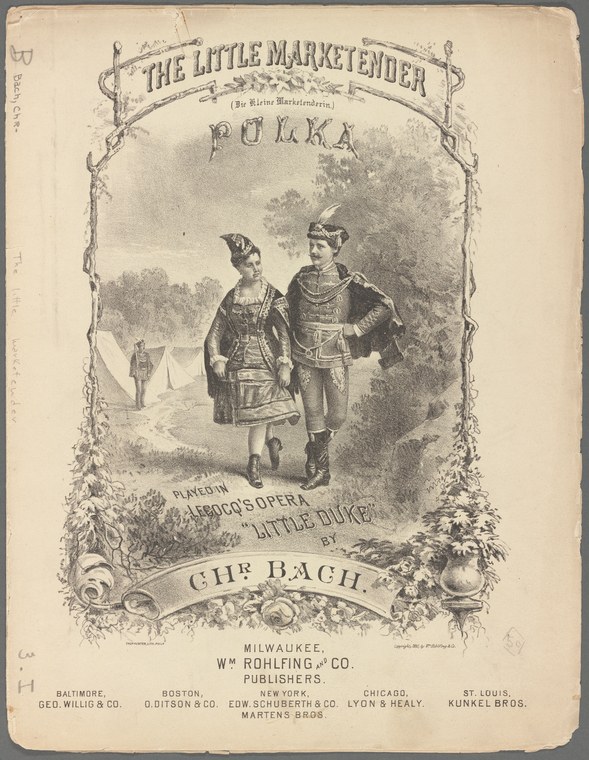
This is the cover or title page for a polka composition titled "The Little Marketender," drawn from Lecocq's operetta "The Little Duke." The composition shows two figures in mid-19th-century theatrical costume set against a romantic landscape with soft atmospheric effects. On the left stands a young woman in a dark dress with horizontal striping and a small hat, holding what appears to be a market basket or merchandise. To her right is a man in elaborate military dress—a richly patterned jacket with decorative braiding and a formal military hat—who leans toward her with an attentive, courtly gesture. Both figures are posed in a moment of social interaction rather than active dance. The background suggests a distant pathway or town, rendered in soft gray tones that emphasize the figures. The entire composition is framed by an ornamental border of scrollwork, vines, and floral garlands typical of music-publishing design of the period. The title is set in a cartouche at the top in bold display capitals.
The dancing
The two figures are positioned in near profile, close enough to suggest an intimate social exchange but not in a dance hold. The woman's posture is upright and proper, her gaze directed toward her companion. The man's body inclines slightly forward in a gesture of gallant attention, his arms relaxed at his sides in the formal manner of military dress. Neither figure shows the dynamic weight shift or extended line typical of active polka movement; they are posed as if caught in a moment of flirtation or social encounter rather than mid-step. The scale and relationship between them suggests a narrative or operatic scene rather than a ballroom dance figure.
The dance depicted
This is a polka—specifically a piano reduction or arrangement of a polka from Lecocq's operetta "La Petite Duchesse" (The Little Duke), which premiered in Paris in 1878. The polka was a central European dance that achieved international popularity across the 19th century and became a staple of operetta, particularly in French comic opera. The title "The Little Marketender" suggests the polka accompanies or characterizes a market-girl figure in the operetta, a common stock character. The image does not depict active polka dancing but rather presents the dramatic personae and the social register of the piece—the flirtation between a common girl and a man of rank, typical of operetta's themes. The polka as a musical form and social dance emphasizes quick, lively steps in duple meter, though nothing in this static theatrical image conveys that energy.
How it was made
This is a chromolithographic title page or cover, printed in tones of sepia, black, and cream. The technique allowed for the soft atmospheric gradations visible in the background and the fine detail in the ornamental border and costume. The inscription at the bottom identifies the publishers: Wm Rohlfing & Co. (Milwaukee), with branches in Baltimore, Boston, New York, Chicago, and St. Louis, and lists other distributors. This was a commercial music publication distributed across the United States, suggesting significant circulation. The lithographic process was the standard for music covers of the period and allowed rapid, inexpensive production of illustrated title pages, making operetta selections accessible to amateur pianists and parlor performers.
About this work
This is a theatrical music cover for a polka extracted from Charles Lecocq's operetta "The Little Duke," presented not as a scene of actual dance but as a dramatic vignette introducing the characters and social situation. The polka was one of the 19th century's most popular and widely disseminated dances, crossing from Central European folk tradition into aristocratic ballrooms, operetta, and domestic music-making. This image documents how dance entered popular consciousness and commercial circulation through operetta and sheet music—not as a technical demonstration but as a social and romantic narrative. The work belongs in a dance gallery because it shows the cultural apparatus by which a specific dance form was commodified, dramatized, and distributed to middle-class households across America.
How to look at it
Read this as a theatrical dramatis personae rather than a dance diagram. The artist has chosen a moment of social approach—the man's inclination toward the woman—that establishes character and relationship rather than demonstrating dance technique. The military costume and the woman's market dress anchor the operatic narrative; the ornamental border signals this as a commercial product designed to appeal to parlor musicians and operetta enthusiasts. Note how the soft atmospheric background and the absence of other figures isolate the couple in an intimate moment—a romantic rather than social-dancing context. The cover is selling not a dance lesson but a story and a feeling.
The artist
The artist is not recorded. The lithograph was produced by the publisher Wm Rohlfing & Co., a music publisher based in Milwaukee with distribution networks across the northern United States. Music publishers of this era maintained in-house artists and lithographers; the quality of the draftsmanship and printing suggests a professional publishing house with access to competent illustrators. The ornamental border style and figure drawing are consistent with European-influenced theatrical music-cover design of the 1870s–1880s.
The period
Charles Lecocq (1832–1918) was a leading composer of French opéra comique and operetta in the second half of the 19th century. "La Petite Duchesse" (1878) was one of his successful works, performed across Europe and America. The polka itself had moved from Czech folk origins through Vienna and Prague into Paris during the 1830s–1840s, where it became a fashionable ballroom dance and a standard feature of operetta. By the 1870s, individual numbers from operettas were routinely extracted and published as sheet music for amateur pianists, creating a vast market for theatrical music in domestic settings. The prevalence of American music publishers distributing European operetta music reflects the transatlantic circulation of popular entertainment in this period.
Where it lives
This object is part of the New York Public Library's Prints depicting Dance collection. It is a commercial music publisher's product, one of thousands of operetta extracts published for the American market in the 1870s–1880s. The holding institution's description categorizes it as dance imagery, though it is more accurately understood as operetta ephemera with incidental dance content.
Dance in this work
Questions about this work
Was the polka still being danced in the 1870s?
Yes, though it was no longer cutting-edge. The polka had dominated ballrooms from the 1840s onward but remained a standard repertoire dance throughout the 19th century. Its inclusion in operetta a generation after its initial craze shows its entrenchment as a popular dance form. Operetta composers used traditional dances—polka, waltz, quadrille—as familiar musical numbers.
What was Charles Lecocq's role in operetta?
Lecocq (1832–1918) was one of the most successful French operetta composers of his generation, second only to Offenbach in fame. His works were known for elegant melodies, clever orchestration, and effective use of traditional dances. "La Petite Duchesse" was performed internationally and remained in the repertoire for decades.
Why did music publishers put illustrated covers on sheet music?
Illustrated covers served marketing purposes: they advertised the source (operetta, ballet), established the price and prestige of the publication, and made the music recognizable and appealing in shop windows and parlors. A beautiful cover encouraged amateur musicians to buy the piece and displayed cultural sophistication in the home.
How does this image relate to actual polka dancing?
It does not depict polka technique or movement. Instead, it presents the social and dramatic context in which the polka appeared within the operetta. The actual dance would have been fast, with quick hops and a characteristic lilt; this image captures the narrative pretext rather than the kinetic reality.
More dance artwork





