49 works in this view — arrow keys or swipe to move between them.
Dance in Art
Salvatore Viganò
Unknown artist
- Collection:
- Prints depicting dance
- Source:
- New York Public Library
- Rights:
- Public domain — free to use, share and adapt.
- Recorded as:
- Public Domain
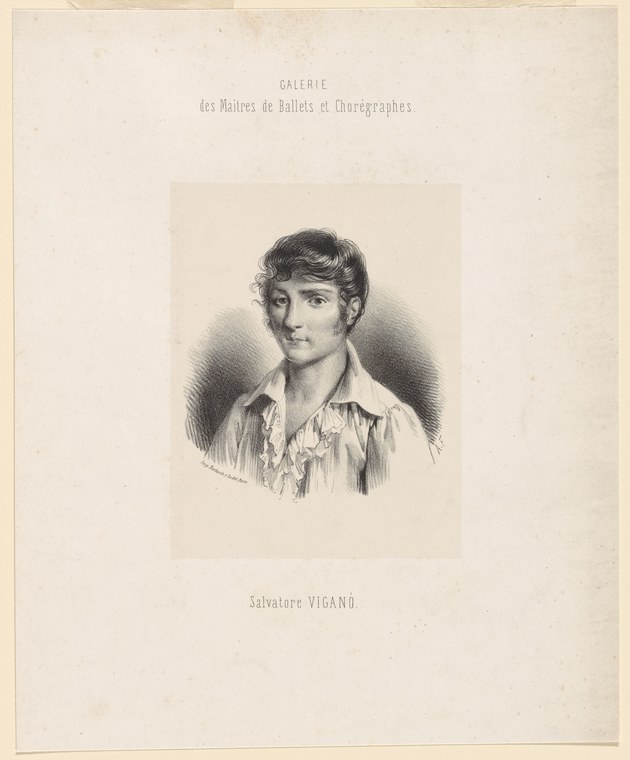
Viganò's choreographic method—dramatizing classical mythology and contemporary stories through integrated movement, gesture, and pantomime—became the foundation of later narrative ballet. This engraving records him not as a performer in a moment of dance but as the originating intelligence behind the form itself, a recognition that choreography is authorship.
What you are looking at
This is a portrait engraving of a young man presented as a bust-length figure within a rectangular frame. He is rendered in three-quarter view, gazing slightly to his left with an contemplative expression. His dark, curled hair is styled in the Romantic fashion of the early 19th century. He wears a white linen shirt with a loosely tied cravat or neck cloth, suggesting informal dress or stage costume. The figure emerges from soft shadows created by careful cross-hatching, which creates volume around the shoulders and face. The background is neutral and undefined, keeping focus entirely on the sitter's features and bearing. The engraving is titled beneath the portrait: "Salvatore Viganò."
The dancing
The figure is motionless and posed for portraiture rather than captured in dance action. His posture is upright and dignified, shoulders back, with his head held with quiet authority. The soft modeling of the face and neck suggests a trained performer comfortable with his own physicality. His gaze is direct but not confrontational—the look of someone accustomed to being watched. There is no gesture, no weight transfer, no indication of active movement.
The dance depicted
Salvatore Viganò (1769–1821) was an Italian choreographer and dancer who revolutionized ballet in the late 18th and early 19th centuries. He is credited with developing the *balletto d'azione*—narrative ballet with dramatic coherence—as distinct from pure court dance or divertissement. This portrait records him as a historical figure rather than capturing him in performance. The simple dress and contemplative bearing suggest an artist conscious of his own significance and legacy.
How it was made
This is an engraving, likely created in the early 19th century, executed in the neoclassical portrait style. The fine parallel lines and cross-hatching create subtle tonal gradations and convey the texture of hair and cloth. The technique allows for precise detail in facial features and soft modeling of form. Engravings of this type were reproducible and affordable, suitable for circulation in prints collections, theatrical publications, or biographical galleries—this work appears in such a context ("Galerie des Maîtres de Ballets et Chorégraphes").
About this work
This is a portrait engraving of Salvatore Viganò, the influential Italian choreographer who transformed ballet in the early Romantic period. The work does not depict dance itself but records the artist as a historical personage—a documentation of the choreographer as creative mind rather than performing body. It belongs in a dance gallery because Viganò's innovations in narrative choreography fundamentally changed what ballet could express and accomplish, and because this image is evidence of his standing and recognition during and after his lifetime.
The portrait sits within a tradition of honoring great dancers and makers through engraved likenesses, distributed in galleries and collected volumes. It is the kind of image that circulated in theatrical circles and among educated audiences interested in the arts, establishing the choreographer as a named, visible historical agent.
How to look at it
View this as a document of recognition rather than a record of movement. Notice the engraver's choice to present Viganò in informal dress and with an inward gaze—he is shown as a thinking artist, not a performing body. The soft modeling and careful attention to the face suggest this is a respectful, sympathetic portrait intended to honor intellectual contribution to the art form. The placement in a titled gallery positions him alongside his peers as a master of the craft.
The artist
The engraver is not named in the catalogue record. The work appears in a titled gallery ("Galerie des Maîtres de Ballets et Chorégraphes" — Gallery of the Masters of Ballet and Choreography), suggesting it is part of a biographical or commemorative series of prominent figures in dance. This type of engraved portrait gallery was a common form of art-historical documentation in the 19th century.
The period
Viganò lived and worked during the transition from late 18th-century court ballet and comic opera to Romantic ballet. His career coincided with the French Revolution and Napoleonic Wars, a period of upheaval that disrupted court patronage and forced ballet to seek new legitimacy through dramatic innovation rather than courtly convention. By the time this engraving was made—likely after his death in 1821—Romantic ballet was consolidating around narrative and spectacle. Viganò's work on integrated gesture and mime became a model for later choreographers including Jean Coralli and Jules Perrot.
Where it lives
This engraving is held in the New York Public Library's prints collection titled "Prints depicting dance." It is part of a gallery or series of biographical portraits of prominent choreographers and ballet masters, a document of 19th-century acknowledgment of dance as a named, authored art form.
Questions about this work
Was Salvatore Viganò a famous dancer?
He was a dancer early in his career, but he is remembered primarily as a choreographer and ballet reformer. He created the *balletto d'azione*, a form of narrative ballet that integrated mime, gesture, and spectacle into coherent dramatic stories. This transformed ballet from a pure dance entertainment into an art form capable of expressing complex narratives and emotions.
Why does this portrait not show him dancing?
By the early 19th century, the status of choreographers was rising. Portraying Viganò in everyday dress and contemplative pose asserts his authority as a creative thinker and artist-inventor rather than as a performing body. The image claims him as a master and maker, not merely an executor.
What is an engraving and why was it used for portraits?
An engraving is a print made by cutting lines into a metal plate (usually copper) and inking the incised lines. The technique allowed for reproducible, affordable copies that could circulate widely among educated audiences and collectors. Engraved portraits were the standard way to record and distribute images of notable figures before photography.
More dance artwork





