49 works in this view — arrow keys or swipe to move between them.
Dance in Art
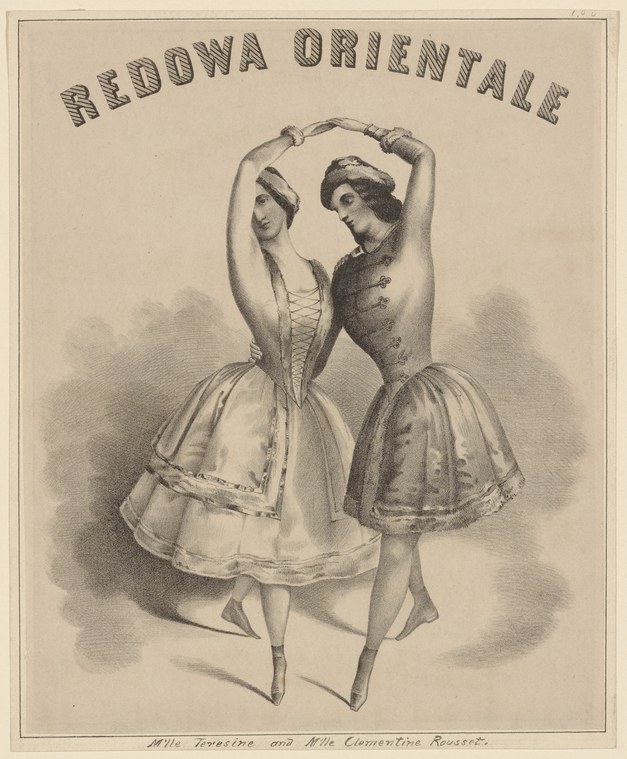
Redowa orientale. M'lle. Teresine and M'lle Clementine Rousset
Unknown artist
- Collection:
- Prints depicting dance
- Source:
- New York Public Library
- Rights:
- Public domain — free to use, share and adapt.
- Recorded as:
- Public Domain
This print provides a rare visual record of how the Redowa was actually performed in its heyday, captured at the moment of the turning action that defines the dance. It documents the professional careers of named female dancers—Teresine and Clementine Rousset—whose performances reached print distribution, indicating significant public popularity. The image also shows how European ballroom dances were repackaged as exotic theatrical attractions with modified titles and presentations.
What you are looking at
Two female dancers in full skirts pose against a plain background in what appears to be a theatrical or promotional print. Both wear mid-19th-century dress: fitted bodices, short skirts with deep flounces, and close-fitting bonnets or headdresses. They stand close together, each raising one arm overhead while their bodies angle toward each other, creating a mirror-like symmetry. Their posture suggests a moment of turning or spinning motion, with skirts beginning to billow outward. The composition is spare—no scenery, musicians, or supporting figures—focusing entirely on the dancers' forms and the geometric play of their raised arms against the neutral background. The engraving technique renders them in fine cross-hatching, with particular attention to the texture and movement of the fabric.
The dancing
Both dancers stand in a nearly identical pose: bodies angled inward, right leg forward, left arm raised vertically with the hand near or above the head. The raised arm frame is open and classical rather than closed or partnered. Their skirts, caught mid-movement, flare outward from the waist, showing the weight-shift that occurs during a turning step or spinning motion. The dancers are presented as individual figures rather than as a couple in hold; their proximity and mirrored positioning create visual unity without physical contact. The upright torso and the angle of the legs suggest they are mid-step rather than in a stationary pose.
The dance depicted
The title identifies this as a *Redowa orientale* (Oriental Redowa), performed by Mlle. Teresine and Mlle. Clementine Rousset. The Redowa was a popular European ballroom dance of the mid-19th century—a turning couple dance in triple time, related to the waltz. The "orientale" modifier suggests either an exotic or theatrical variation or styling. The pose captures the dynamic moment of a turning figure, with the raised arm and tilted body axis characteristic of the turning step. The fact that the dancers are presented identically rather than as a conventional couple suggests this may be a theatrical or novelty variation performed by two women, or a promotional image designed to showcase the movement itself rather than social partnership.
How it was made
This is an engraving or lithograph on paper, rendered in fine black line and cross-hatching to create tone and shadow. The technique was common for theatrical prints and dance ephemera of the 1850s–1860s. The clarity of line and the uniform presentation of both figures suggests a professional commercial print, likely produced for theatrical promotion or as a collectible souvenir. The open background and emphasis on costume detail—particularly the construction and movement of the skirts—indicates the primary audience was interested in both the spectacle of the dance and the fashion of the performers. The print would have circulated among theatre-goers and dance enthusiasts.
About this work
This is a mid-19th-century theatrical dance print depicting two professional dancers performing a variation of the Redowa, a popular European ballroom turn-dance adapted here with an "oriental" character. The image captures the moment of rotation, with both dancers in identical turning poses, skirts flaring in response to the centrifugal movement of the step. The print is an artifact of commercial dance promotion and fashion in the Gilded Age, a period when ballroom dances were being actively staged, novelty versions, and performed by professional companies rather than confined to private ballrooms.
The work sits at the intersection of social dance history and theatrical spectacle. It documents not only the Redowa as a living dance but also the practice of presenting ballroom dances on stage and the emergence of female professional dancers as entertainment figures. The mirrored composition and the specificity of the costume detail make it a valuable record of both choreographic practice and sartorial convention in mid-19th-century performance.
How to look at it
Observe the moment the artist chose to freeze: the dancers mid-turn, with the skirts caught at maximum flare and the arms raised in the turning frame. Notice how the symmetry of the two figures—the mirror-image composition—emphasizes the rotational movement itself rather than partnership or story. The raised arm and the angle of the body relative to the legs show the weight shift that occurs in a turning step in triple time. The fine detail in the rendering of the fabric reveals the construction of mid-19th-century dance skirts and how movement made them move; the flounces and the way the hem catches light indicate the dancer is in flight, not standing still.
The period
The Redowa entered European ballrooms from Bohemia in the 1830s–1840s and became a staple of mid-Victorian social dance alongside the waltz and polka. By the 1850s–1860s, when this print was made, the dance was established enough to be performed professionally on stage. The addition of "orientale" to the title reflects the Victorian era's fascination with exoticized versions of European dances, achieved through costuming, music, or movement stylization. Professional dance performance at this time was shifting; women were increasingly visible as named performers in commercial theatrical contexts. The ballroom itself was being reimagined as a theatrical space, with social dances staged for audiences rather than experienced as participatory social activity.
Where it lives
This print comes from the New York Public Library's collection of prints depicting dance. The work's catalogue history is minimal; like many theatrical ephemera, it entered the archive with incomplete attribution and dating information. It represents the type of commercial dance promotion print that would have been sold at theatres or distributed to dance enthusiasts.
Dance in this work
Questions about this work
What is a Redowa?
The Redowa was a ballroom dance in triple (3/4) time that originated in Bohemia and became popular across Europe from the 1840s onward. It was a turning couple dance, similar to a waltz but with a distinct rhythm and step pattern. The "orientale" version shown here suggests a theatrical or exotic adaptation of the basic ballroom step.
Why are both dancers performing the same pose?
This may indicate a novelty theatrical version performed by two women, or it may be a compositional choice by the print-maker to showcase the essential turning figure of the step itself. In ballroom contexts, the Redowa would have been danced by a man and woman in closed position; here the mirrored, open presentation creates visual symmetry and emphasizes the rotational action.
How can you tell this is a Redowa and not another waltz-family dance?
The title explicitly identifies it as a Redowa. Visually, the pose—the raising of one arm vertically and the specific weight placement—is consistent with the Redowa's turning action. However, without seeing the full sequence of steps or hearing the music, the visual distinction from other turning ballroom dances would be difficult to establish from a single moment alone.
Who were Teresine and Clementine Rousset?
They were professional dancers known enough to be named on promotional prints, suggesting they were notable stage performers of the mid-19th century. Beyond their appearance in this print and the Redowa's connection to Parisian and European theatrical circuits, little additional biographical information is recorded in standard sources.
More dance artwork





