49 works in this view — arrow keys or swipe to move between them.
Dance in Art
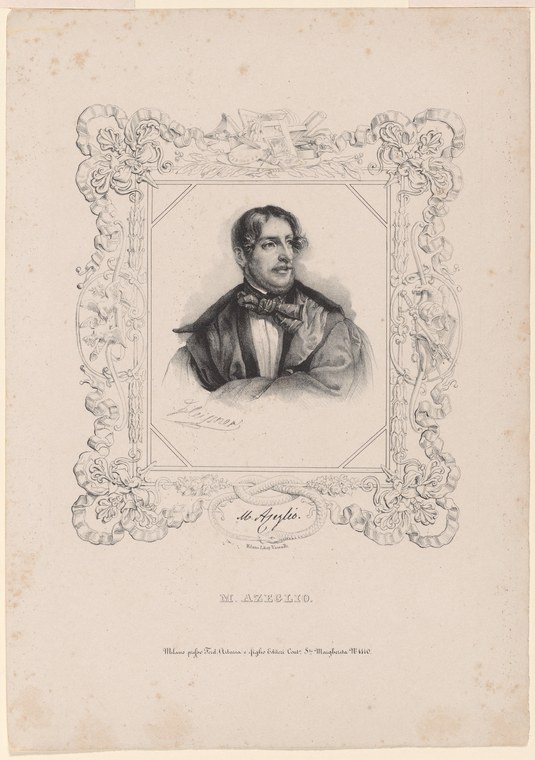
M. Azeglio.
Unknown artist
- Collection:
- Prints depicting dance
- Source:
- New York Public Library
- Rights:
- Public domain — free to use, share and adapt.
- Recorded as:
- Public Domain
If M. Azeglio was a significant figure in nineteenth-century dance—as a performer, choreographer, or theorist—this portrait represents how such figures were documented and honored in print culture. However, without confirmation of his identity and role, the work's specific contribution to dance history cannot be assessed from the image.
What you are looking at
A three-quarter-length portrait of a man in formal nineteenth-century dress, framed by an ornate rococo border of scrolls, foliage, and decorative cartouches. The sitter wears a dark coat with a white shirt front and bow tie, turned slightly to his right and gazing upward with a contemplative expression. The engraving employs fine cross-hatching to model the face and fabric, creating a sense of three-dimensionality against the plain background. The elaborate frame, with its theatrical flourishes and ornamental elements, suggests this is a formal presentation of a notable figure—possibly an artist, performer, or public personality of the period.
The dancing
A single figure in repose; no active dance posture. The body is stationary and formally posed, with the head tilted slightly upward and to the side in a attitude of reflection. The shoulders are relaxed and squared. There is no indication of movement, weight shift, or the trained carriage of a dancer.
The dance depicted
The catalogue title 'M. Azeglio' and the formal portrait mode offer no direct evidence of dance. If Azeglio was a dancer, choreographer, or figure associated with dance history, this portrait does not depict him in motion or engaged in performance. This is a commemorative or biographical print, not a dance scene.
How it was made
This is an engraving, executed in the fine-line tradition typical of mid-nineteenth-century portraiture. The technique—linear hatching to build tone, precise detail in the facial features and dress, and the ornamental rococo frame—indicates professional production for circulation among a educated or cultured public. The work was likely printed from a metal plate, suggesting multiple impressions were distributed. The elaborate decorative border elevates the sitter's status and reflects the conventions of portrait prints used to honor notable individuals.
About this work
This is a formal portrait engraving of M. Azeglio, presented in the ceremonial tradition of nineteenth-century biographical prints. The identity of the sitter and his significance to dance history cannot be established from the image alone. The work belongs to the tradition of commemorative portraiture rather than dance documentation. Its inclusion in a dance collection suggests that Azeglio held a role in dance or performance history, but the print itself is a static portrait, not a record of dancing or choreography.
How to look at it
Examine the fineness of the engraved line and the careful cross-hatching used to suggest three-dimensional form in the face. Note the formal pose and upward gaze, conventions of portraiture meant to convey dignity and contemplation. The ornamental frame is integral to the work's meaning—it signals that this is a person of note, presented for public remembrance or study.
The artist
The engraver is not identified in the catalogue record. The style and technique are consistent with professional portrait printing of the 1840s–1860s. The ornate rococo border suggests a printer working in a classical European tradition of formal portraiture.
The period
This engraving dates to an era when portrait prints served as the primary means of circulating images of public figures. In the nineteenth century, dancers and choreographers were often commemorated in this way, particularly those who achieved prominence in opera ballet or theatrical dance. The rococo ornamental frame reflects aesthetic tastes of the mid-nineteenth century, when such elaborate surrounds were fashionable for portraiture.
Where it lives
The work is held in the New York Public Library's collection of prints depicting dance. Its presence in that collection suggests the NYPL cataloguer identified Azeglio as a figure of importance to dance history, though the specific basis for that identification is not evident from the record.
Questions about this work
Who was M. Azeglio?
The catalogue record does not identify him. The portrait's inclusion in a dance collection suggests he may have been a dancer, choreographer, or other theatrical figure of the nineteenth century, but confirmation would require additional research. The engraving itself is a formal commemorative portrait with no indication of his profession or achievements.
Is this a portrait of a dancer?
The portrait shows no active dance posture or movement. It is a formal seated or standing pose typical of nineteenth-century biographical prints. If Azeglio was a dancer, this image does not depict him performing or in a dance-related context.
What is the ornate frame?
The rococo border—with scrolls, floral ornaments, and decorative cartouches—is part of the engraved design. Such elaborate frames were a convention of formal portraiture, elevating the sitter's status and indicating the work was meant for circulation and display among educated viewers.
More dance artwork





