49 works in this view — arrow keys or swipe to move between them.
Dance in Art
Danse des nègres
Unknown artist
- Collection:
- Prints depicting dance
- Source:
- New York Public Library
- Rights:
- Public domain — free to use, share and adapt.
- Recorded as:
- Public Domain
This is a rare printed record of African or African-descended dance in a colonial public setting, offering visual evidence of how such dances were practiced and how they were perceived and represented by European artists and audiences. The informal, energetic quality and the mixed groupings suggest improvisation and community participation, contrasting sharply with European formal dance of the same period. The work is a primary document in the visual history of the African diaspora and the emergence of creolized dance forms in colonial societies.
What you are looking at
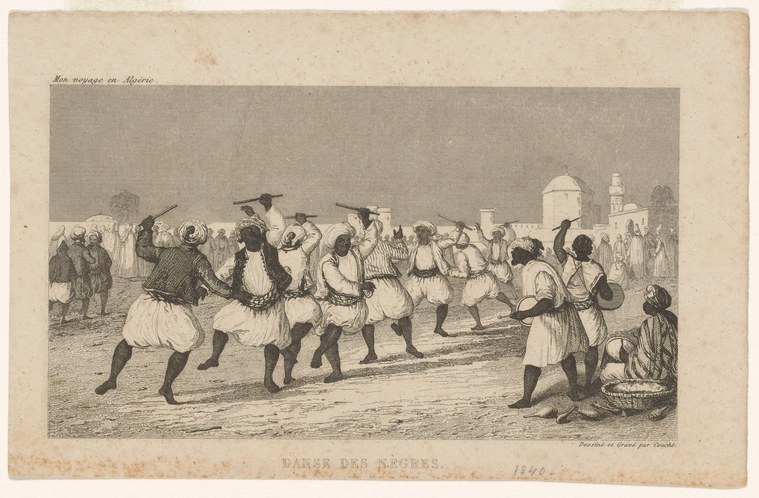
A large gathering of dancers fills a broad plaza in what appears to be a colonial or port setting, with buildings and structures visible in the background. The composition divides into a central performance area and surrounding spectators. In the center, multiple figures in light-colored clothing (appearing white or cream, possibly skirts or loincloths) move energetically across the ground. The dancers are distributed across the space in loose, informal groupings rather than rigid lines, creating a sense of spontaneous, communal movement. The foreground right shows seated observers watching the performance. The engraving technique creates strong contrasts between light figures and dark ground, and the shading suggests an open-air daytime scene. The overall impression is of a public festivity or celebration drawing a large crowd.
The dancing
The dancers' bodies are captured in varied poses suggesting active, dynamic movement—some with raised arms, others in lunging or striding positions. Many appear to be wearing wrapped or gathered lower garments that catch light and create volume, while their upper bodies are relatively bare or lightly clothed. The positioning is loose and improvisational rather than synchronized; individual dancers are oriented in different directions, and the groupings are scattered across the space. The seated figures in the foreground are passive observers, establishing a clear distinction between performers and audience. The energy and posture of the central figures suggest vigorous, celebratory movement rather than restrained or formal choreography.
The dance depicted
This print depicts what the title identifies as a dance of African or African-descended peoples, almost certainly in a colonial Caribbean or Atlantic world setting given the architectural context and the presence of white observers. The informal, energetic character and the outdoor public setting suggest a social or festive dance rather than a performance for a European stage. The varied dress and loose groupings are consistent with creolized dance forms that emerged in plantation colonies, though the specific choreography cannot be identified from the image alone. The title's language reflects eighteenth or nineteenth-century European terminology and suggests this was produced for European consumption, likely as part of documentation or exoticization of colonial territories.
How it was made
This is a line engraving, identifiable from the parallel hatching lines creating tone and shadow, the precision of the linear work, and the characteristic bite of the engraver's burin. The technique allowed for reproducibility and wide distribution, suggesting this was part of a published series or album rather than a unique work. Engraving of this refinement would have been expensive and aimed at educated, affluent European audiences. The date is unknown, but the style and subject suggest the late eighteenth or nineteenth century, a period when European prints of colonial scenes and 'exotic' peoples were produced in significant quantity for the commercial market.
About this work
This engraving records a scene of collective dance in a colonial setting, presented to a European audience through the conventions of the print trade. The title's use of the term 'nègres' and the composition—with white observers separated from the dancers and the scene treated as a spectacle—reflects the visual language of colonial ethnography and exoticization. The work belongs to a large genre of printed imagery that circulated in Europe during the eighteenth and nineteenth centuries, documenting (or constructing narratives about) colonial territories and their peoples. For dance history, it offers evidence of how African and creolized dance forms were seen, interpreted, and represented by European observers, though the image is mediated by colonial perspective and the conventions of the print medium.
How to look at it
Attend to the contrast between the postures and dress of the dancers and the seated European observers: the artist has chosen to freeze a moment of vigorous, open movement and has given the dancers a physicality distinct from European formal dance. Notice the variation in pose and direction—there is no unison, no line, no symmetry—and the way the light-colored garments stand out against the ground, making the bodies highly visible. The outdoor, public setting and the scale of the gathering suggest this was a communal or festive occasion rather than a performance by professionals for an elite audience. The engraver's choice to fill the composition with dancers and spectators alike emphasizes the social scale of the event.
The period
The late eighteenth and nineteenth centuries saw a surge in European trade in prints depicting colonial scenes, 'exotic' peoples, and natural history subjects. These were produced for commercial sale to affluent collectors and were often based on travel accounts, sketches by military or naval personnel, or the imagination of European engravers. Dance scenes, in particular, were popular subjects because they could be presented as evidence of difference, primitiveness, or exotic sensuality. At the same time, the actual dance forms being depicted were themselves in flux, shaped by forced migration, slavery, cultural mixing, and resistance. The distance between what the engraver recorded or imagined and what dancers were actually doing remains substantial.
Where it lives
This work is held in the NYPL Prints collection, which documents visual culture across centuries and geographies. It belongs to a category of printed ephemera and documentary imagery that circulated widely in Europe and colonial territories.
Dance in this work
Questions about this work
Where and when did this dance take place?
The catalogue record does not specify a date or location. The architectural style and composition suggest a colonial Caribbean or Atlantic world setting in the eighteenth or nineteenth century, but the image alone does not establish a precise place or moment. The work may be based on direct observation, a travel account, or European imagination.
What does the title 'Danse des nègres' tell us?
The title uses the French term current in the period for people of African descent. It identifies the dance as belonging to or performed by African or African-descended peoples, a label that would have marked it for European audiences as something foreign and distinctive. The term reflects the language and racial categories of the period and should not be reproduced without that historical context.
Can we identify the specific dance form?
No. The informal, energetic character and outdoor setting suggest a social or festive dance rather than a formalized, choreographed performance, but the specific name, steps, and music are not documented in or recoverable from the image. Many creolized dance forms emerged in colonial slave and post-slave societies, but this image does not provide enough detail to attribute it to any one of them.
Who would have seen this print?
Engravings of this quality were expensive and aimed at educated, affluent European collectors interested in travel literature, natural history, and exotic subjects. The work would have circulated in that market, shaping European perceptions of colonial peoples and dance without representing actual performance practice accurately.
More dance artwork





