49 works in this view — arrow keys or swipe to move between them.
Dance in Art
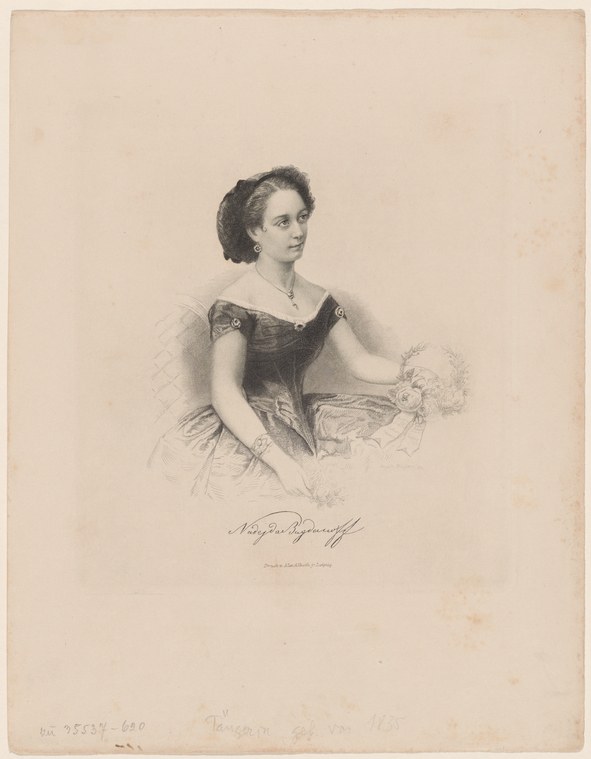
Nadejda Bagdanoff [facsimile signature]
Unknown artist
- Collection:
- Prints depicting dance
- Source:
- New York Public Library
- Rights:
- Public domain — free to use, share and adapt.
- Recorded as:
- Public Domain
The work illustrates the role of printed portraiture in building and maintaining a dancer's public reputation and marketability in the late nineteenth century, a practice central to the economics and celebrity of theatrical performance.
What you are looking at
A three-quarter-length portrait of a woman in elegant evening dress, shown in profile facing left. She wears a dark off-shoulder bodice with short sleeves, the neckline draped in pale fabric, and holds a large bouquet of flowers in her lap. Her dark hair is pulled back in a fashionable arrangement typical of the mid-to-late nineteenth century. The composition is rendered as a lithograph or engraving against a plain background, with skillful use of light and shadow to model the figure and create depth. The signature "Nadejda Bagdanoff" appears below the portrait in cursive script, identifying the subject.
The dancing
The woman is seated, her body angled three-quarters to the viewer, with her weight settled composedly. Her right arm rests across her lap, supporting the flowers; her left shoulder is raised slightly, creating an elegant line from shoulder to waist. The pose is entirely stationary and dignified rather than caught in movement—this is a formal portrait, not a moment of dance. Her posture conveys the refined bearing expected of a nineteenth-century performer or society woman.
The dance depicted
While the catalogue identifies this as a work from the 'Prints depicting dance' collection and labels it 'dance,' the image itself shows no evidence of dance activity. Nadejda Bagdanoff was a Russian dancer of the late nineteenth century, and this is a conventional portrait of her made for circulation among patrons and the public—a standard practice for professional performers. The work documents the subject's identity and status rather than capturing any moment of her performance or technique.
How it was made
This is a lithograph or engraved portrait, evidenced by the linear hatching, the tonal modulation, and the precise line work characteristic of nineteenth-century reproductive print techniques. The medium allowed for relatively inexpensive circulation and wide distribution, making such portraits standard promotional objects for stage performers. The technique's emphasis on linear definition over painterly texture reinforces the formality of the presentation.
About this work
This is a formal portrait print of the Russian dancer Nadejda Bagdanoff, likely made for circulation among patrons and audiences in the late nineteenth century. Although filed in a dance collection, it documents the subject's professional identity and public image rather than her dancing. The work is a conventional example of how theatrical performers of the period were promoted and remembered through portraiture.
How to look at it
Observe the subject's formal, frontal presentation and the careful attention to the textures of fabric and the delicate modeling of her face and bare shoulders. Note the bouquet as a conventional attribute of femininity and high status. The stillness and composure of the pose are deliberate—this is a woman presenting herself for public approval, not a dancer demonstrating her art.
The artist
The artist is not recorded. The signature below the portrait is that of the subject, Nadejda Bagdanoff, not the printmaker. The execution suggests a professional reproductive engraver or lithographer, likely working from a painted original or photograph, a standard commercial practice of the period.
The period
In the late nineteenth century, printed portrait reproductions of stage performers were a major industry, helping to build public recognition and fan bases. These works circulated as lobby cards, postcards, and illustrated supplements to periodicals. The formal evening dress and refined setting typical of such portraits reflected the social status claimed by leading theatrical performers, particularly in the imperial Russian ballet tradition.
Where it lives
The work is held in the New York Public Library's collection of prints depicting dance. It is catalogued as a portrait lithograph or engraving, likely late nineteenth century, and carries the accession number visible on the verso.
Questions about this work
Was Nadejda Bagdanoff a famous dancer?
Nadejda Bagdanoff (also transliterated as Bagoeff or Bagaroff) was a Russian dancer active in the late nineteenth century, performing in Europe and North America. While not as widely celebrated as some of her contemporaries, she was sufficiently prominent to have had her portrait circulated in printed form, a practice reserved for successful professionals.
Why is this portrait in a dance collection if it shows no dancing?
Portraits of dancers were conventionally filed in dance collections because they document the performers themselves, even if they do not show performance in action. Such works are valuable for understanding the social presentation, fashion, and celebrity culture of theatrical dancers in a given period.
What is the bouquet a symbol of?
In nineteenth-century portraiture, particularly of women performers, flowers signified femininity, grace, and the admiration of audiences. Flowers were also actually presented to performers at curtain call, making the bouquet a natural and honorific attribute in portraits.
More dance artwork





