49 works in this view — arrow keys or swipe to move between them.
Dance in Art
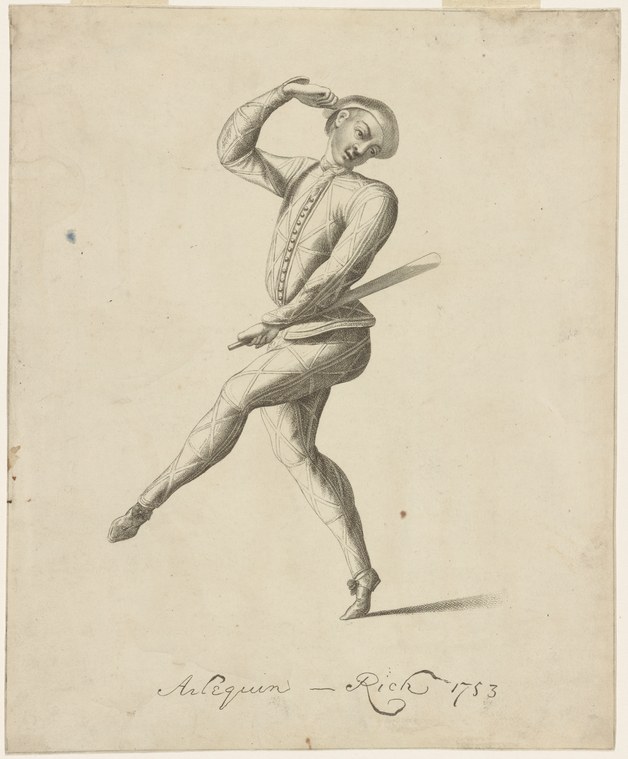
Arlequin - Rich, 1753
Unknown artist
- Collection:
- Prints depicting dance
- Source:
- New York Public Library
- Rights:
- Public domain — free to use, share and adapt.
- Recorded as:
- Public Domain
Harlequin and commedia dell'arte performance dominated popular theater in the 18th century, yet are poorly represented in visual art compared to ballet. This drawing is direct evidence of how trained acrobats and comedians moved onstage—the leaps, the control, the ornamental arm work—and shows that 'theatrical dance' encompassed far more than what we now call ballet. It also documents the celebrity of John Rich, whose Harlequin was famous enough to merit commemorative portraits in action.
What you are looking at
A single male dancer leaps diagonally across the page in a moment of sustained elevation, his body twisted mid-air in a pose of theatrical exuberance. His left arm is raised and bent near his head in a gesture of flourish, while his right leg extends upward and his left trails behind; his torso arcs in a pronounced contrapposto. He wears a fitted doublet with decorative buttons or fastenings down the front, breeches, and soft shoes with what appear to be ties or garters at the ankles. His hair is styled in the fashion of the mid-18th century, close-cropped and curled. The figure is rendered in black chalk or graphite on cream paper, with careful attention to musculature and the play of weight. A sword hangs at his hip. The drawing is spare—no setting, no musicians, no other dancers—so the focus falls entirely on the arrested moment of the leap and the virtuosity of the pose. The inscription at the lower left reads "Arlequin — Rich 1753," identifying both the character and the artist or subject.
The dancing
A single male dancer captured in mid-leap, with his body twisted in a pronounced spiral. His upper body arches backward and leftward while his right leg kicks upward and his left leg trails; his left arm gestures upward near his head, and his right arm is less clearly defined but appears to stabilize or frame the movement. The dancer's weight is distributed between the thrust of the jump and the rotational torque of the torso—this is not a vertical ascent but a dynamic, spiraling elevation. His legs and torso show the musculature of a trained performer, and the anatomical clarity suggests the artist observed or studied male dancers closely. The pose emphasizes agility, height, and the capacity for sustained aerial lines.
The dance depicted
This is a theatrical dance in the commedia dell'arte tradition, as indicated by the character name Arlequin (Harlequin). The acrobatic vocabulary—the high leap, the twisted torso, the ornamental arm gesture—belongs to the pantomime-based comic performance of the 18th-century stage, where actors trained in physical virtuosity combined jumping, tumbling, and expressive gesture. This is not ballet in the classical sense, nor is it social dance; it is stage entertainment rooted in Italian commedia that had become central to European theatrical culture. Rich (likely the famous 18th-century pantomime performer John Rich, known for his Harlequin roles) was celebrated for exactly this kind of physical prowess and comic-acrobatic skill. The drawing documents not a choreographed step but a signature moment of showmanship—a leap designed to astonish and delight.
How it was made
This is a chalk or graphite drawing, almost certainly rendered in black chalk on laid paper, a standard medium for theatrical studies and figure studies of the period. The technique allows for rapid capture of dynamic gesture and anatomical detail while remaining portable and economical—ideal for documenting performers or moments in rehearsal. The inscription suggests this may have been either a study from life or a commemorative record made after a celebrated performance. The finish is deliberate but not laboriously refined; the artist prioritizes the legibility of the pose over decorative background or finish, which was standard practice for dance notation or actor studies in the 18th century. Such drawings circulated among theatrical professionals and collectors of theatrical ephemera.
About this work
This is a mid-18th-century drawing of Harlequin in a moment of acrobatic flight, a character type central to commedia dell'arte and European pantomime theater. The inscription dates it to 1753 and associates it with Rich, likely John Rich, the most celebrated Harlequin performer of his time. The drawing captures not choreography in the modern sense but the virtuosic physical language of comic stage performance—a language built on tumbling, leaping, and expressive gesture rather than on the formal positions and steps of ballet. The work sits at a crucial historical moment, when theatrical dance was diversifying beyond court ballet into popular, acrobatic, character-driven entertainment. For dancers and historians, it documents the physical vocabulary of a vanished tradition and the high technical demands of stage clowning in the 18th century.
How to look at it
Attend to the twist of the torso and the asymmetry of the pose: this is not a single sustained leap but a complex rotation in space. The left arm raised near the head is a theatrical gesture—a signal of emotion or exuberance—not a ballet frame. The way the legs trail and reach suggests that the artist understood jump as something involving the whole body, not just the legs. Look at the precision of the anatomical detail in the torso and thigh: the artist has rendered the muscular engagement required to hold this pose aloft, which argues either close observation of a trained performer or substantial knowledge of the body in motion. The spare composition forces the viewer to focus on the dancer's body and the difficulty of the leap.
The artist
The artist is not recorded in the catalogue, but the inscription attributes the drawing to Rich in 1753. This may mean the drawing was made by Rich himself (if he was also an artist), or more likely that it documents Rich's performance. If the artist is unknown, the drawing is almost certainly a theater professional's study or a commissioned record—possibly made by a visiting artist attending Rich's famous Covent Garden productions.
The period
In 1753, theatrical dance existed in two distinct worlds: the aristocratic ballet of the court and the popular, acrobatic theater of the stage. Harlequin pantomime had dominated English popular theater for decades, with John Rich as its reigning star; his physical virtuosity and comic timing made him wealthy and celebrated. At the same time, ballet was professionalizing and formalizing—the five positions, the turned-out legs, the vertical alignment that would define classical technique were being codified. This drawing sits between those worlds, documenting a performer and a tradition that privileged agility, wit, and acrobatic display over the balletic virtues of line and elongation.
Where it lives
This drawing is held by the New York Public Library in its collection of prints depicting dance. It is catalogued with minimal description, suggesting it was one of many theatrical ephemera acquired en masse rather than as a celebrated object. The catalogue record contains no medium, date, or artist attribution beyond the inscription on the work itself.
Questions about this work
Was Harlequin a real dance style?
Harlequin was a character type in commedia dell'arte, an improvisational theater tradition, not a codified dance technique. Harlequin scenes involved acrobatics, pantomime, and expressive gesture, all performed by trained actors-dancers. The physical vocabulary was learned through apprenticeship and passed down through performance, not through notation or formal instruction.
Who was Rich?
This is almost certainly John Rich (1692–1761), the most famous Harlequin performer of the 18th century. He was celebrated across Europe for his comic physicality and acrobatic skill, and he made a fortune performing at and managing London's Covent Garden Theatre. He was wealthy, famous, and widely portrayed in prints and paintings.
Why is there no background or setting?
This is a figure study, not a scene composition. The focus is on documenting the leap and the pose itself—the performer's physical achievement. Theater studies of this kind often omitted setting to isolate and study the human body and gesture.
More dance artwork





