49 works in this view — arrow keys or swipe to move between them.
Dance in Art
Augusta Nielsen
Unknown artist
- Collection:
- Prints depicting dance
- Source:
- New York Public Library
- Rights:
- Public domain — free to use, share and adapt.
- Recorded as:
- Public Domain
This print documents the visual culture surrounding a Romantic-era dancer at the height of her prominence, showing how theatrical celebrities were marketed and remembered through portraiture. It reveals the boundary between performance art and social presentation in the 19th century: dancers were valued not only for their technical and dramatic skill but also as objects of beauty and fashion, their images circulated among the same audiences who admired them on stage.
What you are looking at
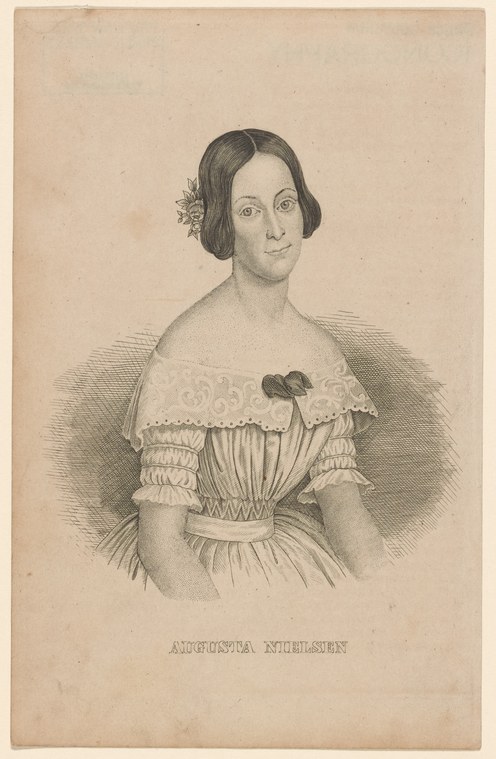
A three-quarter-length portrait of a young woman, identified by the inscription as Augusta Nielsen, rendered in fine engraving or steel-plate technique. She is shown from the waist up, turned slightly to the right, wearing an elegant off-the-shoulder ball gown with pronounced puffed sleeves gathered at the bicep and a fitted bodice with horizontal pleating across the torso. The neckline is low and wide, exposing the shoulders, and a dark ribbon or bow ornament sits at her breast. Her dark hair is parted in the center and swept up in the fashion of the 1830s–1840s, with a small floral arrangement pinned above her left ear. The background is plain, rendered with fine parallel shading lines that suggest depth without distracting from the figure. The work exhibits the refined tonal control and delicate modeling characteristic of the finest printmaking of the period, with particularly skillful rendering of the fabrics and the subtle modeling of her face and shoulders.
The dancing
The figure is presented in a calm, frontal pose with no indication of active movement or dance position. Her shoulders are relaxed and level, her gaze directed forward with a slight downward tilt of the head and what might be read as a faint, knowing expression. There is no visible suggestion of a dance hold, footwork, or the bodily tension that would indicate a moment captured mid-performance. The pose is that of a formal portrait subject rather than a dancer executing steps.
The dance depicted
The inscription identifies this as Augusta Nielsen, who is likely the Danish dancer and actress Augusta Nielsen (1822–1902), a celebrated performer of the Romantic ballet era who was particularly associated with the Royal Danish Ballet. However, the portrait itself shows no active dancing: it is a formal dress portrait in the convention of the 1830s–1840s, presenting the subject as a fashionable woman of rank rather than capturing her in performance. The elegance of the gown—the epitome of Romantic-era evening wear—may suggest her professional status and access to the finest dress, but the image does not depict dance itself. If this is intended to commemorate her as a performer, it does so through costume and social presentation rather than through the capture of movement or technical display.
How it was made
This is a steel-plate engraving or fine stipple engraving, a reproductive print technique that allowed for precise tonal gradation and fine detail. The parallel hatching lines visible in the background, the subtle modeling of fabric and flesh through accumulated minute marks, and the overall fineness of line all point to engraving rather than lithography or etching. Steel-plate technology, developed in the late 18th century, allowed for much longer print runs than copper-plate engraving, making such refined portraits accessible to a wider middle-class audience. The technique was the standard for high-quality reproductive prints of theatrical celebrities and notable society figures during the 1830s–1850s.
About this work
This is a formal society portrait in engraved print, likely dating to the 1830s–1840s, commemorating a woman identified as Augusta Nielsen, a prominent Danish dancer and performer of the Romantic era. Although the subject herself was celebrated as an artist, this image does not capture her in the act of dance; instead, it presents her according to the conventions of fashionable portraiture, emphasizing her social standing, beauty, and refined taste in dress. The work belongs in a gallery of dance in art as a historical record of how dancers of the period were represented in visual culture—not as moving bodies in performance, but as fashionable society figures.
How to look at it
Observe the engraver's skill in rendering the complex interplay of light and shadow across the silk and muslin of the gown, particularly the subtle tonal gradations in the puffed sleeves. Notice the delicate attention to the face: the modeling of the cheeks and the slight softness of the gaze give the portrait a sense of intimacy rather than heroic distance. The small floral ornament and dark ribbon are precisely detailed, markers of fashionable femininity. The stillness of the pose is deliberate—this is not a moment of action captured but a carefully composed study of elegance and repose.
The artist
The artist is not recorded. The work is a reproductive print, likely created by a professional engraver working from a painted or drawn original, possibly a portrait by a known society portraitist of the period. Such prints were produced by specialist workshops and publishing houses that specialized in theatrical and society portraiture, particularly in London and Paris, the centers of both ballet and print production in this era.
The period
The 1830s–1840s were the height of Romantic ballet, when dancers like Marie Taglioni, Fanny Elssler, and (in Scandinavia) Augusta Nielsen achieved international celebrity. Lithography and engraving were the primary means of mass-producing and distributing images of performers; theatrical prints were collected by enthusiasts much as photographs would be a century later. The fashion visible in this engraving—the off-shoulder gown with puffed sleeves—was at the height of Romantic elegance, and such portraits often appeared in fashion magazines and gift books aimed at cultured women. The refinement of the printing technique suggests this was a luxury item, a high-quality commemorative print of a celebrated performer.
Where it lives
The work is held in the New York Public Library's collection of prints depicting dance. It is part of a larger body of 19th-century theatrical and society portraiture that documents performers and cultural figures through reproductive printmaking.
Questions about this work
Was Augusta Nielsen a famous dancer?
Yes. Augusta Nielsen (1822–1902) was a prominent Danish dancer and actress, particularly celebrated at the Royal Danish Ballet during the Romantic era. She performed major roles in contemporary ballets and was known for her dramatic presence as well as her technical skill. She was among the most celebrated dancers of her time in Northern Europe.
Why does this portrait not show her dancing?
Formal portrait conventions of the 1830s–1840s did not typically show performers in mid-movement. Portraits were meant to be timeless records of the subject's beauty and social status, not documents of performance. Even when commissioned to commemorate a dancer or actor, the image usually presented them in evening dress and formal pose, as this does.
What technique was used to create this print?
This is a steel-plate engraving, a reproductive print technique that produced fine, precise detail through accumulated parallel lines. Steel plates allowed for larger editions than copper, making such refined portraits accessible to middle-class collectors. The technique remained standard for high-quality theatrical portraiture until photography became dominant in the 1860s.
Is this a one-of-a-kind work?
No. This is a print—one of many impressions pulled from the same engraved steel plate. Thousands of copies could be produced from a single plate, making theatrical portraits among the most widely distributed artworks of the 19th century. Such prints were sold singly or collected in albums and gift books.
More dance artwork





