49 works in this view — arrow keys or swipe to move between them.
Dance in Art
Caroline Fieldstedt
Unknown artist
- Collection:
- Prints depicting dance
- Source:
- New York Public Library
- Rights:
- Public domain — free to use, share and adapt.
- Recorded as:
- Public Domain
As a historical portrait of a named woman from the nineteenth century, this print is valuable evidence of how female performers were presented and marketed to the public. It documents the convergence of high fashion, performance culture, and reproductive printmaking in the mid-nineteenth century, and may provide biographical or professional context for Fieldstedt if other sources about her career survive.
What you are looking at
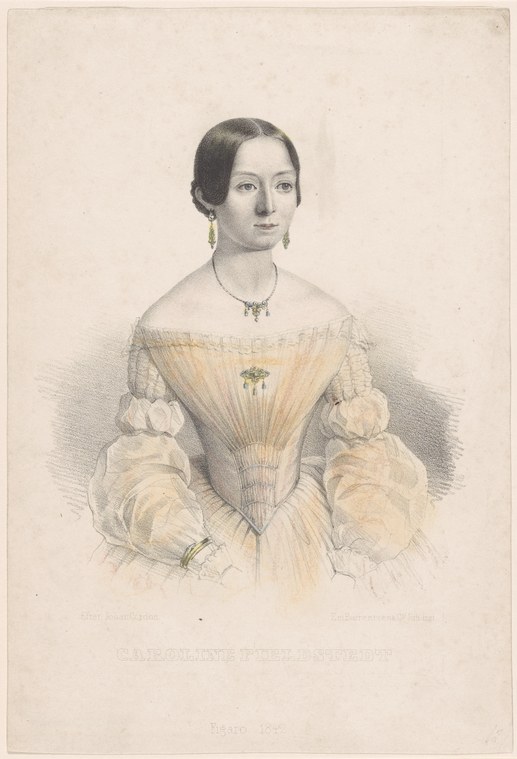
A young woman in formal mid-nineteenth-century dress stands in a three-quarter pose against a plain background, facing slightly to the left. She wears a pale yellow or cream evening gown with a fitted bodice decorated with a jeweled brooch at the center, and voluminous off-shoulder sleeves gathered at the forearm into wide, puffy cuffs of white fabric—characteristic of 1840s fashion. A gold necklace with pendant hangs at her throat, and she wears drop earrings. Her dark hair is parted in the middle and swept back smoothly from her face in the period style. Her posture is upright and composed, with her hands folded before her, the fingers of her right hand visible. The rendering is a hand-colored lithograph or engraving, executed with careful attention to the play of light across the fabrics, particularly the luminous quality of the sleeve cuffs and the subtle shading that gives the bodice dimension.
The dancing
A solitary standing figure, motionless and formally posed. Her weight is evenly distributed, her body erect and dignified, her arms relaxed at her sides with hands clasped loosely at the center of her body. There is no suggestion of active dance movement—this is a portrait study rather than a scene of dancing. The posture and presentation are those of a fashionable woman of the period presented for formal viewing.
The dance depicted
This work does not depict dance. It is a formal portrait of a woman in concert or theatrical dress, likely rendered as a souvenir or publicity image of a performer or notable woman of fashion. No dancing body, movement, hold, or choreographic context is present. The work may relate to performance culture—Caroline Fieldstedt may have been a dancer, singer, or actress—but the image itself shows only a static portrait.
How it was made
This is a hand-colored lithograph or engraving, likely produced in the 1840s for mass circulation as a portrait print or theatrical souvenir. The technique employed allows for the subtle gradation of tone across the fabrics and the soft modeling of the face and neck, while the hand-coloring—visible particularly in the yellow of the gown and flesh tones—adds immediacy and appeal to what is fundamentally a reproductive print. Such prints were affordable and widely distributed, making them an important medium for publicizing performers and fashionable women of the era.
About this work
This is a formal portrait print of Caroline Fieldstedt, a woman of the mid-nineteenth century, rendered in the convention of theatrical or concert portraiture. The work documents both the fashion and the performance culture of the 1840s, presenting a woman in elegant evening dress in a composed, dignified pose. While the catalogue places it in a collection of dance imagery, the image itself contains no depiction of dance; it is instead a historical record of a woman who may have been a performer, and of the visual and sartorial conventions of her time.
How to look at it
Attend to the fashioning of the figure: the precision of the fabric rendering, the jewelry, the careful arrangement of hair. Note the formal, static quality of the pose—this is not a moment of performance or movement, but a formal presentation of a woman in her finest dress. The hand-coloring and the subtlety of the lithographic or engraved line are evidence of the care taken in producing a high-quality portrait print suitable for circulation among a fashionable audience.
The period
This portrait was made in the era of the Romantic ballet, roughly 1840–1850, when lithographic and engraved portraits of theatrical performers were an important form of popular publicity and memorabilia. Dancers and singers of the period were often immortalized in such prints, which circulated widely among audiences. The fashion visible here—the off-shoulder neckline, the puffy sleeves, the fitted bodice—is characteristic of the 1840s and was common both in society dress and in stage costume of the era. The dignified, static pose reflects the conventions of formal portraiture rather than the dynamic imagery sometimes used to market dancers.
Where it lives
This work is held in the New York Public Library's collection of prints depicting dance. It arrived in the collection under that rubric, though the image itself does not show dancing. Such misclassification is not uncommon when portrait prints of performers are catalogued by their subject rather than by the content of the image.
Questions about this work
Was Caroline Fieldstedt a dancer?
The catalogue does not specify. The print is a formal portrait and provides no visual evidence of her profession or the nature of her performance career, if she had one. The name may be identifiable in historical records of mid-nineteenth-century performers, but this image alone does not establish her role.
Why is this portrait in a dance collection?
It is likely that Fieldstedt was a performer of some kind—dancer, singer, or actress—and the print was catalogued as dance-related on that assumption. However, the image itself shows no dance and would be equally at home in a collection of theatrical portraiture, fashion history, or printmaking.
What is this print made of?
The catalogue does not specify, but the image is consistent with a hand-colored lithograph or engraving of the 1840s, a common and affordable format for theatrical and fashion portraiture. The technique allowed for wide circulation and made the print accessible to a middle-class audience.
More dance artwork





