49 works in this view — arrow keys or swipe to move between them.
Dance in Art
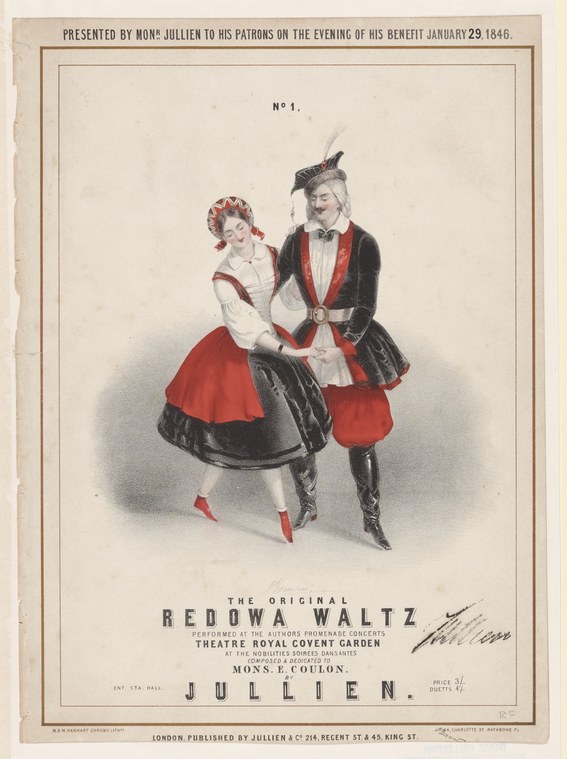
No. 1, The original Redowa waltz...by Jullien
Unknown artist
- Collection:
- Prints depicting dance
- Source:
- New York Public Library
- Rights:
- Public domain — free to use, share and adapt.
- Recorded as:
- Public Domain
The Redowa was a significant ballroom dance of the 1840s and represents an important transitional moment between the formal, stately waltz and the more energetic social dances of the later nineteenth century. This image is among the most direct visual records of how the Redowa was actually danced, and its explicit reference to Jullien's benefit performance anchors it to a specific moment in dance history. For dancers and historians of ballroom technique, this print offers rare documentary evidence of how a now-forgotten dance was executed and presented to contemporary audiences.
What you are looking at
A hand-colored lithograph showing two dancers in ballroom dress, positioned in a close embrace characteristic of the waltz. The male dancer, on the left, wears a black coat with red lapels and a white shirt front, topped with a plumed hat; the female dancer, on the right, wears a white bodice with puffed sleeves and a voluminous red skirt trimmed with black silk. Both figures are caught mid-rotation, their bodies leaning into the turn with the characteristic sway of the Redowa. The composition is set against a neutral background with subtle shading that gives the figures depth and movement. The dancers' feet are positioned to suggest the triple-time rhythm of the waltz, with the woman's red heels visible beneath her skirt. The print is marked "No. 1" at the top, indicating this is the first in a series of dance instruction or promotional imagery.
The dancing
The dancers are in closed ballroom position, with the man's right arm around the woman's waist and her left hand resting on his shoulder; their other hands are joined at approximately chest height. Both figures lean into the turn with a forward momentum characteristic of rotational waltzes. The woman's weight appears to be on her right foot as she begins to pivot, while the man's posture suggests he is leading the rotation. The diagonal line of their bodies and the tilt of their heads convey speed and the centrifugal force of the turn. Their positioning and frame would be recognizable to any dancer trained in nineteenth-century ballroom technique.
The dance depicted
This is the Redowa, a popular ballroom dance of the 1840s–1860s that combined elements of the waltz and the polka. The dance was performed in closed position with the couple rotating around the room in a rapid, hopping turn. The title explicitly identifies this as "The Original Redowa Waltz," and the date of 1846 and the reference to a benefit performance by Monsieur Jullien confirms this is a dance that had gained sufficient popularity to merit commercial promotion through sheet music or theatrical publicity. The image documents how the Redowa was danced at the height of its fashionable moment: the man leads a woman through a continuous rotating turn, with the bouncy, energetic quality of the movement captured in the forward lean and dynamic positioning of both figures.
How it was made
This is a hand-colored lithograph, a mass-production technique that allowed the addition of color to printed images by laying pigment onto a dampened stone after the initial black-ink printing. The quality of the line work, the subtle modeling of the figures through shading, and the precision of the anatomical detail suggest this was drawn for a skilled lithographer. The coloring—applied by hand rather than by additional stone—gives the image a quality of immediacy and directness. Such prints were characteristic of mid-nineteenth-century theatrical and dance publicity, allowing for rapid, affordable reproduction of attractive images for promotional purposes.
About this work
This is a promotional image for a popular dance of the 1840s, created to publicize a benefit performance by the notable dance musician and composer Monsieur Jullien in January 1846. The Redowa was a fashionable ballroom dance of the period, and this print captures both its visual appeal and its technical character: a vigorous turning waltz performed in close embrace. The image is valuable not only as evidence of what mid-nineteenth-century dancers looked like and how they moved, but as a document of how the dance was marketed and promoted to a paying public. It belongs in a gallery about dance in art because it demonstrates the intersection of dance practice, commercial culture, and visual representation in the nineteenth century.
How to look at it
Attend to the forward lean of both dancers' bodies and the diagonal line created by their spines—this captures the centrifugal pull of a rapid rotational turn. Notice how the woman's skirt and the man's coat tail suggest movement, as if frozen mid-spin. The positioning of the feet, particularly the woman's visible heels, indicates the footwork of the waltz-step rather than the flat-footed posture of a promenade. The closed, intimate frame—the man's hand at the woman's waist, her hand on his shoulder—was itself a matter of some note in an era when such proximity in public was becoming both more fashionable and still slightly daring. The hand-coloring and the careful attention to fabric texture and detail reflect the mid-nineteenth-century convention of making such promotional images as attractive and appealing as possible to potential customers.
The artist
The artist is not recorded in the catalogue, but the lithograph was published by Jullien of 24 Regent Street, London. Jullien was a prominent dance musician, composer, and impresario of the mid-nineteenth century, known for his fashionable quadrille orchestrations and benefit concerts. This image was likely drawn by a professional dance lithographer of the period, but the work's primary function was commercial rather than artistic—to advertise a performance and capitalize on public interest in fashionable dance.
The period
The 1840s were the height of the waltz's popularity in European ballroom culture, and the decade saw the emergence of numerous waltz variants and hybrid dances that attempted to combine the elegance of the waltz with the energy and novelty of newer dances like the polka. The Redowa represented one such experiment: a dance that took the rotational structure and closed position of the waltz but added the hopping, bouncy quality of the polka. Jullien was instrumental in popularizing such dances through his orchestrations and public performances. The promotional image itself reflects the period's growing commercialization of dance, where fashionable dances became commodified goods advertised through prints, sheet music covers, and theatrical publicity.
Where it lives
This print is held in the New York Public Library's collection of prints depicting dance. It was published by Jullien of 24 Regent Street, London, in or before 1846. As a promotional object associated with a specific benefit performance, it was originally intended as an ephemeral advertisement—a use reflected in the date and performer information printed on the sheet.
Dance in this work
Questions about this work
What was the Redowa, and how was it different from other waltzes?
The Redowa was a ballroom dance of the 1840s–1860s that blended the rotational structure and closed position of the waltz with the hopping, energetic quality of the polka. While the waltz was characterized by smooth, gliding motion, the Redowa added a bouncy vertical action, making it faster and more athletic. It was particularly popular in Britain and France during the mid-nineteenth century, and this image captures the vigorous, spinning movement that made it a novelty attraction in fashionable ballrooms.
Who was Monsieur Jullien, and why would his benefit concert warrant a promotional print?
Louis Antoine Jullien (1812–1860) was a prominent French-born conductor, composer, and impresario who became famous in London for his orchestral concerts and his compositions for fashionable dances. Benefit concerts were a standard way for performers to raise money and promote themselves; they were attended by society figures and reported in the press. A benefit concert by someone of Jullien's stature would have been a significant social event, making a promotional print of the Redowa an investment in his own fame and the piece's popularity.
How do we know this print shows the Redowa and not another waltz?
The title on the print explicitly reads 'The Original Redowa Waltz,' removing any ambiguity. Additionally, the vigorous forward lean and the dynamic, almost bouncy quality conveyed by the positioning of the figures align with contemporary descriptions of the Redowa as a faster, more energetic waltz-variant than the standard Viennese waltz. The print thus serves as visual documentation of how a named dance was understood and performed at the moment of its popularity.
What technique was used to create this image, and what does that tell us about its circulation?
This is a hand-colored lithograph, a mass-production technology that allowed for rapid, affordable reproduction of images. The black-ink lines were printed from stone, and the colors were applied by hand to each print. This technique made such promotional images economically viable for distribution to dance studios, music publishers, and society customers. Its use indicates that the Redowa and Jullien's performance were considered commercially significant enough to warrant investment in color promotion—a luxury afforded only to the most fashionable dances and performers.
More dance artwork





