49 works in this view — arrow keys or swipe to move between them.
Dance in Art
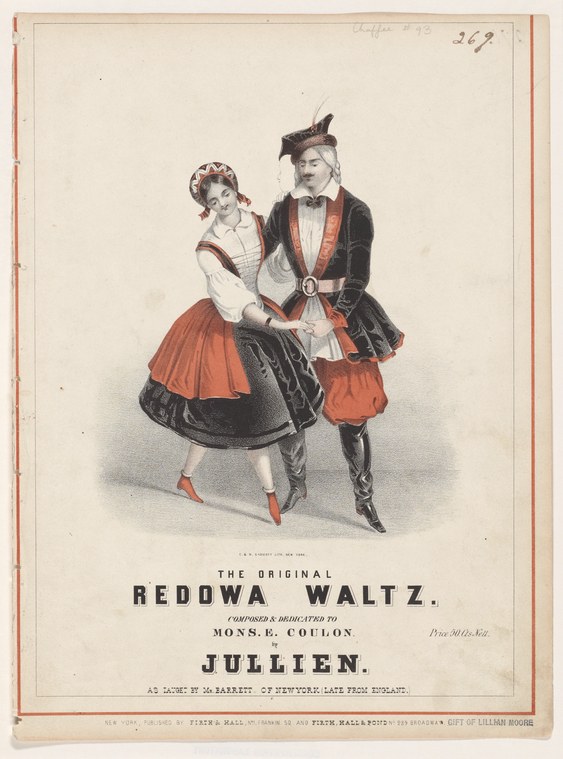
The original Redowa waltz...by Jullien
Unknown artist
- Collection:
- Prints depicting dance
- Source:
- New York Public Library
- Rights:
- Public domain — free to use, share and adapt.
- Recorded as:
- Public Domain
The Redowa is now largely forgotten outside specialist historical dance circles, yet this print captures a dance that was genuinely fashionable for a decade. For historians of ballroom culture, costume, and social dancing, the image is evidence of how couple dances were promoted, taught, and remembered—through colour prints that circulated in homes, dance studios, and concert halls. The print shows the Redowa as a designed spectacle, not a folk tradition: it was marketed, choreographed, and sold.
What you are looking at
A couple in fashionable 1860s dress are captured mid-dance against a plain background. The man, wearing a dark jacket with red-lined tails, a white shirt front, and a tall plumed hat, leads with his right arm extended. The woman, in a red skirt with deep black flounce and a white corseted bodice trimmed in red, wears her hair in an elaborate style with a decorative headdress. She leans into the turn, her body angled sharply, her weight on her feet as she responds to the lead. The couple is shown at an active moment of rotation—the woman's skirt catches the movement, billowing and following the line of the turn. This is a moment of ballroom spectacle: the richness of the fabrics, the height of the costumes, and the dynamic suspension between the partners all register the prestige of the dance.
The dancing
The pair is in a closed ballroom position, the man's right hand at the woman's waist and his left extended. The woman's posture shows weight settling into a turn; her upper body is upright but angled, her arms positioned to maintain frame. The geometry of their bodies—the lean, the twist, the woman's skirt following the motion—reads as a trained partnership executing a recognisable step sequence. The man's tall frame and plumed hat establish him as the leading partner; the woman's angled torso and the catch of her skirt demonstrate active participation, not passive following.
The dance depicted
This is a Redowa, a couple dance that emerged in Prague around the mid-19th century and was a ballroom standard by the 1860s. The Redowa combines elements of the waltz with a polka-like hop, danced in 3/4 time. The title credits the composition to Julien (likely the conductor and arranger Louis-Antoine Jullien), who published dance music for the Redowa and other fashionable forms. The print documents this as a published choreography or arrangement for performance, not a folk or casual variant. The costume, the formal ballroom setting implied by the simplicity of the background, and the couple's trained bearing all confirm this as a ballroom dance captured at the moment of widest European and American vogue.
How it was made
This is a hand-coloured lithograph or tinted engraving, evident from the clean outlines, the subtle shading in the figures' faces and bodies, and the applied colour—red for the woman's skirt and jacket trim, flesh tones, black for detail. The printing medium allowed rapid reproduction and distribution as sheet music cover art or as a standalone print for sale to dance enthusiasts. The text at the base identifies this as a published composition, suggesting this print served both as advertisement and as a memento of a fashionable performance or as instructional reference for dancers learning the step.
About this work
This print documents the Redowa at the height of its fashionable moment in mid-Victorian ballrooms. The Redowa was a transatlantic dance that captured the energy of the 1850s–60s—faster than a waltz, more playful, and briefly ubiquitous in the polite drawing rooms of Europe and North America. The image is notable not as fine art but as a primary source: it shows the hold, the costume, the moment of turnwork, and the gender roles embedded in ballroom partnership of the era. The attribution to Julien and the publication details place this within the commercial apparatus of dance, where composers, publishers, and choreographers marketed novel dances to the expanding middle class through printed music, prints, and published instructions.
How to look at it
Attend to the moment the artist chose: the woman is not in a static pose but caught at the height of a turn, weight distributed and body angled to follow the lead. The plumed hat, the red trim, the full skirt and its movement register the spectacle of the ballroom—this is high dress, not everyday clothes. Notice the woman's posture: she is not passive or merely decorative. Her frame is maintained, her turn is active. This is a trained dance partnership rendered as a moment of motion. The simplicity of the background focuses all attention on the couple and the turn itself.
The artist
The print is credited to Julien's composition but the artist/engraver is not named. Louis-Antoine Jullien (1812–1860) was a French conductor, composer, and impresario famous for popularising dance music and orchestral arrangements. He published numerous quadrilles, waltzes, and other ballroom dances, often naming them after fashionable locations, events, or his own innovations. Jullien was a figure of commercial music and dance, producing material for the concert hall and the ballroom in equal measure. The Redowa publication would have been one of dozens of similar prints Jullien's house produced.
The period
The Redowa emerged in the 1840s and reached its peak in the 1850s–60s, a moment when ballroom culture was expanding rapidly with industrialisation and the growth of middle-class leisure. The waltz, introduced to Britain and America in the early 19th century amid some scandal, had by the 1840s become respectable. The Redowa, the polka, the schottische, and similar dances represented a quickening of ballroom fashion—each a three-time measure with a distinctive step pattern, each publishable as sheet music, each marketable as 'new.' The print medium itself was part of this apparatus: cheap lithography meant that fashionable dances could be advertised and instructed through images that reached a broad audience. This was the era of the dance fad.
Where it lives
This print is held in the New York Public Library's Prints collection, which documents dance and entertainment in the 19th century. It is a published print, likely a sheet music cover or a standalone engraving sold to the dance-going public. The source identifier and catalogue number confirm it as part of a collection of dance-related ephemera from the period.
Dance in this work
Questions about this work
What is a Redowa?
The Redowa is a couple dance in 3/4 time that combines elements of the waltz and polka. It emerged in Prague around the 1840s and became a fashionable ballroom standard in Europe and America during the 1850s and 60s. It is faster and more playful than a waltz, with a characteristic hop or bounce. After about 1870, it fell out of favour and is now rarely danced outside historical dance communities.
Who was Louis-Antoine Jullien?
Jullien (1812–1860) was a French conductor and composer famous for popularising orchestral and ballroom music. He was a prolific publisher of dances, particularly quadrilles and waltzes arranged for orchestras and ballrooms. He toured Europe and America as a conductor and impresario, bringing fashionable music and dance to concert halls and ballrooms. He was a figure of commercial music, not classical composition, and published hundreds of dances.
What does the costume tell us?
Both figures wear fashionable 1860s formal dress. The man's tall plumed hat, dark jacket, and white shirt indicate evening wear or fancy-dress ballroom costume. The woman's elaborate coiffure, corseted bodice, and full red skirt with black flounce are typical of mid-Victorian ballroom dress. The richness and formality of the costume register the Redowa as a respectable, high-status ballroom dance, not a folk dance or novelty.
Why is this print important?
The print documents how ballroom dances were marketed and circulated in the 19th century. It is evidence of the dance itself—the hold, the turnwork, the costume, and the gender roles. As a published print, it shows how novel dances became fashionable through commercial reproduction and distribution. It captures the Redowa at the moment of its greatest popularity, before it fell out of fashion.
More dance artwork





