49 works in this view — arrow keys or swipe to move between them.
Dance in Art
Scène de carnaval
Unknown artist
- Collection:
- Prints depicting dance
- Source:
- New York Public Library
- Rights:
- Public domain — free to use, share and adapt.
- Recorded as:
- Public Domain
Carnival prints are primary documents of how European urban societies choreographed and visualized public festivity before the dominance of ballroom and theatrical forms. The image records the heterogeneity and social mixing that carnival enabled—nobles, servants, performers, and spectators moving together in ways that were otherwise prohibited. For historians of dance and social practice, it offers concrete evidence of how carnival spectacle was composed visually, who participated, and what costume and masquerade meant to urban festive culture.
What you are looking at
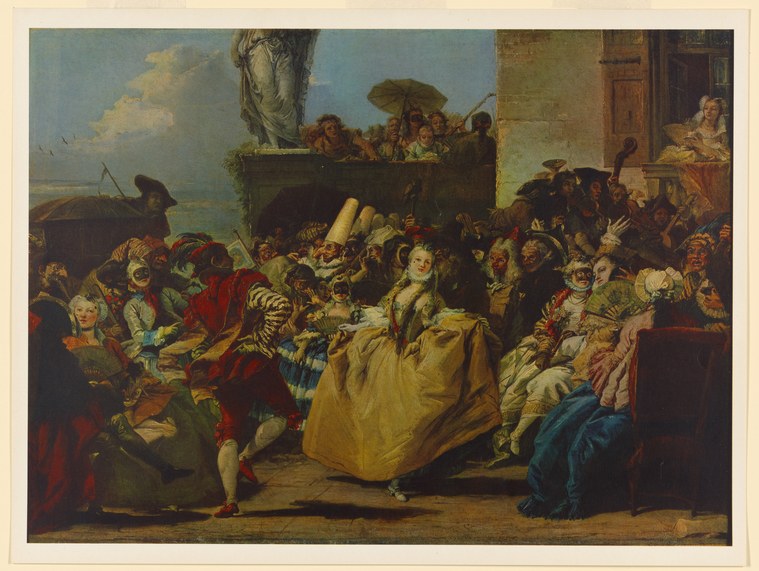
A densely populated carnival or festive scene set in a Mediterranean port town, viewed from a slightly elevated vantage point. The composition is divided between foreground revelry and architectural background: in the immediate foreground, figures in elaborate costume and masquerade dress cluster around a central woman in a luminous yellow gown who appears to be the focal point of attention. To the left, a small boat with figures aboard sits at a dock; to the right, a fortified building with crenellations and windows frames the scene. The sky is pale blue, suggesting daylight. The crowd is a crush of bodies in motion—some dancing, some gesturing, some watching—rendered in warm ochres, reds, and earth tones against the cooler architecture. The palette and loose, gestural brushwork suggest this is a print, likely an engraving or etching that has been hand-colored or printed in color. The artist has captured the chaotic energy of carnival: masks, feathered costumes, exaggerated postures, and the mingling of social ranks that carnival traditionally permitted.
The dancing
The bodies are rendered with attention to theatrical excess rather than anatomical precision. Figures lean, gesture expansively, and cluster in informal groups with little formal partnering or hold. The woman in yellow in the center stands relatively still and contained, surrounded by more animated masqueraders who adopt exaggerated postures—arms raised or extended, bodies twisted and angled. There is no evidence of structured partner dance positions; instead, the movement reads as processional, social, and celebratory. Costumes include what appear to be Commedia dell'arte masks and motley dress, suggesting this is a scripted or semi-improvised carnival performance rather than ballroom dance. The density of the crowd and the lack of clear dance formations suggest ensemble revelry rather than couple dancing.
The dance depicted
This appears to depict carnival or carnival-adjacent festivity, most likely Italian given the architectural style, Mediterranean setting, and costume conventions. The specific dance form is not identifiable from the image—this is a scene of social revelry, masquerade, and processional movement rather than a named dance with codified steps or formations. The painting (or print) captures the type of carnivalesque performance documented in 16th–18th century accounts of Italian court festivals and urban carnivals, where masked dancers, musicians, and performers mingled in public squares or during organized pageantry. The yellow-gowned figure may represent a character or symbolic role, possibly Venus or a personification of festivity itself, around whom the revelry orbits. The heterogeneous dress and informal spatial relationships suggest this records the visual spectacle of carnival rather than teaching or documenting a specific choreographic tradition.
How it was made
From the image, this appears to be a print—most likely an engraving or etching—that has been colored by hand or printed in multiple colors. The handling of light and shadow through hatching and line, the clarity of the architectural forms, and the way the composition is rendered in distinct planes all suggest the intaglio or relief printing tradition rather than oil painting. The relative shallowness of the spatial recession and the flattened treatment of the crowd are characteristic of prints from the 16th–18th centuries. The technique allowed such imagery to circulate widely; carnival scenes were popular subjects for prints aimed at educated audiences curious about exotic or festive customs. The coloring appears selective and somewhat artificial—the bright yellow gown stands out distinctly—which is consistent with hand-coloring of black-and-white printed impressions.
About this work
This is a print documenting a carnival or festive scene, likely Italian, rendered in the style and format of an engraved or etched print with subsequent hand-coloring. It captures not a ballroom dance or named choreographic form but the visual disorder and social permeability of carnival—the moment when masks, costumes, and ritual inversion permitted public performance outside normal hierarchy. The work belongs in a dance collection not because it depicts a codified dance style but because it records how communities moved together during festive occasions, and how artists chose to represent that collective, temporary liberation. It is evidence of how carnival was seen and valued as a visual and kinetic phenomenon worthy of reproduction and circulation.
How to look at it
Look at the compositional center: the still, glowing figure in yellow around whom the rest of the composition swirls. This is a typical Renaissance and Baroque strategy for organizing a chaotic scene—anchoring the viewer's eye to a point of calm within tumult. Notice how the costumes and masks identify roles and character types rather than individual identities; this is the visual language of carnival, where social personas are inverted or masked. Observe the variety of poses and the informal clustering—there is no geometric order, no line, no progression. This is how carnival moved: without choreography, driven by music, impulse, and the freedom the occasion permitted. The elevated viewpoint allows the artist to show the full press of the crowd while still maintaining narrative legibility.
The period
Carnival prints became a staple of European visual culture from the 16th century onward, particularly in Italy, the Low Countries, and France. They served multiple purposes: documentary, satirical, ethnographic, and entertainment. By the 17th–18th centuries, prints of carnival scenes, masquerades, and street festivity were fashionable among educated collectors and wealthy urban households. The Italian carnival, particularly the Venice Carnevale, was famous across Europe and frequently depicted in prints aimed at foreign audiences. The architectural vocabulary of the scene—the fortified building, the port setting—suggests a Mediterranean location, possibly Venice or another Italian city-state. The Commedia dell'arte figures and the visual chaos of the crowd reflect the improvisational performance traditions that flourished in this period.
Where it lives
The work is held in the New York Public Library's collection of prints depicting dance. The catalogue record provides no artist, date, medium, or detailed provenance, suggesting it may be one of many similar carnival prints in institutional collections, catalogued by subject rather than by individual attribution.
Questions about this work
Is this a real dance or a made-up scene?
This depicts carnival—a real festive occasion with rules, traditions, and expected behaviors, but not a named dance with codified steps. Carnival was performative and choreographed at the social level: who could participate, what masks and costumes were permitted, what music played, and how bodies could move together were all governed by convention. But there was no 'carnival dance' with a defined technique or vocabulary, the way you might learn a minuet or a waltz. This print records the visual spectacle and social mixing that carnival enabled.
What is the yellow-dressed woman doing?
She is likely a symbolic or allegorical figure—possibly Venus, Festivity, Plenty, or another personification—rather than a named character or participant. She stands relatively still and contained while masked revelers gesture and move around her. This compositional strategy allows the artist to organize visual chaos: the still center holds the eye, and the motion around it reads as celebration directed toward or orbiting that figure. She may also represent the object of carnival's attention or the occasion being celebrated.
When and where was carnival danced like this?
Urban carnivals in Europe were most visible and elaborate from the 16th century onward, with the Venetian Carnevale being the most famous. Most European cities held carnival celebrations before Lent, involving masked processions, music, dancing, and social role-reversal. These celebrations reached peak elaboration in the 17th and 18th centuries. This print likely documents one of those traditions, though the specific city and date are unknown from the record.
Why are there so many people dressed as characters?
Carnival permitted and encouraged the wearing of masks and costumes that let people adopt different identities—some comic (Commedia dell'arte figures like those visible here), some fantastical, some satirical. Masks and costume were not optional; they were the enabling mechanism of carnival. They allowed social mixing and behavior that would otherwise be prohibited. The visual excess in this print—the wild variety of dress and pose—is the point: carnival was the time when visual and social order could be temporarily inverted.
More dance artwork





