49 works in this view — arrow keys or swipe to move between them.
Dance in Art
Arthur St. Léon
Unknown artist
- Collection:
- Prints depicting dance
- Source:
- New York Public Library
- Rights:
- Public domain — free to use, share and adapt.
- Recorded as:
- Public Domain
Arthur St. Léon choreographed some of the Romantic era's greatest ballets, including *La Vivandière* and *Le Corsaire*, and his career spanned from the 1830s through the 1860s across Europe's leading opera houses. This portrait, though not depicting dance itself, is a primary historical record of his appearance and serves as a touchstone for understanding how celebrated choreographers were presented and remembered in their own era.
What you are looking at
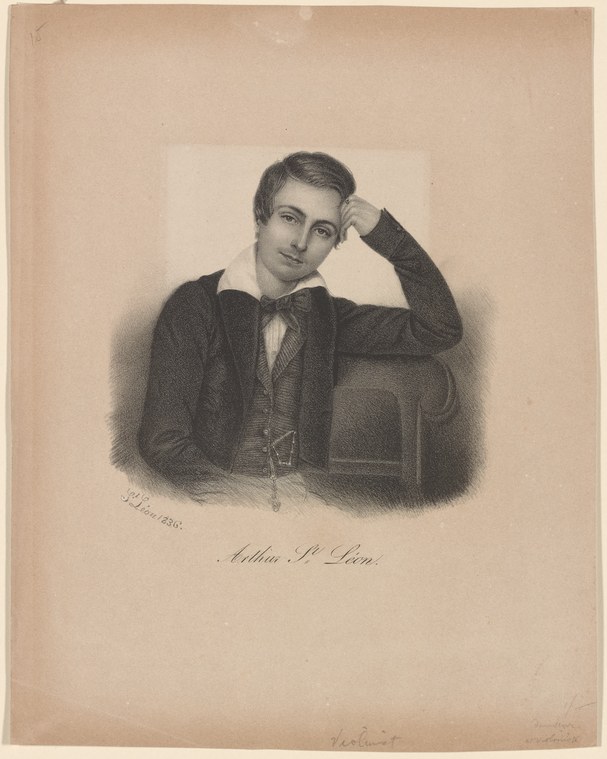
A three-quarter-length portrait of a young man in early 19th-century dress, shown from roughly the waist up against a plain, light background. He wears a dark coat over a patterned waistcoat and a white collar, his posture relaxed and introspective. His right arm is raised, hand resting against his head in a pose of gentle contemplation or repose. The technique is a lithograph or engraving rendered in fine grayscale tones, with careful attention to the texture of fabric and the modeling of the face and neck. The man's expression is direct but thoughtful, his gaze meeting the viewer's. A signature or inscription appears in the lower left, and the name 'Arthur St. Léon' is inscribed in script below the image.
The dancing
A solitary standing figure, seen from the front and slightly turned. The weight appears evenly distributed, the posture upright but not stiff. The raised right arm and hand-to-head gesture conveys repose or contemplation rather than active movement; this is a portrait pose, not a dance position. The left arm hangs naturally at the side. The gesture is introspective and intimate rather than theatrical.
The dance depicted
No dance is depicted in this portrait. The image is a formal commemorative likeness of the historical figure Arthur St. Léon, the 19th-century choreographer, dancer, and maître de ballet. St. Léon was a major figure in Romantic-era ballet and created many of the era's most celebrated works, but this portrait captures him at rest, in the conventional pose of a gentleman of letters or the performing arts, not in the act of dance. The work belongs to the tradition of celebrity portraiture of the period rather than depicting dance itself.
How it was made
This is a lithograph or engraving in black ink on paper, rendered in fine grayscale with careful tonal gradation. The technique allows for precise rendering of facial features and fabric texture while maintaining a certain immediacy and directness suitable to portraiture. The style—the soft modeling, the use of light and shadow, the plain background—is consistent with commercial portraiture of the 1820s–1840s, suggesting this was produced for reproduction and circulation among the theater-going public or the dance world. Such prints were typical of how celebrated performers of the era were commemorated and marketed.
About this work
This is a formal portrait engraving or lithograph of Arthur Saint-Léon (1815–1870), one of the great ballet choreographers and dancers of the Romantic period. He is shown in the conventional pose of a thoughtful gentleman, his gaze direct and his bearing dignified. Although the portrait itself does not depict dance, it is a historical document of considerable importance: it records the likeness of a major creative figure in the history of ballet and, in its style and execution, exemplifies the mid-19th-century practice of circulating celebrity portraiture of performing artists. The work belongs in a gallery of dance in art not because it shows dancing, but because it preserves the face and formal public image of one of the art form's most influential makers.
How to look at it
This portrait is a study in the formal conventions of mid-19th-century celebrity portraiture. Attend to the hand-to-head gesture, which conveys intellectual repose and creative contemplation—a pose designed to suggest the inner life and artistic sensibility of the sitter. The plainness of the background directs all attention to the figure and his expression. The fine rendering of the face and the careful attention to the quality of the fabrics are marks of a professional portrait intended to convey both likeness and social standing.
The artist
The artist of this print is not recorded in the catalogue. The style is consistent with the practice of mid-19th-century commercial lithography and portrait engraving in Europe, a period when such prints were produced in series to meet demand from the theater public. Many such portraits were made after paintings or drawings and circulated among fans, scholars, and theater libraries.
The period
This portrait dates from the height of Romanticism in ballet (1820s–1850s), an era when choreographers like Saint-Léon were celebrities whose images were widely reproduced and collected. The formal, dignified presentation of the subject reflects the elevated cultural status of ballet in this period and the respect accorded to its makers. Lithography and engraving were the mass-reproduction media of the era, making such portraits accessible and affordable to a broad audience of dance enthusiasts and theater-goers.
Where it lives
The work is held in the New York Public Library's collection of prints depicting dance. It is one of many commercial portrait engravings and lithographs produced in the 19th century to commemorate celebrated dancers, choreographers, and other performing artists.
Questions about this work
Is this Arthur St. Léon the ballet choreographer?
Yes. Arthur Saint-Léon (1815–1870) was a celebrated ballet choreographer, dancer, and maître de ballet whose works were performed throughout Europe. He created some of the Romantic era's most important ballets, including *La Vivandière* (1844) and *Le Corsaire* (1856). This portrait is a historical record of his appearance.
Why is a portrait of a person included in a gallery of dance in art?
Although this portrait does not depict dancing or a dance scene, it preserves the likeness of one of the most influential choreographers in the history of ballet. It is a primary historical document and an example of how celebrated dance-makers were publicly presented and remembered in their own era.
What does the hand-to-head pose signify?
In the conventions of 19th-century portraiture, this pose suggests contemplation, intellectual engagement, or creative thought. It was a conventional gesture designed to convey the inner life and artistic sensibility of the sitter, marking him as a person of culture and imagination.
What technique was used to make this print?
The work appears to be a lithograph or engraving rendered in fine grayscale. Such prints were the primary means of reproducing and circulating images of celebrities in the 19th century, allowing many copies to be made and sold at affordable prices.
More dance artwork





