49 works in this view — arrow keys or swipe to move between them.
Dance in Art
Jacob Graf Durazzo
Unknown artist
- Collection:
- Prints depicting dance
- Source:
- New York Public Library
- Rights:
- Public domain — free to use, share and adapt.
- Recorded as:
- Public Domain
Durazzo was instrumental in Vienna's shift toward dance reform and modern choreographic practice; his patronage shaped the work of key innovators including Hilverding and Angiolini. This portrait is primary-source documentation of a major historical figure in dance administration and cultural sponsorship whose influence extended throughout European courts.
What you are looking at
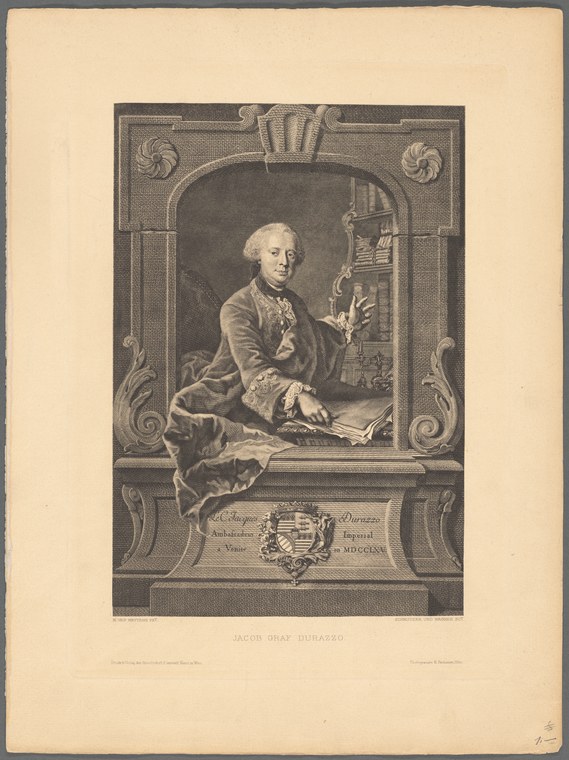
A man in 18th-century dress stands at a writing desk or small table in a classical interior, holding a quill pen or brush in one hand while gesturing toward a sheet of paper or document before him. He wears a chocolate-brown coat with decorative embroidery, his pale hair styled in the fashion of the mid-to-late 1700s. The setting is framed by an ornate baroque architectural surround—fluted pilasters, scrollwork, and a shell cartouche at the apex—suggesting this is a formal portrait of a distinguished figure. A small decorative urn or finial sits atop the frame. In the background, glimpsed through the architectural frame, are hints of a classical interior space. The entire composition is rendered as an engraving, with fine parallel lines creating tone and shadow. Below the image sits a coat of arms and an inscription in Latin and German that likely identifies the subject.
The dancing
The single figure is shown in a pose of intellectual or artistic production rather than physical motion. His right hand holds a writing instrument aloft in a gesture of creation or composition; his left rests on the desk surface. His posture is upright and dignified, with weight evenly distributed in a standing position. There is no visible dance hold, frame, or bodily movement—the pose is that of a statesman, composer, or administrator at work, not a dancer in motion.
The dance depicted
This engraving does not depict dance. The title identifies the subject as Jacob Graf Durazzo, an 18th-century imperial administrator and patron of the arts at the Viennese court. While Durazzo was indeed a significant figure in dance history—as director of the imperial theaters in Vienna he oversaw ballet productions and worked with choreographers—this portrait shows him in his professional capacity as a bureaucrat and cultural administrator, not as a dancer or in a dance context. The image records his role as a maker and patron of dance rather than a performer of it.
How it was made
This is a copper-plate engraving, characteristic of 18th-century portraiture and formal documentation. The technique uses fine parallel lines and cross-hatching to model form, light, and fabric texture—particularly visible in the rendering of the coat and the face. Engravings of this type were circulation prints, produced in multiples for distribution among educated elites, diplomats, and institutions. The elaborate architectural frame and heraldic cartouche indicate this was an official portrait, likely commissioned to commemorate Durazzo's position and service.
About this work
This is an 18th-century engraved portrait of Jacob Graf Durazzo, an Austrian imperial official and major patron of dance at the Viennese court. The image documents him in his administrative capacity—seated or standing at work, pen in hand—rather than as a dancer. Durazzo's historical importance lies in his directorship of Vienna's imperial theaters during the 1750s-1760s, a period of major innovation in ballet and dance practice. This portrait belongs in a dance collection not because it shows dancing, but because it records a crucial figure in the institutional and artistic history of 18th-century theatrical dance.
How to look at it
Attend to the symbolic language of the portrait: the pen and desk identify intellectual and administrative authority rather than physical skill. The classical frame and heraldic insignia mark this as an official document of rank and service. The carefully rendered costume and dignified posture present Durazzo as a man of taste and cultivation—qualities essential to his role as a curator and director of the arts. The engraving technique itself, with its fine parallel lines and restrained tonal range, conveys formality and permanence.
The artist
The engraver is not identified in the catalogue record. The style and technique are consistent with mid-to-late 18th-century Austrian or German court engraving; the work was likely commissioned as an official commemorative print by the imperial administration or by Durazzo himself. The elaborate frame and heraldic apparatus suggest a printmaker of some standing working within courtly patronage.
The period
This engraving dates to the height of the Enlightenment, when dance was undergoing significant reform across European courts. In Vienna particularly, the 1750s-1760s saw the emergence of a new, more naturalistic ballet aesthetic—moving away from purely ornamental court dance toward narrative and dramatic forms. Durazzo's tenure as director of the imperial theaters coincided with the choreographic innovations of Franz Hilverding and Gasparo Angiolini. In the visual arts, formal engraved portraits of patrons and administrators served to document and legitimize cultural authority; the classical architectural frame situates Durazzo within the learned, refined world he patronized.
Where it lives
The work is held in the New York Public Library's collection of prints depicting dance. It is classified as a historical document and portrait engraving, not a dance scene. The inscription below the frame in Latin and German provides the subject's name and likely his titles and dates of service.
Questions about this work
Why is a portrait of an administrator in a dance art collection?
Durazzo was a major historical figure in 18th-century dance. As director of Vienna's imperial theaters from 1754 to 1766, he commissioned and oversaw the creation of innovative ballet and choreographed works that shaped the modern history of the art form. Portraits of patrons and administrators are essential documents for understanding how dance was institutionalized and valued in court societies.
What did Durazzo do for dance?
Durazzo engaged the choreographers Franz Hilverding and Gasparo Angiolini to create reform ballets that moved beyond pure ornament toward dramatic narrative and expressive movement. His tenure marked Vienna's emergence as a center of choreographic innovation during the Enlightenment. He also helped establish the infrastructure and prestige that made ballet a serious court art.
How do we know this is an engraving and not a drawing or painting?
The systematic parallel lines (hatching and cross-hatching) used to create tone, shadow, and texture are the technical signature of copper-plate engraving. Engravings were made by incising lines into a metal plate, which was then inked and printed. This technique produces the characteristic fine, regular mark-making visible throughout the portrait.
More dance artwork





