49 works in this view — arrow keys or swipe to move between them.
Dance in Art
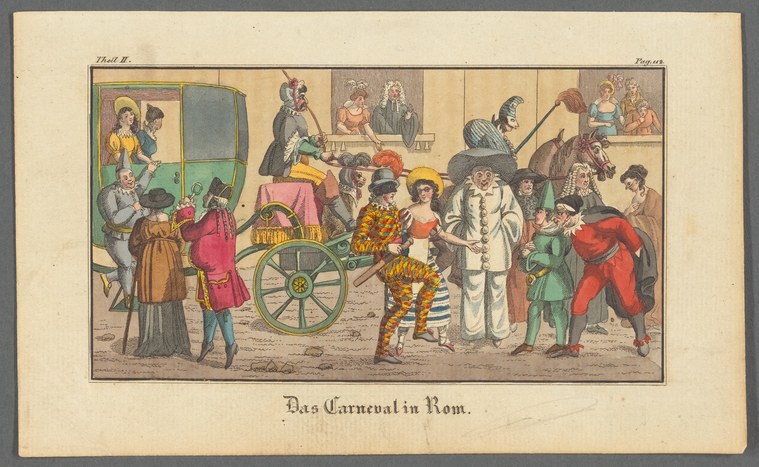
Das Carneval in Rom
Unknown artist
- Collection:
- Prints depicting dance
- Source:
- New York Public Library
- Rights:
- Public domain — free to use, share and adapt.
- Recorded as:
- Public Domain
This work preserves the character of carnival dancing and street performance in one of early modern Europe's most celebrated carnival cities, at a moment when such festivities were both culturally central and increasingly subject to religious and political restriction. It shows dancing not as a discrete event in a ballroom or court, but as embedded in urban public life, social mixing, and spontaneous performance. The print also records the role of costume, masking, and character types (the Harlequin figure) in shaping carnival movement and social behavior.
What you are looking at
A crowded street carnival in Rome unfolds across this hand-colored print, viewed from a slight elevation. The composition is divided into foreground and background activity: in the immediate foreground, a diverse group of costumed revelers dominates—a figure in a yellow and black checkered or striped harlequinade costume with a red hat dances prominently in the center-right, attended by figures in formal dress (coats, breeches, cocked hats) and others in carnival masks and dominoes. To the left, a decorated carnival wagon or float topped with an ornate golden structure is drawn by figures in attendance. The background shows a street scene with buildings, balconies where observers watch from windows and upper stories, and additional figures moving through the space. The overall atmosphere is one of licensed revelry and social mixing—servants and nobility, masked and unmasked figures, appear in close proximity in a way that would be impossible in everyday Roman society. The light is even and clear, suggesting daylight during the day of celebration.
The dancing
The figures display varied postures ranging from standing observation to active movement. The figure in the harlequinade costume in the center appears to be in mid-gesture, body angled, arms positioned for movement or gesture-making—whether dancing proper or simply gesticulating in performance is ambiguous from the frozen moment. Most other figures stand upright, some in formal parade stance, others leaning or turning to watch. There is no evidence of partnering or coupled dance positions; instead, the movement appears social, individual, and performative rather than balletic or formally choreographed. The figures' relative heights suggest depth, with nearer figures taller and more detailed than those receding into the background.
The dance depicted
This represents carnival dancing and revelry in Rome, specifically the Carnevale Romano, which took place primarily on the streets and in the piazzas of the city during the weeks before Lent. The image captures the character of carnival as social performance and licensed disorder rather than formal dance: masks, costumes, the mixing of social classes, and the presence of decorated vehicles (the carnival wagon is a characteristic element of Roman carnival processions). The central harlequinade figure may be a professional or semi-professional performer hired to entertain the crowd, or may represent the general spirit of masquerading and comic performance. What is depicted is carnival dancing in the social and vernacular sense—movement as part of street theater and public festivity rather than as a codified dance form. The actual steps, holds, or formal patterns are not recoverable from the image.
How it was made
This is a hand-colored woodcut or engraving, printed in black ink and then colored by hand with watercolor or gouache. The printing technique is evident from the even black outlines, the regular hatching for shading, and the characteristic registration marks. The hand-coloring is evident from the soft washes and slight bleeding of pigment, and the variations in intensity that suggest individual coloring rather than mechanical printing of multiple color blocks. This technique allowed for wider circulation than a unique painting while remaining relatively inexpensive for a popular print. The combination of print and hand-coloring suggests a product aimed at a middle-class or educated popular market—souvenirs of travel, records of customs, or illustrations for collectors of curiosities about distant places.
About this work
A hand-colored print documenting the street carnival of Rome, showing a crowded scene of masked revelers, costumed performers, and spectators during the Carnevale Romano. The image captures the social and performative character of carnival celebration—not formal dance, but the movement, gesture, and physical exuberance that accompanies licensed public revelry. As a print, it circulated as a record of Roman customs and a souvenir of one of Europe's most famous carnival celebrations, making it a document of both visual culture and the place of dance-like movement in early modern urban public life.
How to look at it
Attend to the variety of postures and dress in the crowd: the contrast between formally dressed observers and costumed performers, between masked and unmasked figures, between the static and the mobile. The central Harlequin figure is clearly the focal point of activity, but notice how the eye is drawn upward and to either side by the architectural framing and the distribution of figures. The wagon in the upper left is a key element of Roman carnival ritual, part of the elaborate processions and decorated structures that moved through the streets. The print captures not a single moment of dance but a general scene of carnival behavior, where movement, costume, music, and social mixing are all part of a continuous performance rather than a discrete dance event.
The period
The Roman carnival was suppressed and revived repeatedly from the 16th through 18th centuries, and reached something close to its final form in the 18th century before its near-total suppression in the early 19th century. This print likely dates to the 18th century, when Roman carnival was at the height of its fame and was a major attraction for visitors and Grand Tourists. The image reflects the Enlightenment interest in recording and cataloguing the customs, manners, and public ceremonies of different societies. Carnival in Rome was distinctive for its street-based character (unlike Venetian carnival, which was more formally theatrical), its mixing of social classes, the use of specific character types and stock figures from commedia dell'arte, and its licensed inversion of social norms. By the time such prints were circulating widely, carnival was already becoming a spectacle for outsiders and an object of cultural documentation rather than a fully organic community practice.
Where it lives
The work is part of the New York Public Library's collection of prints depicting dance. It bears the title 'Das Carnival in Rom' (The Carnival in Rome), suggesting German or Northern European publication or documentation, likely as part of a series of prints on European customs and public ceremonies.
Dance in this work
Questions about this work
Is this showing a specific dance or just carnival celebration?
Carnival dancing was not a single dance form but rather movement and gesture embedded in street performance, masquerading, and public revelry. The print captures the social and performative context rather than any particular choreography or dance steps. What we see is the character types (like the Harlequin), the costumes, and the physical exuberance typical of carnival street life.
What was the Roman carnival and when did it happen?
The Roman carnival was an annual festival held in the weeks before Lent, centered on the streets and piazzas of Rome, characterized by masking, costuming, the mixing of social classes, and licensed disorder. It was suppressed and revived multiple times but flourished particularly in the 18th century before being largely banned in the 19th century. This print likely documents the 18th-century version.
Who made this print and when?
The artist is not recorded in the catalogue. The print is hand-colored and likely dates to the 18th century. The title is in German, suggesting publication in Northern Europe or by a publisher serving German-speaking markets. The subject—documenting European customs for a distant or foreign audience—was characteristic of Enlightenment-era popular prints.
More dance artwork





