49 works in this view — arrow keys or swipe to move between them.
Dance in Art
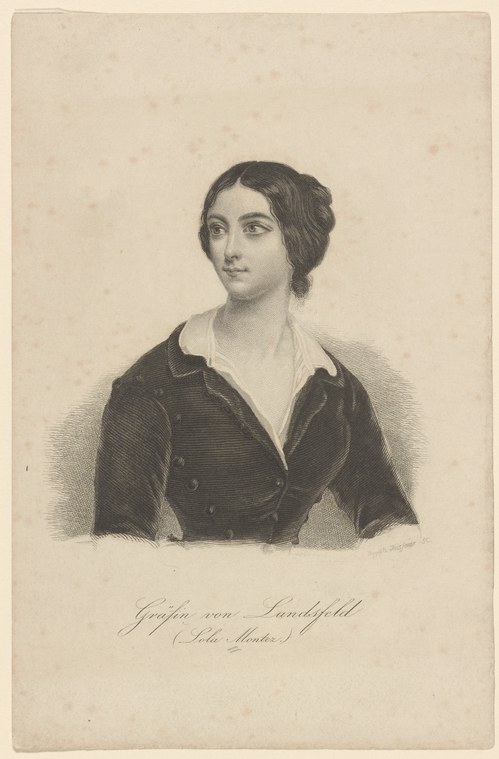
Gräfin von Landsfeld (Lola Montez)
Unknown artist
- Collection:
- Prints depicting dance
- Source:
- New York Public Library
- Rights:
- Public domain — free to use, share and adapt.
- Recorded as:
- Public Domain
Lola Montez was one of the most notorious and celebrated performers of the mid-19th century, and her image circulated widely in prints like this. This portrait is a primary document of how a controversial female performer was translated into the language of genteel portraiture—a negotiation between her fame and her social standing.
What you are looking at
A half-length portrait of a woman in three-quarter view, gazing slightly downward and to the left. She wears a dark velvet jacket or bodice with a deep V-neckline and large collar, lined in a lighter fabric, worn over a pale chemise. Her dark hair is pulled back in a neat chignon typical of the 1840s. The background is plain and neutral, rendered in soft tones with subtle shading that creates depth around the shoulders. The engraving technique produces fine parallel lines (hatching) to model the face and fabric, creating a luminous quality in the skin and a sense of the jacket's luxurious pile. The image is a formal printed portrait, not a performance scene or theatrical tableau.
The dancing
A single standing figure shown from the bust upward, posed with quiet dignity. The shoulders are relaxed and squared; the neck is long and graceful. There is no active bodily movement or dance position visible. The woman's gaze is meditative, directed away from the viewer, suggesting introspection rather than performance. The body is still and composed, consistent with the conventions of formal portraiture rather than the captured motion of dance.
The dance depicted
This is a portrait of Lola Montez, the Irish-born dancer and performer who became famous across Europe in the 1840s for her exotic dances and theatrical presence. However, the portrait itself does not depict dance. It is a formal portrait print—the kind of celebrity portrait distributed to the public and collected as memorabilia. Montez was known for her Spider Dance and other sensational stage performances, but this image presents her as a subject of dignified portraiture, not in performance or mid-movement.
How it was made
This is an engraving, identifiable by the fine parallel lines (hatching) used throughout to model form, tone, and texture. The technique allows for the subtle rendering of fabrics—the velvet jacket's nap, the sheer chemise—and the luminous modeling of the face. Engravings were labor-intensive to produce but could be printed in large numbers, making them the primary medium for distributing celebrity portraits in the 19th century. This is clearly a commercial portrait print, likely published for public sale or collection.
About this work
A formal engraved portrait of Lola Montez, the celebrated dancer and performer of the 1840s, presented as a figure of refined elegance rather than theatrical spectacle. The image belongs in a dance archive not as a depiction of dance itself, but as evidence of how dancers were represented and consumed in popular visual culture. The portrait genre, and its careful rendering of fashionable dress and composed bearing, tells us as much about the status and marketability of performers as any stage image would.
The work is significant because it reveals the distance between Montez's public persona on stage (known for sensational and controversial performances) and her presentation in formal portraiture. The subdued palette, the inward gaze, and the fashionable but modest dress construct a very different figure from the exotic dancer of legend—showing how visual media shaped and negotiated the reception of performers whose work itself was often deemed shocking.
How to look at it
Notice the tension between the figure's fame and the restraint of the format. The portrait offers no hint of theatrical display or movement—no costume reference, no stage setting, no dynamic pose. Instead, we see fashionable dress and composed bearing. The downward gaze and the plain background emphasize the subject as an object of contemplation rather than performance. The fine technique of the engraving itself, visible in the careful hatching, signals the prestige of the medium and the investment in capturing a 'true' likeness for a discerning public.
The artist
The artist is not recorded. The print was likely produced by a commercial printmaking house in London or Paris, where Montez was based and celebrated during her peak fame in the 1840s. Such portraits were typically made from an original painting or drawing, then reproduced by an engraver for distribution to the public and collectors.
The period
In the 1840s, Lola Montez was at the height of her fame in Europe, performing her signature Spider Dance and other theatrical pieces that combined ballet training with exotic and sexually suggestive choreography. The era saw both a boom in celebrity culture and the circulation of performer portraits as commodities. At the same time, the Romantic era's interest in exotic otherness and feminine mystique shaped how female performers were depicted and consumed. This engraved portrait belongs to the tradition of celebrity portraiture that made stars visible and available to a mass audience.
Engraving was the dominant reproductive medium for distributing images at this time; photography was still in its infancy. Engraved portraits allowed for idealization and controlled representation in ways that photography would later disrupt.
Where it lives
The work is held in the New York Public Library's prints collection dedicated to dance imagery. It is a reproductive print (engraving), not a unique object, and would have been one of many copies distributed commercially during Montez's career or shortly after.
Questions about this work
Is this a picture of Lola Montez dancing?
No. This is a formal portrait print, not a performance or stage image. Montez is shown in fashionable dress, posed for a portrait gallery rather than captured mid-movement. It is a celebrity portrait of the kind that circulated in the 19th century as memorabilia and collectible images.
What was Lola Montez famous for?
Montez was an Irish-born dancer and performer who became one of the most celebrated and notorious stage performers of the 1840s-50s. She was known for her Spider Dance and other pieces that blended theatrical narrative with sensational choreography. She also became involved in political scandal and intrigue, which only heightened her fame.
Why do we have a portrait of her in a dance collection?
Celebrity portraits like this are important documents of how dancers were represented and consumed in popular visual culture. They show how performers were marketed, what status they held, and how their public image was shaped by the media of the time. A portrait can tell us as much about the culture of dance as a performance image does.
More dance artwork





