49 works in this view — arrow keys or swipe to move between them.
Dance in Art
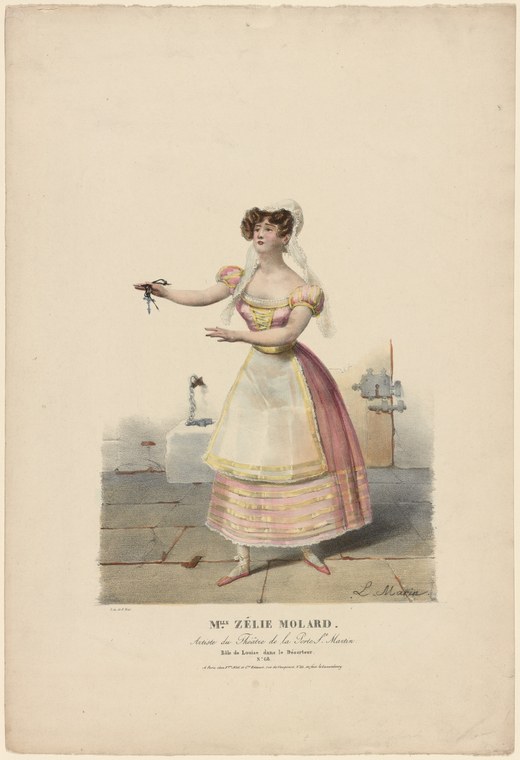
Mlle. Zélie Molard, artiste du Théâtre de la Porte St. Martin, rôle de Louise dans Le déserteur
Unknown artist
- Collection:
- Prints depicting dance
- Source:
- New York Public Library
- Rights:
- Public domain — free to use, share and adapt.
- Recorded as:
- Public Domain
The inscription naming Mlle. Molard and her specific role makes this a documentary record of a historical performer and production, valuable for theater and dance historians tracking the careers of named artists and the staging of early 19th-century opera-comique. The theatrical print tradition this represents was one of the primary ways audiences encountered and remembered staged performance before photography, making such images essential to understanding how dance and theater were circulated and celebrated in popular culture.
What you are looking at
A young woman in Regency-era dress stands alone against a neutral background, posed as if on a stage. She wears a high-waisted white muslin gown with a gold silk underdress and a wine-red silk overskirt or sash draped across her body. Her dark curled hair is dressed with a white veil or head ornament. She holds a small bouquet or nosegay of flowers extended in her right hand at chest height, while her left arm is raised in an elegant line. Her posture is upright and theatrical, with her weight poised on her feet in a stance suggesting controlled, graceful movement. In the background are sketched stage properties: what appears to be a fortress or military structure on the left and draped fabric on the right, indicating a stage set. The entire composition is rendered as a hand-colored engraving with fine line work and delicate watercolor wash.
The dancing
A single figure in a standing pose with the weight held upright and centered. The right arm extends forward and slightly down in an offering gesture with the flowers; the left arm is raised to shoulder height in an open, expressive line. The overall frame is frontal and composed, with no suggestion of dynamic motion or partnered dance—the pose is one of presentation or formal greeting rather than active dancing. The stance and arm carriage reflect early 19th-century theatrical deportment, emphasizing elegance and display.
The dance depicted
This is not a representation of dance in motion, but rather a theatrical portrait of an actress in costume for a specific role. The inscription identifies her as Mlle. Zélie Molard in the character of Louise from the opera *Le Déserteur* (performed at the Théâtre de la Porte-Saint-Martin in Paris). The pose is a moment of dramatic presentation—likely a recognition scene or romantic offer—rather than a choreographed dance sequence. The flowers, upturned face, and formal stance suggest a moment of emotional significance rather than terpsichorean action.
How it was made
This is a hand-colored engraving, identifiable by the fine line work and controlled hatching visible in the background and fabric. The delicate application of watercolor or gouache in pinks, yellows, and golds over the black line work is typical of early 19th-century theatrical print production. Such prints were distributed widely to theater-going audiences and collectors as affordable mementos of celebrated performances and performers. The technique allowed for rapid reproduction and dissemination, making this work part of a commercial theatrical print industry.
About this work
This is a theatrical character portrait rather than a dance image, documenting the costume and presentation of a named actress in a specific operatic role in early 19th-century Paris. Mlle. Molard is shown in full stage dress as Louise in *Le Déserteur*, a work that blended spoken dialogue with musical numbers and likely included dance or choreographed movement, though none is depicted here. The image belongs to a gallery of dance in art because theatrical dance and opera-ballet were inseparable in the period, and because the figure, dress, and stage setting document the world in which theatrical dance was performed and consumed. The work is a primary document of theatrical culture and the visibility of named female performers in the operatic stage.
How to look at it
Attend to the theatricality of the pose: the frontality, the controlled arm positions, the upward gaze and slight turn of the head. This is not a naturalistic moment but a composed, staged display designed for an audience. Note how the flowers function as a prop and narrative device—they tell us something about the emotional moment the actress is portraying. The stage setting sketched in the background anchors this as a theatrical portrait, not a studio portrait. The delicate finish of the print and the hand-coloring invite close viewing and suggest this was a luxury item, a keepsake of an admired performance.
The artist
The artist is not recorded in the catalogue. The style and execution are consistent with professional Parisian theatrical print makers of the 1820s–1840s. The signature or workshop mark visible in the lower right (if legible) may be present in specialized theatrical print archives. Such prints were often produced by jobbing engravers and colorists working for theatrical publishers and print sellers, whose names and individual practices are often lost to history.
The period
This print dates to the early 19th century, a period of flourishing theatrical culture in Paris and rising celebrity of individual performers. The Théâtre de la Porte-Saint-Martin was a commercial venue specializing in opera-comique and melodrama, genres that regularly incorporated dance and choreographed spectacle. The Regency silhouette—high waist, slim skirt, classicizing drapery—reflects the neoclassical fashion of approximately 1810–1830. Theatrical prints of named performers were a major commercial product during this period, rivaling in popularity the portrait prints of royalty and nobility. This image documents the moment when female performers became named, individual celebrities rather than interchangeable members of a chorus.
Where it lives
The work is held in the New York Public Library's collection of prints depicting dance. It is part of the broader tradition of theatrical character prints and operatic portraits that circulated widely in 19th-century Europe and America, typically sold in print shops near theaters or by traveling theater troupes.
Questions about this work
Is this a dance image or just a theatrical portrait?
It is primarily a theatrical portrait of an actress in costume, not a representation of dance in motion. However, it documents the visual world of early 19th-century operatic theater, in which dance was a regular component of performance. The image belongs in a dance collection because it illuminates the theatrical and visual context in which dance was made and seen.
Who was Mlle. Zélie Molard?
The inscription identifies her only as an artist of the Théâtre de la Porte-Saint-Martin performing the role of Louise in *Le Déserteur*. Further biographical information would require consultation of specialized theatrical archives and 19th-century Parisian theater records. Her celebrity was sufficient to warrant the production and sale of this character print.
What is *Le Déserteur*?
*Le Déserteur* was an opera-comique (a theatrical genre blending speech, song, and often dance) likely first performed in Paris in the early 19th century. The specific production and plot details would require consultation of specialized opera and theater histories.
Why are the flowers and stage setting important?
The flowers function as a narrative prop, suggesting a moment of romantic or emotional significance within the plot. The sketched stage setting—fortress and draped fabric—anchors the portrait as a moment from a specific theatrical production rather than a generalized portrait, and documents the visual language and spectacle of operatic stagecraft.
More dance artwork





