49 works in this view — arrow keys or swipe to move between them.
Dance in Art
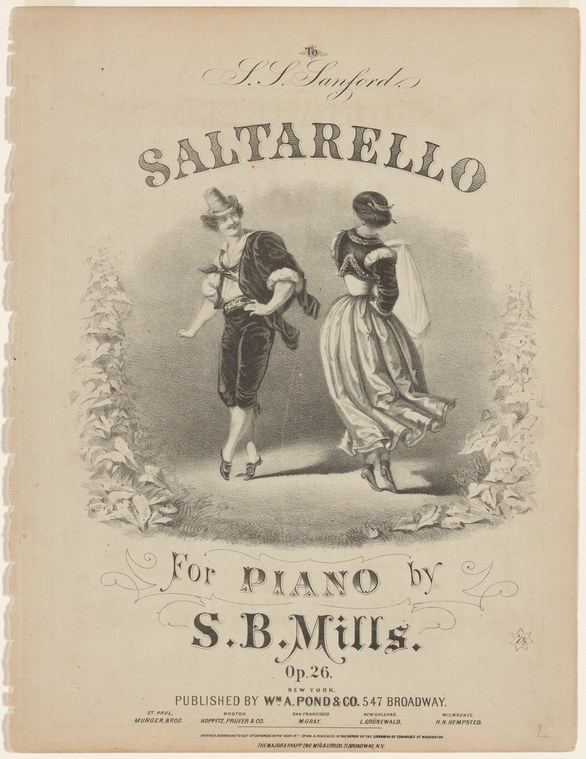
Saltarello for piano by S.B. Mills, Op. 26
Unknown artist
- Collection:
- Prints depicting dance
- Source:
- New York Public Library
- Rights:
- Public domain — free to use, share and adapt.
- Recorded as:
- Public Domain
The saltarello was one of several 'national' dances—alongside the polka, redowa, and mazurka—that American composers and publishers packaged for the parlor market in the mid-nineteenth century. This image is a primary source for how the dance was understood and presented visually in its heyday: energetic, playful, and socially sanctioned for mixed company. For historians of dance and social customs, the work documents the mechanism by which European popular dances were domesticated into American genteel culture.
What you are looking at
This is the title page of a piano composition depicting two figures in nineteenth-century dress engaged in a lively dance. A male dancer in dark breeches, a fitted jacket, and a hat leans forward with one arm extended toward his female partner, whose body twists away in an animated posture. The woman wears a full skirt with a fitted bodice and a small hat; her raised arms and tilted torso suggest rapid rotation or a springing step. Both figures are caught mid-movement on a plain stage floor, rendered in soft grays that create a sense of theatrical lighting. Ornamental foliate borders frame the composition at left and right, typical of mid-nineteenth-century music publication design. The overall mood is one of energetic, courtly gaiety—the kind of social dance that filled ballrooms and concert halls of the 1850s-60s.
The dancing
The male figure leans forward at the waist with legs bent and weight on the balls of his feet, one arm extended toward his partner in invitation or acknowledgment. The female figure stands more upright but with her torso tilted and rotated; her arms are raised and angled, her skirts swirl in a way that suggests either a rapid turn or a bouncing step. The two are not in closed hold but appear to be in conversation through movement—he reaching toward her, she responding with a spiraling or springing action. The separation between them and their distinct body angles suggest a dance of social courtship rather than locked partnership.
The dance depicted
The title identifies this as a *Saltarello*, an Italian folk dance that became fashionable in European ballrooms and concert halls during the nineteenth century. The saltarello is characterized by rapid, springing steps (the name derives from *saltare*, to jump or leap) and is typically danced by couples in a playful, flirtatious manner. The image captures the essential quality of the dance: the springy, upward energy in both figures, the woman's rising and rotating action, and the man's forward-leaning posture all align with historical accounts of the saltarello's execution. As a piano composition by a mid-nineteenth-century American composer, this work represents the domestication of European folk and national dances into genteel parlor music.
How it was made
This is a lithographic title page, a technique that allowed for rapid reproduction and mass circulation of sheet music. The delicate tonal gradations in the gray printing and the fine detail in the ornamental borders are characteristic of mid-nineteenth-century lithography. The composition was clearly drawn on stone and printed in a single color; the soft modeling of the figures' forms and the subtle shadows give the dance scene an almost sculptural presence despite the flatness of the medium. As a title page rather than an internal illustration, this image would have been the first thing a pianist or music collector saw, advertising both the composition and the fashionable, Continental character of the dance it evokes.
About this work
This is the title page of *Saltarello for Piano, Op. 26*, a composition by S. B. Mills published in New York by W. A. Pond & Co. around the 1860s. It depicts the saltarello, an Italian-origin jumping dance that became a staple of nineteenth-century ballroom culture and concert music. The image captures two dancers in mid-movement: the man leaning forward with extended arm, the woman rotating upward in the characteristic springing action of the dance. The work belongs to a large body of American sheet music that brought European national and folk dances into middle-class homes through piano arrangements. As a lithographed title page, it represents both the visual marketing of music and a moment in the nineteenth-century fascination with collecting, naming, and performing the dances of Europe.
How to look at it
Notice the moment the artist has chosen: neither the beginning nor the end of a step, but the apex of the springing action. The male figure's forward lean and extended arm convey both courtship and the spatial interaction characteristic of a couple dance, while the woman's twisted torso and raised arms capture the upward energy and rotational quality of the saltarello's footwork. The ornamental frame and theatrical blank background follow the convention of mid-nineteenth-century dance imagery: the dancers are removed from any specific social setting and presented as idealized, timeless performers of a named dance. This abstraction—away from the ballroom and toward the generic dancer—was typical of how commercial sheet music presented dance in the era.
The artist
S. B. Mills was a nineteenth-century American composer and pianist known for salon music and piano transcriptions. The composition opus number (26) suggests a prolific output; Mills appears to have specialized in dance music and light concert pieces aimed at the amateur musician. The work was published by W. A. Pond & Co., one of the major music publishers in New York during this period, indicating Mills had sufficient standing to secure professional publication and promotion through commercial lithographic means.
The period
The 1850s and 1860s saw a boom in the publication and performance of European national and folk dances in American ballrooms, concert halls, and homes. The polka craze had swept through the continent and America in the 1840s, and composers and publishers capitalized on the public appetite for named, exoticized dances. The saltarello, along with the tarantella and other Italian and Spanish dances, offered publishers and performers a way to signal Continental sophistication and cosmopolitan taste. At the same time, the development of chromolithography and improved printing techniques made it economically feasible to illustrate sheet music with detailed, artistically rendered images—a competitive advantage in an expanding market for domestic music.
Where it lives
This is a title page from a printed piano score held in the Library of Congress as part of its collection of American sheet music. It is cataloged as part of the Library's *Prints depicting dance* collection, which preserves visual representations of dance from a wide range of media and periods.
Dance in this work
Questions about this work
What is a saltarello?
A saltarello is a lively couple dance of Italian origin, characterized by rapid, springing steps and playful, flirtatious movement. The name comes from the Italian word *saltare* (to jump or leap). It became fashionable in European and American ballrooms during the nineteenth century and was adopted by composers for the concert hall and the parlor.
Was this image drawn from life, or is it a conventional representation?
This is almost certainly a conventional representation in the style of mid-nineteenth-century dance imagery. The dancers are idealized figures in a generic stage space, not a documentary record of a specific performance. The artist (not identified on the print) was working from an understanding of what the saltarello *was* and how it was supposed to look, not from observation of a particular pair of dancers.
How was this image made?
This is a lithographic print, a planographic printing technique in which the design is drawn on a stone and then printed. Lithography allowed for fine tonal gradations and rapid reproduction, making it ideal for illustrated sheet music. A single stone could produce many copies, each printed by hand, which made the cost and time of producing illustrated music covers economically feasible for commercial publishers.
Who was S. B. Mills?
S. B. Mills was a nineteenth-century American composer and pianist whose works focused on salon and dance music for amateur musicians. The opus number and publication history suggest he was a working professional in the music trade, but details of his biography are not well documented in standard reference works.
More dance artwork





