49 works in this view — arrow keys or swipe to move between them.
Dance in Art
Scapin
Unknown artist
- Collection:
- Prints depicting dance
- Source:
- New York Public Library
- Rights:
- Public domain — free to use, share and adapt.
- Recorded as:
- Public Domain
Scapin's theatrical vocabulary—the exaggerated posture, the comic gesture, the physical swagger—reveals a performance tradition that predates and parallels ballet, showing how European theatrical movement existed in multiple registers. For scholars tracking the evolution of stage movement and character work, this image documents a stock character whose performance style was taught, imitated, and evolved across centuries.
What you are looking at
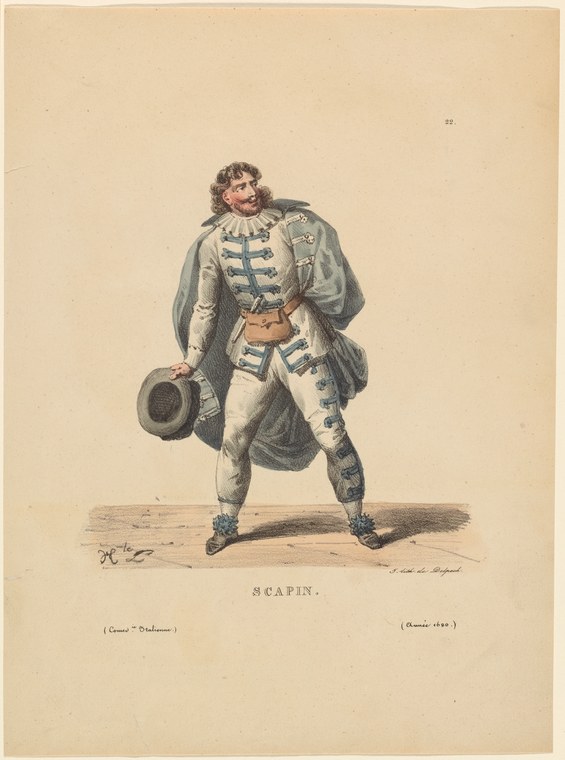
A single male figure stands in a wide, dynamic stance against a plain cream background, wearing an ornate military costume from the commedia dell'arte tradition. His outfit consists of a richly decorated jacket with elaborate frogging and braid in blues and golds, paired with cream-colored breeches and dark boots. A heavy cloak or mantle in slate blue drapes from his shoulders. He holds a wide-brimmed hat in his left hand at waist level, while his right arm extends outward in a gesture of swagger or address. His body leans slightly forward and to the side, weight distributed in a theatrical pose that emphasizes showmanship. The figure's curled hair and animated expression suggest performance mode—he is not at rest but caught mid-gesture, as if addressing an audience or announcing himself. The composition is a typical theatrical costume study or character portrait, presented frontally with minimal setting to focus attention entirely on the figure and costume.
The dancing
The single figure displays the exaggerated posture and self-presentation of commedia dell'arte performance rather than balletic or social dance technique. His weight is planted firmly, with legs spread wide in a bravura stance that reads as parade or exhibition rather than movement through space. The arm and shoulder carriage is theatrical and assertive—the extended right arm draws attention outward, while the torso twists slightly to enliven the silhouette. There is no partnering, no frame suggesting partnered dance, and no visible footwork. The pose is one of character display and comedic self-aggrandizement.
The dance depicted
This is Scapin, the cunning valet of commedia dell'arte tradition, recognizable by the name inscribed below and by the character's stock costume of bright military dress and servant's wit. Scapin appears in plays by Molière and others throughout the 17th and 18th centuries, often dancing and moving with acrobatic agility and exaggerated comic gesture. He is not a dancer in the ballet sense but a theatrical character whose movement vocabulary blended acting, mimicry, and physical comedy. This image captures the performance mode of the character rather than a specific choreographed moment, showing how the costume itself signaled the role and the broad, energetic physicality expected of the performer.
How it was made
This is a hand-colored engraving or lithograph, likely 19th century based on the printing style and palette. The linear work is finely detailed—visible in the costume's intricate frogging and the figure's carefully rendered features—while the color has been applied as a wash or light tint, leaving the cream paper visible and contributing to the theatrical presentation. The technique allowed for multiple copies to circulate, suggesting this was a popular reference image for costume, performance history, or theatrical study. The inscription and page number (22) indicate this is part of a larger series or album.
About this work
Scapin is a costume study or character portrait from the commedia dell'arte tradition, presenting the famous servant character in his stock military dress and bravura pose. The work documents both a recognizable theatrical role and a mode of performance—broad, gestural, and comedic—that existed alongside and in dialogue with formal dance traditions of the 17th–19th centuries. The figure's exuberant physicality and self-presentation mark this as theatrical character work rather than concert dance, but it preserves crucial evidence of how movement, costume, and character merged in popular performance.
How to look at it
Observe the arrested moment: the figure is neither in repose nor in a classical ballet position, but in theatrical declaration—the weight forward, the arm extended, the body angled to project outward. Notice how the costume itself generates the pose; the elaborate military dress is inseparable from the character's boastfulness and comic self-presentation. The artist has chosen the moment of greatest visibility and swagger, freezing Scapin mid-performance as if he has just delivered a line or is about to spring into physical comedy. The blank background emphasizes that this is about character and costume documentation, not narrative or setting.
The artist
The artist is not recorded in the catalogue. The engraving technique and style suggest a 19th-century theatrical or costume documentation practice, possibly French given Scapin's prominence in French theatrical tradition (particularly through Molière). The work appears to be part of a larger series of theatrical character studies, likely produced for reference, education, or popular circulation.
The period
This print sits at the intersection of commedia dell'arte's long European history and 19th-century theatrical documentation. By the time this engraving was made, commedia characters like Scapin had become historical reference points—preserved in prints and albums rather than living improvised performance. The parallel rise of ballet as a formalized art was shifting theatrical movement toward codified technique, yet commedia's gestural and acrobatic vocabulary remained culturally vivid and worthy of preservation through printed images. The engraving format allowed these images to reach a wide audience of theater practitioners, students, and enthusiasts.
Where it lives
This work is held in the Prints depicting dance collection at the New York Public Library. It is one of a numbered series (page 22), indicating it is part of a larger bound album or portfolio, likely 19th-century, assembled as a reference resource for theater practitioners or dancers interested in performance history and costume.
Questions about this work
Is this actually dance?
Scapin is a theatrical character, not a formalized dancer, but his performance tradition was physical, gestural, and acrobatic. Commedia dell'arte characters moved constantly—with exaggerated mimicry, tumbling, and comic physicality. This print documents movement practice even if not in the ballet vocabulary of the period. For historians of stage movement and theatrical performance, commedia characters like Scapin are essential ancestors of modern dance and physical theater.
Who was Scapin?
Scapin is a stock character from commedia dell'arte, the Italian improvised theater tradition. He appears in multiple plays, most famously in Molière's *Les Fourberies de Scapin* (1671). He is a cunning valet—clever, quick, physically agile, and given to broad comic business. Actors playing Scapin were expected to master physical comedy, acrobatics, and witty gesture. The character represents a complete performance package: costume, movement vocabulary, and comic timing.
What does the military costume signify?
Scapin's ornate military dress—with its elaborate frogging and braid—is a commedia stock costume that signals both the character's pretensions and his role as a quick-change artist and schemer. The gaudy military style allows for broad visual comedy: Scapin often impersonates figures of authority or wealth, and the costume supports that deception. The outfit is designed to move—to accommodate tumbling, exaggerated gesture, and the physical gags that characterized his performance.
More dance artwork





