49 works in this view — arrow keys or swipe to move between them.
Dance in Art
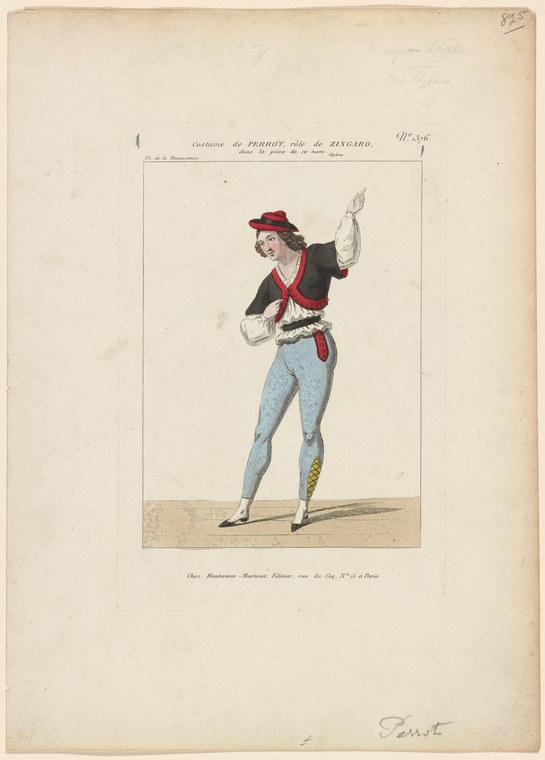
Costume de Perrot, rôle de Zingaro, dans la pièce de ce nom, opéra, Th. de la Renaissance
Unknown artist
- Collection:
- Prints depicting dance
- Source:
- New York Public Library
- Rights:
- Public domain — free to use, share and adapt.
- Recorded as:
- Public Domain
Pierrot and the commedia characters were central to how 19th-century performers moved and told stories onstage; this print captures the visual identity and physical vocabulary of a specific theatrical role. Understanding costume and character type is essential to reading 19th-century dance history, since many roles combined spoken text, mime, and stylized movement that would not be recognizable without reference to the tradition of commedia dell'arte. This object is evidence of how theatrical dance and spoken theatre shared vocabulary and audience in this period.
What you are looking at
A single male figure stands in profile against a plain background, wearing the costume of Pierrot in the role of Zingaro (Gypsy). He wears a red hat, a dark (black or dark blue) jacket with red trim at the collar and waist, and bright blue tights or close-fitting breeches. His posture is lively and exaggerated: his weight is shifted onto one leg, his torso leans forward energetically, and his free leg is raised slightly. One arm extends outward and upward in a theatrical gesture while the other holds what appears to be a paper or document. His expression and body angle suggest a moment of comic action or declamation—the arrested moment of a character mid-gesture or mid-narrative. The figure stands on a simple ground line with no other props or setting details; the composition focuses entirely on the character's silhouette and dress.
The dancing
This is a single dancer or actor in a standing pose that reads as both energetic and comedic. His weight distribution and the upward lift of one leg suggest active potential rather than a stabilized position—a readiness to move or turn. The raised arm with extended hand is a classic commedia dell'arte or pantomime gesture of address or revelation. The other arm maintains the property (letter or paper), keeping the viewer's attention on narrative business rather than pure movement. The posture is that of a performer in the middle of speaking or acting to an audience rather than a pure dance figure.
The dance depicted
This is not a representation of a specific dance, but rather the costume portrait of an actor-dancer in a theatrical character role. Pierrot and the commedia dell'arte tradition were central to theatrical dancing in this period, and Zingaro (the Gypsy) was a common variant character. The figure's stance and gesture suggest the improvisational movement vocabulary of pantomime and light comedy rather than formal dance technique. The title's reference to 'Théâtre de la Renaissance' and the operatic context indicate this is a costume study for a staged work, likely from the mid-to-late 19th century. The work documents performance practice rather than depicting a choreographed dance sequence.
How it was made
This is a hand-colored print or aquatint, recognizable by the fine linear technique visible in the background tones and the crisp outlines typical of aquatint production. The blue of the tights and the red of the costume details appear to be applied by hand over a printed base, a common practice for theatrical costume prints of the 19th century. This technique allowed for relatively affordable production and wide circulation among theatre patrons and costume makers seeking visual reference. The precision of the figure's outline and the careful color separation suggest professional production for commercial or institutional use, likely distributed to actors, theatres, or collectors of costume imagery.
About this work
This is a hand-colored theatrical costume print documenting a specific character role—Pierrot as Zingaro—from a 19th-century performance, likely at the Théâtre de la Renaissance in Paris. It belongs in a gallery of dance in art because the commedia dell'arte tradition and its character types were foundational to European theatrical dance and movement vocabulary. Pierrot in particular became a major figure in Romantic ballet and pantomime, and the costume portrait is an essential historical document of how these roles were realized onstage. The work shows us not a choreographed dance but the physical and sartorial apparatus through which character and comedy were performed—a different but equally important aspect of dance history.
How to look at it
Note the exaggeration in the pose and gesture—nothing here is naturalistic. The raised leg, the forward lean, the extended arm: these are not the proportioned positions of classical ballet but the readable, comic silhouette of pantomime. The costume itself encodes meaning: Pierrot's white base (which would be visible if we saw the full figure) signified innocence and pathos, while the red accents mark energy and emotion. The paper in his hand is significant—Pierrot was often a character of letters, notes, and misunderstandings, so this property tells a story. Look at how the artist has frozen him mid-gesture, in a moment of communication or revelation rather than in a posed line or symmetrical arrangement.
The period
The commedia dell'arte tradition experienced a major revival in European theatre and ballet in the 19th century, particularly in France. Pierrot and other stock characters became fixtures of pantomime, ballet d'action, and light opera. The Théâtre de la Renaissance (founded in Paris in 1838) was a major venue for such works. Costume prints like this one served both practical and commercial purposes: actors needed visual reference for historically or traditionally authentic costume, while theatre patrons and collectors purchased them as souvenirs. This was the era before widespread photography of performance, so printed images of costume were the primary visual record of how roles were realized in specific productions.
Where it lives
This work is held in the Prints collection of the New York Public Library, part of its extensive theatrical holdings. It is identified as depicting a costume from a production at the Théâtre de la Renaissance, likely from the mid-to-late 19th century, though the specific date and production cannot be determined from the record. The work belongs to a large category of theatrical costume prints produced for commercial circulation in 19th-century Paris.
Questions about this work
Is this a portrait of a real dancer?
No—this is a costume study, not a portrait of an individual. It documents the appearance of a specific character role (Pierrot as Zingaro) as it would have been worn in a theatrical production. The figure shown is a generic instantiation of the character type, not a named performer. Such prints were used as reference by costume makers, other actors, and theatre patrons rather than as records of individual performers.
What is Pierrot, and why does it matter?
Pierrot is a stock character from the commedia dell'arte tradition—a white-clad servant or everyman figure who is usually clumsy, lovesick, or foolish. In the 19th century, Pierrot became a major character in ballet, pantomime, and light theatre. The costume and movement vocabulary associated with Pierrot influenced how performers moved and expressed emotion in theatrical dance, making the character essential to understanding this period of dance history.
What does 'Zingaro' mean?
Zingaro is Italian for 'Gypsy.' This title indicates a variant or hybrid version of the Pierrot character, possibly with added elements of exoticism, wandering, or musical performance. Character variants and costume modifications were common in 19th-century theatre, where traditional commedia roles were continually adapted and reinterpreted for contemporary audiences.
What is an aquatint print?
Aquatint is an intaglio printing technique using acid to create tonal areas on a copper plate. It allowed printmakers to produce soft tonal effects and broad areas of color, making it ideal for costume and theatrical prints. Hand-coloring was then applied over the printed base to achieve the bright, specific colors visible in this image. This combination of printing and hand-coloring made theatrical costume prints relatively affordable and widely available.
More dance artwork





