49 works in this view — arrow keys or swipe to move between them.
Dance in Art
Morris dancers
Unknown artist
- Collection:
- Prints depicting dance
- Source:
- New York Public Library
- Rights:
- Public domain — free to use, share and adapt.
- Recorded as:
- Public Domain
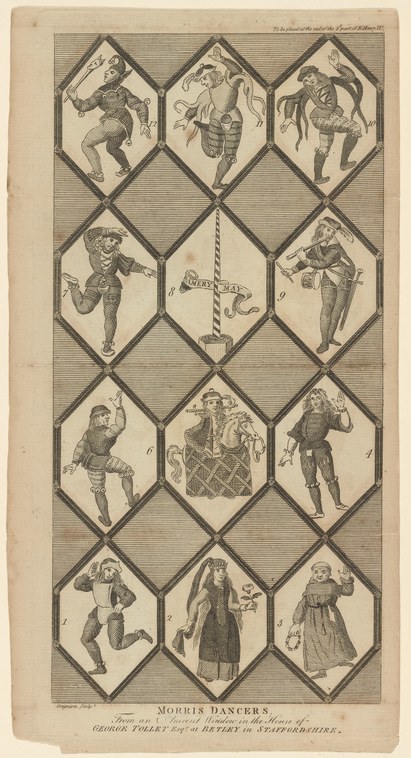
This is one of the earliest printed images of Morris dancing, a major English folk tradition that persists today. It documents not a fixed choreography but the aesthetic character of how bodies moved in a male dancing tradition — the extension, the energy, the use of the full body — at a moment before the form was revived and codified in the 19th century.
What you are looking at
A printed broadsheet presenting nine dancing figures arranged in a 3×3 grid of diamond-shaped frames, all against a plain background with horizontal hatching. Each frame isolates a single dancer in motion, rendered in black ink with fine cross-hatching for volume and shadow. The dancers wear early modern costume — breeches, doublets, and hose — and move with exuberant energy, legs extended, arms gesturing freely, bodies twisted mid-leap or mid-stride. The central frame contains a text cartouche rather than a figure. The composition reads like a instructional or documentary record: nine variations of vigorous male folk dancing, each dancer captured at a different moment in the movement, no two poses identical. The engraving is finely detailed; individual threads of costume are rendered, and the dancers' musculature is suggested through careful line work.
The dancing
All nine figures are male, solo dancers with no partner contact. Each occupies an independent frame, making direct comparison of posture the point of the composition. The dancers show high extension — legs lifted, often in balletic turnout — combined with a loose, athletic upper body. Arms are raised, bent, or extended in varied positions; bodies lean, twist, and arc. The footwork is not clearly legible at this resolution, but the weight appears distributed across the whole foot rather than on the toe. This is vigorous social dancing rather than courtly formal holding; the energy is centripetal, the movement grounded but expansive.
The dance depicted
The title identifies this as Morris dancing, the English folk tradition of male-only group dances performed at festivals and celebrations. Morris dances historically featured rhythmic footwork, hand-clapping, and the use of sticks or handkerchiefs as props, though this print shows neither. The variety of poses suggests the artist is documenting the aesthetic character of the form rather than a single fixed pattern — a record of vigour and extemporaneous movement more than choreographic detail. The early modern costume is consistent with Morris dancing tradition, though the print is undated and could represent practice from the 16th to 18th century. This is a rare printed image of folk dance from before the 19th-century revival movement.
How it was made
This is an engraving — fine parallel lines (hatching) create tone and volume, with the composition printed from an incised metal plate. The technique produces the crisp, high-contrast image and allows for fine detail in costume and anatomy. The nine-frame diamond-grid format suggests this is a broadsheet or page from a larger printed work, designed for circulation and instruction or documentation. Engravings of this quality required skilled craftwork and capital investment, implying this was a published work intended for a literate, probably urban audience. The medium's reproducibility meant this image of Morris dancing could circulate widely, making it a form of cultural documentation.
About this work
This engraving presents nine male dancers in Morris costume, each frozen in a different moment of vigorous, energetic movement. Morris dancing was an English folk tradition of male group dancing, performed for celebration and ritual, and this print appears to be a documentary or instructional record of how the dance looked and was performed in the early modern period — one of very few contemporary images of English folk dancing before the 19th century. The composition treats each dancer as a separate study, allowing the viewer to compare postures and appreciate the variety of movement within a single tradition. The work sits at the intersection of folk practice and print culture, making visible a form of social dancing that left few written traces.
How to look at it
Note how each frame presents a different moment in the dance — some dancers leap high, others stride forward, one extends a leg in a sharp attitude, another twists the torso. The artist is not showing a static pose but capturing the momentum and variety of the movement. The consistency of costume across all nine figures makes the differences in body position visible: the range of what Morris dancers' bodies did. Look at the arms: they vary widely in position, suggesting improvisation or the artist's license to show the form's energy rather than a single 'correct' posture.
The period
Morris dancing emerged in England in the late 15th century, performed by men at village festivals, May celebrations, and ceremonial occasions. By the 16th and 17th centuries, when this print was likely made, Morris was established popular entertainment, though it also faced Puritan opposition in some periods. The engraving's style suggests early modern production — the costume and the hatching technique are consistent with 16th- or 17th-century printmaking. This period saw growing interest in printing images of social custom and folk practice, part of a broader European movement to document manners and ceremonies.
Where it lives
Held in the New York Public Library's collection of prints depicting dance. The work is catalogued as a print from an unknown period by an unrecorded artist, suggesting it entered the collection as a single sheet or page rather than as part of a larger documented provenance.
Dance in this work
Questions about this work
What is Morris dancing?
Morris is an English folk dance tradition performed by men, typically in groups, at celebrations and festivals. It is characterized by vigorous rhythmic footwork, often accompanied by sticks or handkerchiefs. The tradition dates to at least the 15th century and continues in modified form today as part of English cultural heritage.
Why are all the dancers male?
Morris dancing was historically an all-male tradition, performed by men in villages and at festivals. The reasons are uncertain but may relate to its origins in ceremonial or processional contexts. Female versions and mixed-gender Morris have developed in modern practice, but historical Morris was male-only.
When was this print made?
The catalogue record does not specify a date. The costume and engraving technique suggest the 16th or 17th century, but without a signature, inscription, or other documentation, the date remains uncertain. The style is consistent with early modern printmaking but could be a later antiquarian reproduction.
Is this an instructional manual?
The composition suggests documentary or instructional intent — nine variations presented for study and comparison rather than a narrative scene. However, without a text block or title page, we cannot be certain. It may have circulated as a standalone broadsheet or as part of a larger printed work on manners or celebrations.
More dance artwork





