49 works in this view — arrow keys or swipe to move between them.
Dance in Art
Redowa polka
Unknown artist
- Collection:
- Prints depicting dance
- Source:
- New York Public Library
- Rights:
- Public domain — free to use, share and adapt.
- Recorded as:
- Public Domain
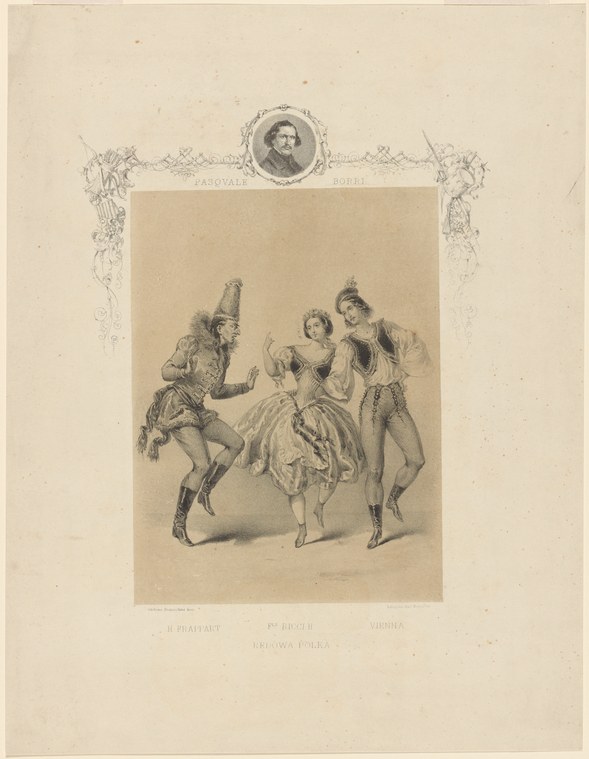
This engraving is valuable evidence of how the redowa was perceived and represented in the popular imagination—not as a technical achievement but as a comic and potentially scandalous spectacle. For historians of ballroom dance, it documents contemporary anxieties about women's bodily exposure and the physical risks of turning dances. For art historians, it exemplifies 19th-century satirical print culture and the use of caricature to comment on social fashion.
What you are looking at
A satirical engraving depicts three figures in a moment of theatrical chaos during a redowa polka. At center, a woman in an elaborate white ball gown with dark trim is caught mid-movement, her skirts billowing upward—a moment of exposure and embarrassment. To her left, a grotesquely caricatured male figure in dark formal dress with exaggerated features leans backward in an absurd posture, his body contorted as if he has lost control of the dance. To the right, a second male figure in military dress stands nearby. The setting is spare and undefined, with no background detail to anchor the scene; the focus is entirely on the bodies and their ridiculous positioning. The composition is frenetic: limbs are elongated and positions are impossible or awkward, emphasizing the physical comedy of the moment. The engraving technique uses fine crosshatching and delicate line work to render fabric texture and facial features, creating a brittle, theatrical effect that enhances the mockery.
The dancing
The woman's frame is unstable and exaggerated: her torso is arched, her arms outstretched for balance, and her body appears to be mid-loss-of-control. The male figures flanking her are drawn with grotesque proportions—elongated limbs, caricatured faces—and their postures suggest slapstick rather than skilled partnering. There is no closed ballroom hold here; instead, the figures occupy separate spatial zones, each caught in an individual moment of physical comedy. The artist has understood the redowa as a vehicle for satire rather than a display of competence.
The dance depicted
This is a satirical engraving of the redowa polka, a mid-19th-century ballroom dance that was popular in European and North American ballrooms. The redowa was a waltz-like turning dance in triple time, danced by couples and noted for its rapid, spinning movements. Here, the artist has seized on the physical vulnerability of the dance—the risk of dizziness, loss of balance, and exposure of the body (particularly women's bodies) during fast, turning movements—and magnified it into grotesque farce. The scene lampoons not the dance technique itself but the pretensions and physical awkwardness of ballroom dancers; it belongs to a long tradition of satirical prints mocking fashionable dance and the social aspirations of ballroom culture.
How it was made
This is a fine engraving, likely wood engraving or steel engraving, printed as a separate sheet with a decorative printed border. The technique allowed for sharp detail and tonal control through crosshatching, which the artist uses to suggest fabric, shade, and movement. The presence of a portrait medallion at the head of the border (possibly identifying the artist or a notable figure) and the printed text below the main image suggest this was circulated as a popular print—affordable, reproducible, and intended for a broad ballroom-going audience. The formal frame around the image is a common device in 19th-century satirical prints, lending an ironic dignity to the chaos within.
About this work
This engraving is a satirical snapshot of mid-19th-century ballroom culture, focusing on the redowa polka—a fashionable turning dance that fascinated artists partly because of its physical risk and potential for embarrassing loss of control. The artist has captured the moment of maximum chaos and exposure: the woman's skirts lifted, the male dancers' postures impossible and grotesque. It is a work of social satire disguised as dance documentation, mocking not the dancers' incompetence but the pretensions and physical vulnerabilities inherent in fashionable ballroom life. The print format and broad circulation suggest this was a popular commentary on contemporary social life, one that invited viewers to laugh at the very dances and dancers they might encounter or be themselves.
How to look at it
Attend first to the moment the artist has chosen: the absolute apex of physical chaos, when control is lost and dignity collapses. The elongation of limbs, the impossible angles of the male figures, and the billowing skirts are deliberate exaggerations designed to undermine any sense of graceful mastery. The decorative border and formal framing device ironically contrast the dignity of the presentation with the chaos of the content—this is a satirist's technique, using formal convention to expose foolishness. The caricature of the male faces and bodies, rendered grotesque, also marks this as satire aimed at specific social types rather than a naturalistic observation of dance.
The period
The redowa polka emerged in the 1840s and became a fashionable ballroom dance across Europe and North America in the 1850s and 1860s. It was part of a broader vogue for increasingly rapid, energetic, and physically demanding ballroom dances—the waltz, the polka, and variants like the redowa represented a departure from earlier, more formal court dances. The speed and spinning nature of the redowa made it both exciting and destabilizing; women's voluminous skirts created visual and physical complications. Satirical prints of ballroom culture proliferated during this period, reflecting both the growing popularity of ballroom dancing and anxieties about decorum, physical exposure, and social aspiration. This engraving belongs to that tradition of social commentary through dance representation.
Where it lives
This engraving is part of the New York Public Library's collection of prints depicting dance. The holding suggests it was preserved as documentary evidence of 19th-century ballroom culture and visual representation of dance.
Dance in this work
Questions about this work
What is a redowa polka?
The redowa was a mid-19th-century ballroom dance, a variant of the waltz performed in triple time with rapid turning movements. It was popular in Europe and North America in the 1850s–1860s. It resembled a fast waltz but with a characteristic hop or bounce in the step. It became notorious for its physical demands and the risk of dizziness or loss of balance—qualities that made it both fashionable and the subject of social satire and moral concern.
Why is this image so exaggerated and ridiculous-looking?
This is a satirical print, designed to mock and amuse rather than document. The artist has deliberately exaggerated the physical chaos and bodily exposure of the redowa to comment on the pretensions and physical vulnerabilities of fashionable ballroom society. Satirical prints of dance and ballroom culture were popular entertainment in the 19th century, offering viewers a way to laugh at social pretension and bodily risk.
What is the text at the bottom?
The text below the image likely identifies the subject and/or the artist. The presence of printed text is typical of 19th-century sheet prints, which were sold individually and circulated widely. The text would have helped viewers understand the subject and the artist's intention.
Who danced the redowa?
The redowa was a fashionable ballroom dance performed by men and women of the middle and upper classes in ballrooms across Europe and North America. It was part of the standard ballroom repertoire and required some skill and stamina due to its speed and spinning nature. By the time this print was made, it was well-established in ballroom culture, though its physical demands made it a target for satire and moral concern.
More dance artwork





