49 works in this view — arrow keys or swipe to move between them.
Dance in Art
Grand polka di bravura: pour piano
Unknown artist
- Collection:
- Prints depicting dance
- Source:
- New York Public Library
- Rights:
- Public domain — free to use, share and adapt.
- Recorded as:
- Public Domain
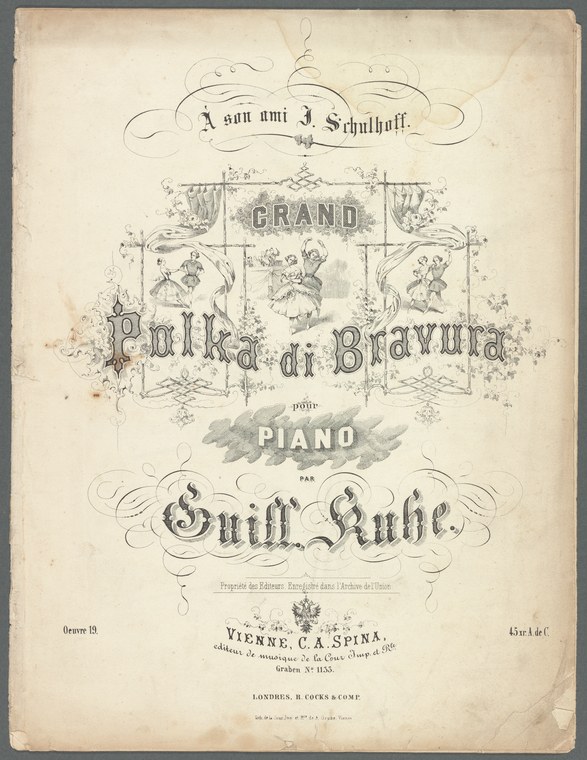
This object documents the polka at the height of its European fashion and shows how dance was transmitted and standardized through commercial music publishing. The small but deliberate vignettes indicate that publishers understood dance imagery as a selling point—the appearance of the dancers on the title page advertised not just the music but the fashionable social practice it served.
What you are looking at
This is the ornamental title page of a published piano score for a Grand Polka di Bravura. The composition is densely decorated with classical engraving flourishes: scrolling banners and rococo swirls frame the central text. Within the decorative cartouche, small vignettes depict figures in motion—on the left and right, dancers in period dress are shown in dynamic poses, apparently mid-performance. The central figures appear to be executing the high-spirited, turning movements characteristic of the polka. The composition is vertically oriented, with the title in large display type at the center and publication details (Vienna: C.A. Spina) at the base. The overall aesthetic is mid-19th-century commercial music printing: ornamental, festive, and designed to appeal to amateur pianists and drawing-room performers.
The dancing
The vignette figures are small and stylized rather than anatomically precise, which is typical of decorative music-cover engravings. The dancers appear to be in pairs or groups, with raised arms and bent knees suggestive of the bouncing, energetic posture of polka technique. One figure on the left seems to be captured mid-leap or hop; the positioning suggests closed-hold couple dancing. The scale and distance of the figures prioritizes ornament over kinetic detail, though the artist has clearly intended to convey the lively, springing quality of the dance.
The dance depicted
This is a polka—a Central European couples dance that achieved enormous popularity across Europe and North America in the mid-19th century. The polka is identifiable both by the title and by the stylized depiction of the bouncing, turning movements in the vignettes. It was danced in the ballroom by amateurs and professionals alike, typically in closed position with rapid, hopping steps and frequent turning. The 'di bravura' in the title indicates this is a showy, virtuosic arrangement intended for skilled pianists, suggesting the music itself was written to impress through technical difficulty rather than for simple social dancing. The Vienna publication house and the stylistic dating place this in the era when the polka was at peak fashion among the middle classes.
How it was made
This is a wood or steel engraving, printed as the cover or title page of a published music score. The fine lines, parallel hatching for shadow, and ornamental detail are characteristic of 19th-century commercial music printing, where decorative title pages were a major selling point. The technique allowed for precise reproduction of intricate designs and made the score affordable for the middle-class home musician. The ornamental surround—the scrollwork, allegorical flourishes, and small vignette figures—was standard practice in music publishing of the 1840s–1860s, signaling sophistication and encouraging purchase.
About this work
This is the title page of a published piano arrangement of a polka, a dance form that dominated European ballroom culture in the mid-19th century. The work belongs to the vast commercial repertory of dance music arranged for amateur pianists—the polka was not primarily a concert form but a social dance, and music like this enabled drawing-room performance and teaching. The engraved vignettes, though small and decorative, document the visual language of polka dancing as it was understood and marketed to the music-buying public: energetic, coupled, turning, and quintessentially modern for its moment. This is a working commercial object, not a fine-art print—its value lies in its glimpse of how dance was understood, standardized, and circulated through music publication.
How to look at it
Attend first to the title and publication details, which anchor the work in a specific commercial context and moment of fashion. Then look at the small vignette figures: the artist has conveyed the polka's characteristic hopping, turning energy even in miniature, and their costume—women in full skirts, men in period dress—confirms the social ballroom setting. The ornamental surround was not incidental; it was part of the appeal and the promise of the music: sophistication, fashion, and social aspiration. The title page is a marketing object as much as a functional one.
The artist
The artist is not recorded. The work was published by C.A. Spina, a Vienna-based music publisher active in the mid-19th century. The engraving style and decorative conventions are consistent with commercial music-printing workshops of that era, where such ornamental title pages were produced in volume by anonymous craftspeople. The composer 'Emile Rahe' is credited on the page.
The period
The polka emerged in Bohemia in the 1830s and became a continent-wide craze by the 1840s and 1850s. It was danced in Vienna, Paris, London, and across the Atlantic with fervent enthusiasm—contemporaries noted it as marking a shift toward faster, more athletic, less formal ballroom dancing. Musically, polkas were published in enormous quantities as piano arrangements for home use, as orchestral scores for balls, and as concert pieces for virtuoso performers. By mid-century, every music publisher offered polka arrangements. The Vienna publication house placed this squarely in the center of the dance's commercial and social life. Artistically, the ornamental engraving style reflects the aesthetic values of the 1840s–1860s: dense, decorative, and populist.
Where it lives
The work is held in the New York Public Library's collection of prints depicting dance. It is a published music score cover, a type of object that circulated commercially in thousands of copies across Europe and America during the mid-19th century.
Dance in this work
Questions about this work
What is a polka?
A polka is a Central European couples dance in duple meter, characterized by a hopping, bouncing step and rapid turns. It emerged in Bohemia in the 1830s and became wildly fashionable across Europe and America from the 1840s onward. It was danced socially in ballrooms and at public dance halls, and was also performed as a concert piece and arranged for every instrumental combination.
Why did publishers print dances on music covers?
Dance imagery on music covers served as advertising: it signaled to buyers what the music was for and invited them to imagine themselves or their families dancing to it. The ornamental vignettes conveyed fashion, aspiration, and novelty. This was commercial art, designed to sell sheet music to amateur home musicians.
Who was Emile Rahe?
The catalogue record does not provide biographical information on the composer. 'Emile Rahe' appears on the title page as the composer of this polka arrangement, but no dates or further details are recorded.
More dance artwork





