49 works in this view — arrow keys or swipe to move between them.
Dance in Art
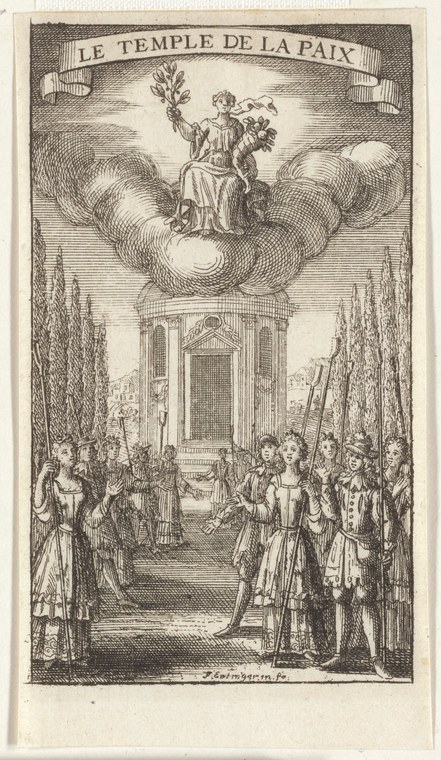
Le temple de la paix
Unknown artist
- Collection:
- Prints depicting dance
- Source:
- New York Public Library
- Rights:
- Public domain — free to use, share and adapt.
- Recorded as:
- Public Domain
This print is valuable evidence of the theatrical and ceremonial contexts in which court dances took place. Understanding dance history requires knowing not only how bodies moved but where they moved and what social and political occasions framed that movement. The formal procession and hierarchical composition reveal how spectacle was organized to communicate power and order.
What you are looking at
A classical allegorical scene shows the figure of Peace—a robed female personification holding an olive branch—enthroned on clouds above a modest neoclassical temple. The temple stands in an open landscape flanked by tall cypress trees, its simple columned façade and triangular pediment rendered in formal perspective. Below, a formal procession of figures in period dress approaches or stands in attendance: men in long coats and breeches, women in full-length gowns, all moving with deliberate ceremony toward or around the temple. The composition employs the convention of an elevated allegorical figure blessing or sanctioning earthly proceedings below. The engraving's fine parallel hatching creates volume and atmosphere, with the clouds rendered in dense cross-hatching to elevate Peace above the terrestrial scene.
The dancing
The figures below are arranged in formal lines with measured spacing, suggesting ceremonial procession rather than free movement. They stand upright with arms at their sides or with restrained gestures. The women's full skirts and the men's formal coats indicate stiff fabrics that restrict the body, common to late-17th-century court dress. The poses are hieratic and orderly—no flexed joints, no weight shift, no lifted bodies. This is the posture of formal ceremony and witnessed ritual rather than active dance.
The dance depicted
This image does not depict dance as movement. It shows a ceremonial or diplomatic procession—likely a formal embassy, state occasion, or allegorical pageant—presented under the blessing of Peace. The title and iconography suggest a late-17th-century context when such Temple of Peace imagery was common in court spectacle and diplomatic ceremony. The figures may participate in dances at such an occasion, but this specific moment captures presentation and witness, not choreography. The work belongs to the visual culture of ceremony and spectacle rather than dance documentation.
How it was made
This is a copper-plate engraving, identifiable from the fine parallel lines (hatching and cross-hatching) that build tone and shadow, the precise linear architecture, and the formal compositional structure typical of reproductive engraving. The signature lower left—though illegible in reproduction—indicates a professional workshop print. Engraving of this period was a primary medium for circulating allegorical and ceremonial imagery among courts and educated audiences across Europe; the technique's precision and durability made it ideal for political and courtly messages that needed to travel and persuade.
About this work
This engraving depicts a formal ceremonial scene set beneath an allegorical vision of Peace. Rather than a dance itself, it documents the kind of court spectacle and diplomatic occasion at which dances would have been performed—a moment of formal presentation and witness rather than active choreography. The work sits at the intersection of allegory, court ceremony, and political imagery characteristic of late-17th-century European court culture, when elaborate spectacles combining music, dance, and dramatic procession served to reinforce political authority and celebrate peace.
How to look at it
Attend first to the composition's division into two registers—the heavenly and the terrestrial—and what that spatial arrangement communicates about the relation between allegory and ceremony. Then observe the precision of the architectural rendering and the ordered rows of figures, which convey formality and control rather than spontaneity. The work asks you to understand ceremony as a performed and witnessed event, and to see how engravings like this one taught European courts what dignity and order should look like.
The artist
The artist is not recorded in the catalogue. The style and technique are consistent with late-17th-century Parisian or Northern European engraving workshops. The formal allegorical composition and high finish suggest a professional atelier producing prints for court circulation and diplomatic gift-giving.
The period
This engraving dates to the era when court spectacle—ballet de cour, grand carousel, diplomatic ceremony—reached its height as an instrument of absolutist statecraft. Peace iconography was particularly prevalent in the 1680s–1690s as European courts celebrated the Peace of Westphalia and other settlements. The Temple of Peace was a common allegorical device in prints, medals, and festival designs. At the same moment, the formalization of ballet technique was occurring under Louis XIV, and court dances were becoming more codified and distant from popular forms.
Where it lives
This engraving is held in the New York Public Library's collection of prints depicting dance. Its specific acquisition history and shelf mark are not provided in the catalogue record. It exists as one example among many European engravings documenting courtly ceremony and spectacle.
Questions about this work
Is this a dance scene?
Not directly. This is a formal ceremonial procession or diplomatic occasion depicted beneath an allegorical vision of Peace. While such occasions would have included dances, this specific moment captures the procession and witness rather than active choreography.
What is the Temple of Peace?
A common allegorical device in late-17th-century European court imagery, representing peace as a blessing on political and diplomatic events. Prints like this one circulated among courts to celebrate treaties, truces, or ceremonial occasions.
What does this tell us about court dance?
It shows the formal, hierarchical context in which court dances took place. The rigid dress, orderly arrangement, and ceremonial atmosphere indicate that dance was embedded in elaborate spectacles designed to communicate power and order, not isolated as an entertainment.
Why is it an engraving rather than a painting?
Engravings were the primary medium for circulating images of court ceremony and political allegory across Europe. The technique's precision and durability made it ideal for prints that needed to travel, be reprinted, and convey an official message.
More dance artwork





