49 works in this view — arrow keys or swipe to move between them.
Dance in Art
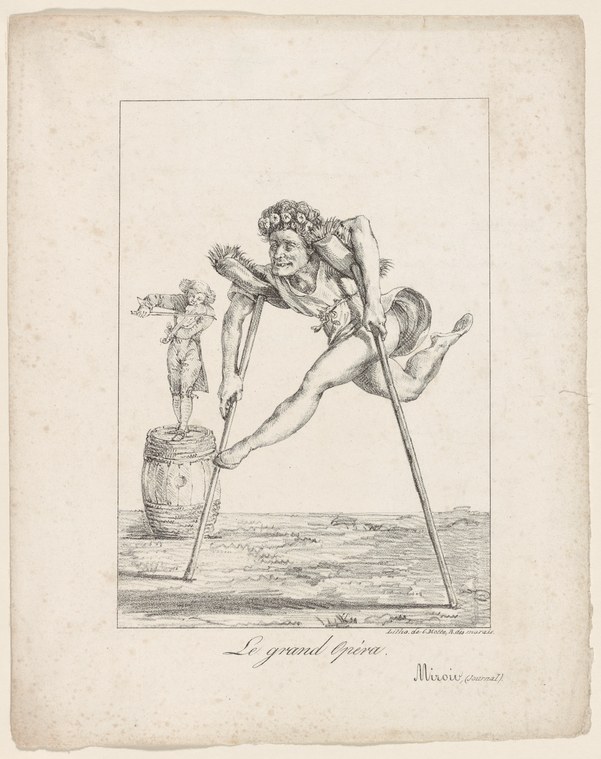
Le grand Opéra
Unknown artist
- Collection:
- Prints depicting dance
- Source:
- New York Public Library
- Rights:
- Public domain — free to use, share and adapt.
- Recorded as:
- Public Domain
This image captures the moment when European opera embraced acrobatic spectacle as a rival attraction to danced narrative, revealing how the boundaries between dance, gymnastics, and theater were fluid and permeable in this period. The engraving's precision and circulation suggest this was not a marginal curiosity but a documented public sensation worthy of satirical documentation for a literate audience.
What you are looking at
A female figure in classical dress dominates the composition, posed impossibly on one leg atop a wooden barrel, her other leg extended high in the air while she balances with one hand. Her body curves in an exaggerated arc, executing what appears to be an acrobatic rather than balletic movement. She wears a draped classical costume with a decorative headdress and is rendered in black ink with careful cross-hatching for shadow and volume. Below her, a tiny male figure in similar classical dress stands on the barrel, his arm raised toward her in a gesture of presentation or support. The setting is a flat, textured ground rendered in parallel lines suggesting depth and recession. The composition is framed within a rectangular border, and French text identifying the work appears at the bottom.
The dancing
The principal figure achieves an extreme hyperextension with the supporting leg locked straight and the raised leg nearly vertical, the torso arched backward in a deep cambré. The free arm extends behind her head. Her weight appears to rest entirely on the single supporting leg with no visible plié, creating an impression of rigid, balletic verticality pushed to acrobatic extremes. The smaller male figure below functions as a supporting player or presenter rather than a dance partner. The two figures are stacked vertically on the same prop, creating a theatrical tableau rather than a partnered interaction.
The dance depicted
This is not conventional theatrical dance but a spectacular acrobatic or circus act presented in the theatrical context of "grand opera." The image likely documents the kind of interpolated specialty acts—acrobatic interludes, pageantry, and technical display—that became fashionable interpolations in European operatic productions during the late 18th and early 19th centuries. The barrel and the gymnastic posturing suggest a street entertainer or circus performer rather than a trained balletic dancer, though the classical costume aligns the act with theatrical aspirations. The French title and satirical precision of the engraving suggest this may be a documented or caricatured spectacle rather than a pure fantasy.
How it was made
This is an engraving, likely etched with a burin, rendered in fine black lines and careful hatching to model form and create spatial recession. The technique required multiple passes and great precision; the cross-hatching and parallel lines build tone and volume through labor-intensive line work. The finished print would have been pulled from an inked copper plate, allowing for multiple impressions and circulation among an educated audience. Engravings were the dominant reproductive medium for satirical and documentary imagery during this period and implied a print-literate, likely middle-class audience familiar with theater and contemporary spectacle.
About this work
This engraving documents a spectacular moment from operatic theater—likely an acrobatic interpolation within a grand opera production. The artist has captured an impossible vertical balance, a female acrobat hyperextended atop a barrel while a small male attendant below gestures upward in support. The work belongs to a tradition of theatrical documentation and satire, using precise engraving technique to render both anatomical extremity and the material apparatus of theatrical spectacle. It records not canonical dance but the hybrid, spectacular entertainments that occupied opera stages and fascinated contemporary audiences, blurring the boundaries between classical theater, acrobatics, and street performance.
How to look at it
Attend to the artist's choice of the moment of maximum extension—the acrobat frozen at the peak of her balance, body arched backward in an impossible curve. This extremity is the spectacle itself, not a transitional movement. Notice how the tiny male figure below is dwarfed, making him a literal stage apparatus supporting the star attraction above. The wooden barrel is rendered with careful texture and shadow, grounding the fantasy in material reality. The classical costume and headdress invoke operatic convention, yet the body's gymnastic extremity belongs to a different register of entertainment entirely.
The artist
The artist is not recorded, but the style and technique place this within the tradition of late 18th-century theatrical satire and documentary engraving. The precision of line and knowledge of anatomical extremity suggest a trained engraver familiar with both classical anatomy and contemporary theater. The work may be from a series of theatrical prints documenting spectacular acts.
The period
In the late 18th and early 19th centuries, European grand opera underwent transformation as a machine for spectacle. Composers and impresarios increasingly interpolated non-narrative spectacular acts—acrobatics, pantomime, pageantry—into operatic plots, competing for novelty and sensation. This reflects broader currents in entertainment: the rise of circus, the codification of acrobatics as a skilled profession, and the migration of street entertainers into theatrical venues. Simultaneously, engraving was the dominant medium for satirizing and documenting these spectacles for urban, print-literate audiences. The image belongs to a culture of theatrical criticism expressed through visual satire.
Where it lives
This engraving is held in the Prints depicting dance collection at the New York Public Library, indicating its reception as a dance-related document despite its acrobatic content. The collection reflects a capacious historical understanding of theatrical movement.
Questions about this work
Is this actually a dance?
Not in the balletic sense. This is an acrobatic act performed within the theatrical context of grand opera. It represents the hybrid entertainments—part gymnastics, part theater, part spectacle—that occupied operatic stages. The engraving documents a real spectacle rather than an imagined one.
What is the figure standing on?
A wooden barrel, rendered with cross-hatching to show its cylindrical form and wood grain. The barrel is part of the spectacle itself, the material apparatus that enables the impossible balance above.
Why is there a tiny figure below?
The smaller male figure functions as a stage assistant or director of the spectacle, gesturing upward in presentation. The size difference emphasizes the acrobat as the primary attraction and may be intentionally comic.
What is the French text?
The title reads "le grand Opéra" (the grand opera), identifying the work as a document of operatic spectacle. The artist's name or a publication date may appear in text not legible in this image.
More dance artwork





