49 works in this view — arrow keys or swipe to move between them.
Dance in Art
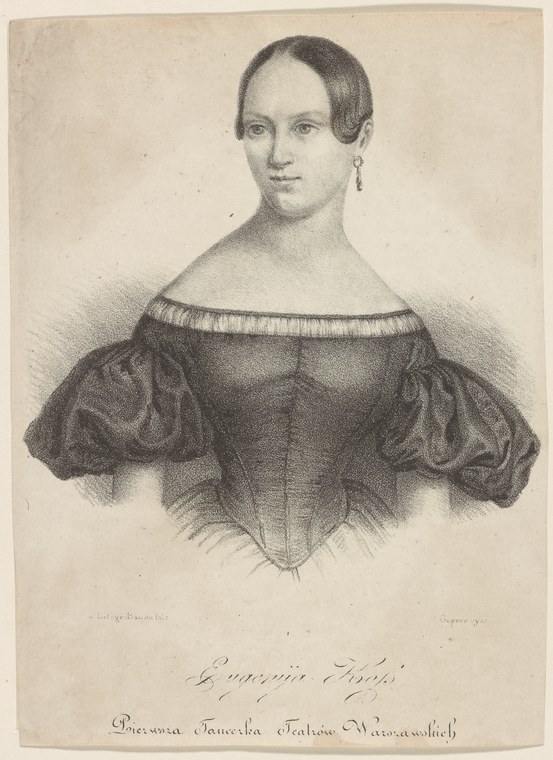
Eugenija Koss: pierwsza tancerka Teatrow Warszawskieh
Unknown artist
- Collection:
- Prints depicting dance
- Source:
- New York Public Library
- Rights:
- Public domain — free to use, share and adapt.
- Recorded as:
- Public Domain
Eugenija Koss represents a documented female performer in Warsaw's theatrical world at a period when women dancers' careers were often recorded only in ephemeral print. The engraving is material evidence of a working dancer's professional standing and visibility to contemporary audiences. For historians of eastern European dance and print culture, this portrait is a primary record of who danced where, and how the theatrical profession was imagined and promoted.
What you are looking at
A bust-length portrait of a woman presented as a formal engraved print. She is shown from the shoulders up, gazing slightly to the viewer's right with a serene expression. Her dark hair is parted in the centre and drawn back smoothly from her face in the fashion of the early 19th century. She wears an off-shoulder dress with a wide, elasticated neckline that sits low on her shoulders, and voluminous puffy sleeves that taper at the forearm—a silhouette characteristic of the Romantic era, circa 1820–1840. The dress fabric appears to be fine muslin or similar material, rendered with delicate cross-hatching to suggest texture and drape. The background is plain and unmodulated, focusing all attention on the sitter's face and upper body. The inscription below identifies her in Cyrillic script as a principal dancer of the Warsaw theatres.
The dancing
The figure is stationary and formally posed, not captured mid-movement. Her shoulders are relaxed and square to the picture plane; her head is turned only slightly, creating an approachable three-quarter view. There is no visible indication of the dancer's frame, hold, or any characteristic positions of stage dance—this is a commemorative portrait rather than a dance action study. The gentle tilt of her head and soft gaze suggest grace and cultivation rather than theatrical animation.
The dance depicted
The inscription alone identifies this as a portrait of Eugenija Koss (or Eugenia Koss), identified as the principal dancer (primera tancerka) of the Warsaw theatres. The image itself contains no depiction of dancing—no stage setting, no other dancers, no body position or costume element that would reveal the specific dance styles she performed. Without additional historical documentation, we cannot determine whether she danced in the Romantic ballet idiom dominant in western European theatres at this period, or whether Warsaw's stages maintained different traditions. The portrait honours her status but does not show her in the act of dancing.
How it was made
This is an engraving, recognizable from the fine parallel lines (hatching and cross-hatching) used to model form and create tonal gradation across the face, neck, and drapery. The technique allows for precise detail in the features and a delicate rendering of muslin texture; the print would have been widely circulated and affordable, making it a standard format for commemorating stage artists of the period. The inscription in Cyrillic indicates production for a Warsaw or Russian-speaking audience, suggesting this was a commercial portrait print distributed to theatre patrons or collectors of theatrical ephemera.
About this work
This engraved portrait commemorates Eugenija Koss, a principal dancer of the Warsaw theatres in the early 19th century. It is a formal headshot in the convention of theatrical portraiture—a genre that celebrated performers through published prints rather than through depictions of their art. The elegant dress, Romantic-era silhouette, and dignified pose place the sitter within the social and aesthetic world of early 19th-century European theatre, where dancers of rank were celebrated as cultivated public figures. The work documents the existence and status of a woman dancer whose name and position survive primarily through such prints.
How to look at it
Attend to the dress: the off-shoulder cut and puffed sleeves are the visual signature of Romantic-era fashion and stage costume, dating the portrait precisely. The engraver's choice to render the muslin in fine detail suggests the material richness of theatrical dress was a selling point. The serene facial expression and three-quarter pose follow the convention of celebrity portraiture—dignified, accessible, and emphasising the performer's cultivation and beauty rather than the physical demands of stage work.
The artist
The artist is not recorded. The inscription is in Cyrillic, and the print style—formal, competent engraving with elegant lettering—is consistent with early 19th-century European theatrical portraiture. The work was likely produced in Warsaw or a major Russian city and distributed as a commercial print to theatre-goers, part of the standard apparatus by which stage celebrities were commodified and circulated.
The period
The 1820s–1840s saw the rise of theatrical portraiture as a distinct commercial genre in Europe. Dancers, actors, and singers were now celebrated through published prints sold to patrons; this democratised access to images of performers and created a new form of celebrity. In Warsaw, which had a sophisticated theatrical culture under Russian imperial rule, such prints would have been made for both local audiences and for distribution to Russian cities. The Romantic era revalued female dancers as central to ballet, though their professional lives and training remain poorly documented outside such images and playbills.
Where it lives
The work is held in the New York Public Library's Prints collection, catalogued under 'Prints depicting dance.' It is a commercial theatrical portrait print, one of hundreds produced across Europe in this period; the NYPL's collection preserves examples from many theatres and cities.
Questions about this work
Was Eugenija Koss a famous dancer?
She held the rank of principal dancer (primera tancerka) at the Warsaw theatres, a significant position. However, no other documentation of her career survives in readily accessible sources, making her a figure known to us largely through this portrait print and theatrical records. The fact that a commercial engraving was published in her honour indicates she had professional status and patron support.
What dance did she perform?
The portrait does not reveal this. The engraving shows her in fashionable street or formal dress, not stage costume or a dance position. Dancers in Warsaw at this period would have performed a mix of ballet, pantomime, and probably some local or folk-derived forms, but we cannot determine from the image alone what she specialised in.
Why is the inscription in Cyrillic if she danced in Warsaw?
Warsaw was part of the Russian Empire during this period (1815–1918), and Cyrillic was the official script. The use of Cyrillic for a Warsaw theatre portrait reflects the political and cultural dominance of the Russian state and suggests the print was also distributed to Russian audiences.
How was this portrait used?
Theatrical portrait prints like this were sold to patrons, collected, and sometimes distributed as gifts or advertisements. They served as memorabilia, evidence of a performer's celebrity, and marketing—much as photographic lobby cards and fan portraits would function later. The formal engraved style signals this was a prestige object, not a cheap ephemera.
More dance artwork





