49 works in this view — arrow keys or swipe to move between them.
Dance in Art
Masquerades and fancy-dress balls in prints
Unknown artist
- Collection:
- Prints depicting dance
- Source:
- New York Public Library
- Rights:
- Public domain — free to use, share and adapt.
- Recorded as:
- Public Domain
This image reveals that 'dance' in the Gilded Age extended beyond the ballroom into the social rituals of street, park, and carriage. Understanding the fashion, etiquette, and public performance visible here illuminates what dancers were trained to do and why their bodies, dress, and comportment mattered. The print documents a moment when dance and fashion were inseparable from broader structures of gender, class, and social aspiration.
What you are looking at
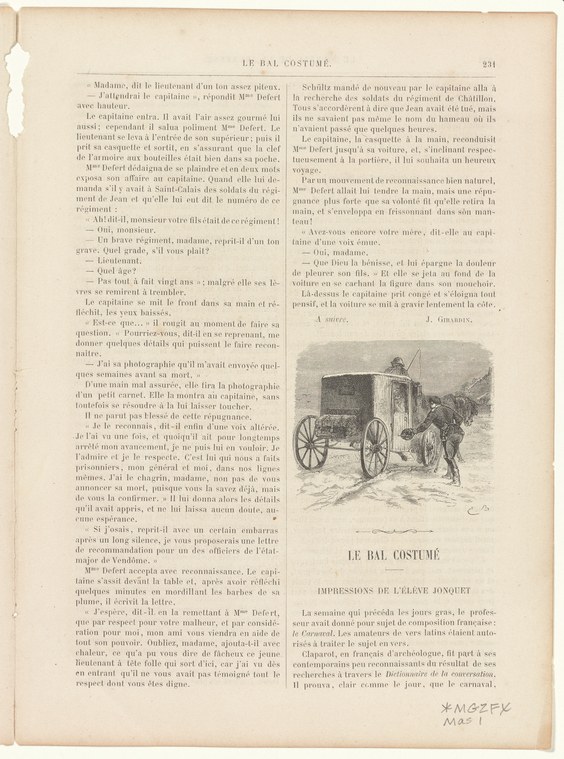
This is a French print illustrating a fashionable carriage scene, likely from the late 19th century based on the dress and vehicle style. A well-dressed couple occupies an open carriage drawn by a single horse. The woman wears an elaborate gown with a fitted bodice and full skirt typical of the period, topped with a decorative hat; the man beside her is dressed in formal day wear including a top hat. The carriage itself is rendered in precise technical detail—a light, elegant vehicle with spoked wheels and ornamental metalwork. The setting appears to be an urban boulevard or promenade, with the carriage positioned as if in motion or pause during a fashionable outing. The composition emphasizes the spectacle of social display: the couple's visibility and the quality of their equipage are clearly the point of the image.
The dancing
The two figures sit upright in formal posture, the woman angled slightly toward her companion in a pose of leisured companionship. Their bodies are still and composed rather than in motion; this is not a moment of active dancing but of social ritual and display. The woman's arms rest in her lap, and both figures maintain the rigid deportment expected of their class and occasion. The relative stillness and formality of their positioning emphasizes that this is a social tableau—a performance of respectability and fashion rather than kinetic movement.
The dance depicted
This print does not depict dance in the conventional sense. However, it does illustrate the social rituals and courtship conventions of the Gilded Age, which were themselves governed by strict choreographic rules of movement, positioning, and display. The carriage promenade was a formal social dance of a different kind—a public performance of status, taste, and availability for courtship. The woman's elaborate dress, the man's formal attendance, and the visible equipage are all part of an elaborate social choreography in which bodies, spaces, and objects move according to strict convention.
How it was made
This is a wood engraving or steel engraving, a medium that allowed for fine linear detail and mechanical reproduction. The technique permitted circulation in newspapers and illustrated journals aimed at a middle and upper-class audience interested in fashion, social etiquette, and contemporary life. The precision of the engraving—the careful rendering of the carriage's mechanical detail, the woman's costume, and the urban setting—suggests this served as both documentation of fashionable dress and a guide to acceptable social conduct. The print's fineness and finish indicate it was made for a relatively affluent readership.
About this work
This is a French print from the Gilded Age documenting the social rituals and courtship conventions of the urban bourgeoisie. It appears in a collection labeled 'Le Bal Costume' (The Costume Ball) and is accompanied by text discussing masquerades and fancy dress. Though not a scene of dancing itself, it illustrates the broader culture of social display and formal ritual that surrounded dance and courtship in the period. The carriage promenade was itself a choreographed social performance, governed by rules of dress, movement, and positioning as strict as those of any ballroom dance.
The print belongs in a dance history collection because it documents the social world in which dance occurred and the conventions that structured interaction between men and women of the period. The elaborate costume, the formal carriage, and the public visibility of the couple all reflect the conventions that shaped both ballroom dancing and the courtship rituals it facilitated.
How to look at it
Attend to the careful positioning of the figures: the woman's elegant posture and elaborate dress are framed as objects of display. Note the precision with which the carriage is rendered—its mechanical detail matters as much as the figures within it, because the quality of the equipage was as much a statement as the quality of dress. Observe how the couple's public visibility on a fashionable street or boulevard is the point of the image: this is not a private moment but a performance of status and availability. The stillness of the figures, despite the mobility implied by the carriage, captures the paradox of Gilded Age social life: constant motion (in carriages, between social venues) serving the purposes of ritual and display.
The artist
The print is unsigned and the artist is unknown. It appears in a French illustrated periodical or collection devoted to contemporary social life and fashion. The quality and precision of the engraving suggest a professional printmaker working within the commercial illustration tradition of the late 19th-century French press, where such images of fashionable life were produced for circulation among the educated bourgeoisie.
The period
This print dates to the Gilded Age, a period of rapid urbanization, industrial wealth, and intense interest in codifying and displaying social status through fashion and public ritual. The late 19th century saw the rise of the illustrated press and the democratization of fashion imagery. Simultaneously, dance itself was undergoing transformation: classical ballet was being challenged by newer forms, and social dancing remained a crucial arena for courtship and the performance of respectability. The print reflects the period's obsession with costume, display, and the rules governing interaction between men and women in public space.
Where it lives
The print comes from the New York Public Library's collection of prints depicting dance, held as part of a broader collection of social and theatrical imagery. It is part of a French publication or journal devoted to contemporary social scenes and costume, suggesting it circulated among an educated, fashion-conscious audience in France.
Questions about this work
Is this actually a dance image?
Not in the literal sense—no one is actively dancing. But it documents the social world in which dance occurred and the elaborate codes of dress and conduct that governed courtship and social interaction. The carriage promenade was itself a ritualized performance, governed by conventions as strict as any dance step. Understanding this image helps explain why dancers and dancing mattered in Gilded Age society.
What is the woman's costume?
The woman wears a fitted bodice with a full skirt gathered at the waist, typical of the 1880s–1890s silhouette. Over this she wears a coat or jacket, and on her head a decorated hat with plumage—all the markers of upper-class fashion. The elaborate and expensive costume is itself the point: it signals her status and her availability as a marriage prospect.
Why is a carriage scene in a dance collection?
Because the print appears in a collection of masquerades and fancy-dress balls, it documents the broader social rituals of courtship and display that surrounded formal dancing. The image shows the world dancers moved through and the standards of dress and conduct they had to maintain. It is part of the documentary record of how dance functioned in Gilded Age society.
More dance artwork





