49 works in this view — arrow keys or swipe to move between them.
Dance in Art
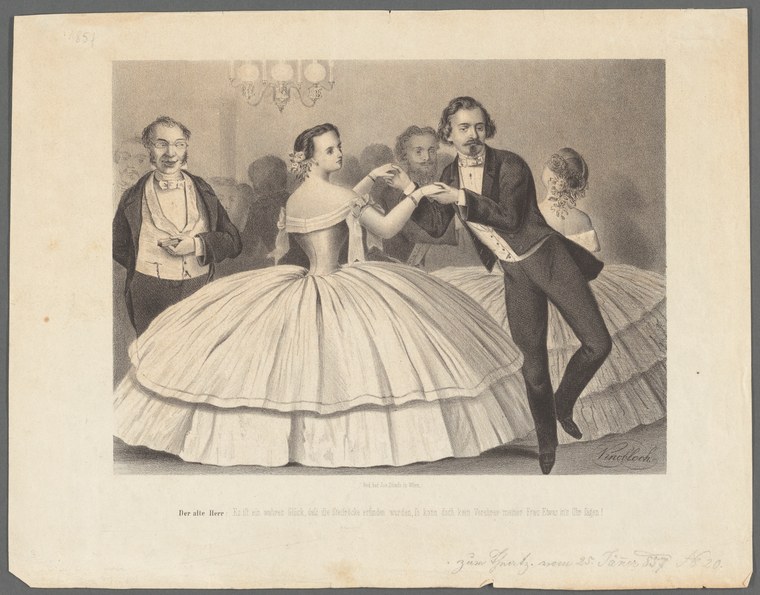
Der alte Herr: Es ist ein wahres Glück, dass die Steifröcke erfunden wurden, so kann doch kein Verehrer meiner Frau Etwas in's Ohr sagen
Unknown artist
- Collection:
- Prints depicting dance
- Source:
- New York Public Library
- Rights:
- Public domain — free to use, share and adapt.
- Recorded as:
- Public Domain
This work reveals that nineteenth-century ballroom culture was constantly in tension with the fashion that defined it. For dancers and historians, it documents the literal physical constraints placed on movement and partnership by crinolines, and it shows that contemporaries were acutely aware of the absurdity. The print also belongs to a rich visual tradition of using dance and the ballroom as settings for social and gender satire.
What you are looking at
A young woman in an elaborate ball gown dominates the center of this satirical engraving. Her dress is constructed with multiple layers of stiffened petticoats that extend dramatically outward, creating an enormous skirt that nearly fills the composition. The fabric is rendered with fine parallel lines suggesting the volume and structure of crinoline. Five men in dark formal coats surround her: one stands to the left observing, two flank her closely on either side with their arms raised toward her shoulders and arms as if managing or presenting her, and two more stand in the background. The setting is a simple interior with a plain wall and what appears to be a chandelier sketched above. The lighting is even and studio-like. The entire scene has the quality of a formal dance lesson or ballroom instruction, with the woman's rigid posture and the men's attentive positioning suggesting she is the subject of their attention—literally and metaphorically the 'problem' being discussed.
The dancing
The woman stands with minimal bend at the knees, her body held rigidly upright within the architectural frame of her skirt. Her arms are positioned at her sides or slightly forward. The men surrounding her adopt varied poses: those nearest reach toward her with arms extended, their postures suggesting they are either restraining the skirt or demonstrating a point about her costume rather than her dancing body. No closed hold or partner connection is evident; instead, the framing suggests admiration, frustration, or instruction directed at the garment itself rather than at the woman's technique or movement potential.
The dance depicted
This is a satirical print about the social absurdity of mid-nineteenth-century ballroom dress, not a straightforward depiction of dance technique. The title in German translates to something like 'The Old Gentleman: It is truly fortunate that stiffened skirts were invented, so that no admirer of my wife can whisper anything in her ear.' The joke concerns the physical barrier created by the crinoline—it prevents close contact in the manner that social dancing of the period required. The scene captures a moment of ballroom culture, likely representing a waltz or quadrille context, but the satire targets the costume rather than the dance itself. The work belongs to the tradition of fashion satire and social commentary that flourished in European prints of the 1840s–1860s.
How it was made
This is an engraving or lithograph (likely lithograph given the tonal qualities and soft lines), rendered in greyscale with fine crosshatching and parallel lines to create volume, shadow, and texture. The technique allowed for rapid reproduction and distribution to a popular audience, and the style is consistent with satirical prints published in German and Austrian newspapers and journals of the mid-nineteenth century. The artist's hand is visible in the careful articulation of fabric folds and the expressive positioning of the figures, suggesting this was a skilled practitioner working in the tradition of social satire.
About this work
This is a German satirical engraving from the mid-nineteenth century depicting the social comedy of ballroom dress at the height of the crinoline era. A woman in an enormous structured skirt is surrounded by five men, with the composition and title making clear that the real subject is the physical barrier created by fashion rather than the woman's dancing ability or the men's skill as partners. The work sits at the intersection of dance culture, fashion history, and social commentary, capturing a moment when the spectacle of dress threatened to overwhelm the mechanics of ballroom partnership itself.
The print is one of many European satirical works of this period that used dance and ballroom settings to critique fashion excess and changing gender relations. It belongs in a dance gallery not because it depicts virtuosity or technique, but because it documents how costume shaped and limited the social practices of ballroom dancing, and because it reveals contemporary anxieties about courtship, physical proximity, and women's bodies in public performance.
How to look at it
Attend first to the enormous skirt: notice how it is rendered with precision, how it dominates the space, and how it physically separates the woman from the men around her. Then observe the men's gestures—they are not dancing with her, but rather gesturing toward the problem of the dress itself. The title, visible at the bottom of the print, makes the satire explicit: read it in conjunction with the visual composition to understand that the artist is not celebrating ballroom culture but mocking the fashion constraints that made it increasingly difficult. The frozen moment is not a step or a turn, but an absurd social tableau.
The artist
The artist is unrecorded in the catalogue, but the style, subject, and technique are consistent with the Vienna and Berlin satirical print trade of the 1850s. The work's sophistication and circulation suggest it was produced by a skilled commercial artist working for a satirical journal or publisher, possibly the Austrian publication 'Fliegende Blätter' or a similar venue. The German text and context point to Central European origin.
The period
This engraving dates from the height of the crinoline era in Europe, roughly 1850–1870, when enormous structured skirts made of horsehair, steel, or whalebone became the dominant silhouette for women's formal dress. Ballroom dancing remained a central social practice for courtship and entertainment among the middle and upper classes, but the physical choreography of dances like the waltz—which required close partnership and arm contact—was in direct conflict with a silhouette that extended three feet in diameter. Satirical prints became a popular medium for commenting on this contradiction, and the tension between fashion and movement became a stock subject. In the broader art world, lithography and commercial printmaking were experiencing a golden age, making social satire more accessible than ever before.
Where it lives
This work belongs to the New York Public Library's collection of prints depicting dance, a holding that spans several centuries and includes both celebrated masterworks and ephemeral commercial prints like this one. The object is a mass-produced satirical print, likely disseminated through journals, broadsheets, or print publishers' catalogues, and it represents the kind of visual culture that shaped popular understanding of dance and fashion in the nineteenth century.
Dance in this work
Questions about this work
What is the joke in this print?
The title explains it: the enormous crinoline skirt is so wide that it physically prevents men from whispering in a woman's ear—a form of flirtation expected in ballroom contexts. The print satirizes the absurdity of a fashion that made the social and physical choreography of ballroom dancing difficult or impossible. The men surrounding the woman are not dancing with her; they are gesturing in frustration or amazement at the garment.
What dance would have been performed in a scene like this?
Likely a waltz or a quadrille, the dominant ballroom dances of the 1850s–1860s. Both required close partnership, arm contact, and physical proximity—all made awkward or impossible by the crinoline. The satire works precisely because the viewer would have recognized the ballroom setting and understood how the fashion violated the physical requirements of the dance.
Is this a real dance or a satirical fantasy?
It is satirical social commentary, not a depiction of an actual dance technique or style. However, it documents a real historical problem: the genuine conflict between ballroom choreography and mid-nineteenth-century women's fashion. The scene is plausible and the anxiety it expresses was widespread and documented in period sources.
Why would this be in a collection of dance imagery?
Because it documents the lived experience of ballroom dancing in a specific historical moment, when costume was as much a part of dance culture as movement itself. It also shows how visual culture—satirical prints—participated in the social discourse around dance, fashion, and gender. For historians, it is evidence of how contemporaries understood the relationship between their bodies, their clothes, and their social practices.
More dance artwork





