49 works in this view — arrow keys or swipe to move between them.
Dance in Art
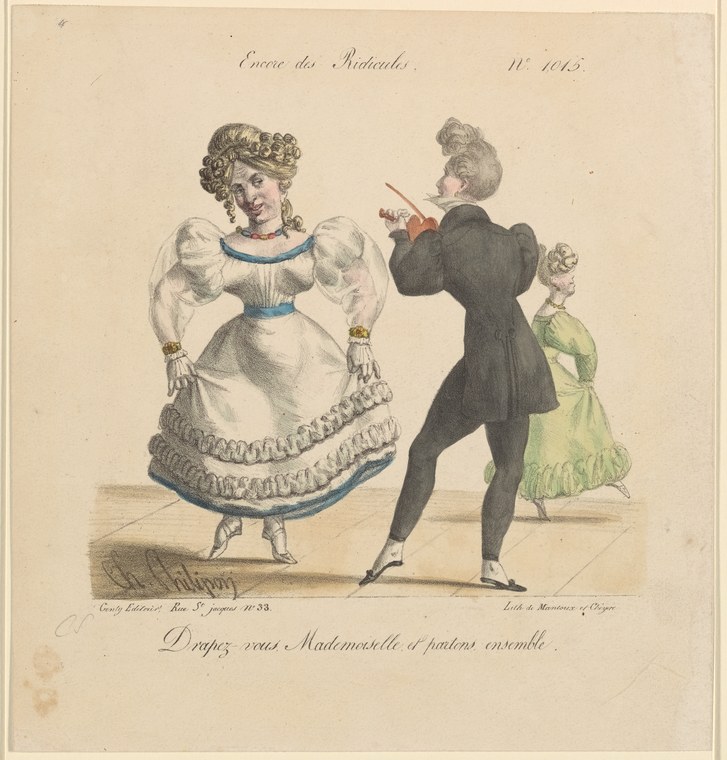
Drapez-vous, mademoiselle, et partons ensemble
Unknown artist
- Collection:
- Prints depicting dance
- Source:
- New York Public Library
- Rights:
- Public domain — free to use, share and adapt.
- Recorded as:
- Public Domain
This work illustrates how dance historians must expand beyond technique to understand movement as social performance and commentary. The print captures the language of body display, courtship ritual, and theatrical affectation that surrounded actual dance in the early 19th century and shaped how bodies were understood and portrayed.
What you are looking at
A hand-colored engraving depicting three figures in a moment of theatrical social interaction. On the left stands a woman in an elaborate white Empire-waist gown with pronounced puffed sleeves and deep blue ribbon trim, her hair arranged in an upswept style adorned with what appears to be feathers or ornamental plumes. She faces the viewer with a gentle smile. In the center, a man in black coat and tight breeches gestures toward her with one hand while holding a paintbrush or pointer in the other, his body angled in a pose of exaggerated courtesy or instruction. To the right stands a young girl or adolescent in a pale green dress, watching the interaction. The background is plain and pale, focusing attention entirely on the three figures. The French caption beneath reads "Drapez-vous, mademoiselle, et partons ensemble" (Drape yourself, miss, and let us leave together), suggesting a scene of social comedy or flirtation.
The dancing
The woman's posture is upright and composed, her weight centered, arms hanging naturally at her sides with gloved hands visible. The man's frame is exaggerated and theatrical: one arm raised in a sweeping gesture of invitation or instruction, his body weight shifted onto one leg in an affected stance. The girl's position is secondary and observational. No closed holds or partnered dance positions are evident; instead, the figures are arranged in a comedic tableau of social manners and address.
The dance depicted
This does not depict an actual dance in progress but rather a scene of theatrical social behavior—likely a satire or comic print about fashion, courtship, or the affectations of fashionable society. The title's imperative "Drape yourself, miss" and the man's exaggerated gestural pose suggest mockery of theatrical artificiality or the pretension of social display. If dance is present, it is not technical dance but rather the performative gesture and posture of social theater.
How it was made
Hand-colored engraving, identified by the fine linear hatching visible in the black clothing and the careful modulation of tone achieved through line rather than wash. The delicate detail of the woman's dress and the precision of facial features are characteristic of 19th-century reproductive engraving. Hand coloring—visible in the blue ribbons, pink cheeks, green dress, and flesh tones—indicates this was a print produced for middle-class consumption, likely published in a series or periodical. The technique allowed rapid production and wide distribution of satirical social commentary.
About this work
This is a satirical social-comedy engraving from the early 19th century, likely French, depicting a moment of exaggerated social courtesy or theatrical pretense. The image belongs in a dance history collection not because it shows technical dance, but because it reveals how movement, gesture, and bodily display functioned as social performance in the period—the theatrical posturing and affected poses of fashionable society. The print documents the vocabulary of social gesture and the relationship between dance, fashion, and courtship humor in Regency-era visual culture. It represents a tradition of satirical prints that used caricature and exaggerated posture to comment on social behavior.
How to look at it
Attend to the artificiality of the man's pose: the raised arm, the affected lean, the theatrical attention to his own display. This is not how bodies naturally move; it is how bodies move when they are self-conscious, performing, or exaggerating social convention. The woman's composed stillness contrasts with his theatricality, inviting the viewer to read this as satire of male social posturing. The title's imperative adds a verbal punchline to the visual joke: the man is not inviting a dance but offering commentary on fashion and social ritual.
The artist
The artist is not recorded in the catalogue. The print is attributed in script at the bottom to "Carly Lithocraft, Rue S. [Jacques?] N° 53" (or similar; the inscription is partially legible) and credit is given to "Lith. à Mannheim & Osper," suggesting publication by a German lithography house or print firm, though the style and subject are French. The work belongs to a tradition of Regency-era satirical prints on fashion and social manners.
The period
This print dates to approximately 1815–1830, the height of the Regency and early Romantic period in Europe. Fashion in this era was characterized by high-waisted Empire silhouettes for women and severe tailoring for men—both visible here. Social dancing, particularly the quadrille and cotillion, was central to courtship and elite sociability, and prints satirizing the exaggerated manners and gestures of fashionable society were popular commodities. The tradition of mocking social pretension through caricature was well established in French and German popular print culture.
Where it lives
The work is held in the New York Public Library's prints collection documenting dance. It is catalogued as part of a series or collection labeled "Prints depicting dance," though the record contains minimal information. The print's publication details suggest a European origin, likely French or German, from the early 19th century.
Questions about this work
Is this actually a dance?
Not in the technical sense. The image shows theatrical social gesture and posture—the exaggerated courtesy and body display of fashionable society—rather than an actual dance step or movement phrase. However, it documents the embodied performance of social identity that surrounded dance in this period.
What is the date of this print?
The catalogue record does not provide a date, and the print itself is undated. Based on the clothing style (high-waisted Empire gowns for women, tight breeches and coat for men), the hand-coloring technique, and the satirical style, it likely dates to 1815–1835. A more precise date would require additional research or archival information.
What does the title mean?
"Drapez-vous, mademoiselle, et partons ensemble" translates as "Drape yourself, miss, and let us leave together." The phrase suggests both an invitation and a comment on fashion and bodily display—the man is directing the woman to arrange her dress (to 'drape' it properly) before departure. This is typical of Regency-era social comedy, where dress, posture, and manners are subjects of ridicule.
More dance artwork





