49 works in this view — arrow keys or swipe to move between them.
Dance in Art
Folk and ethnic dancing in wood engravings
Unknown artist
- Collection:
- Prints depicting dance
- Source:
- New York Public Library
- Rights:
- Public domain — free to use, share and adapt.
- Recorded as:
- Public Domain
This work is not relevant to the study of dance history or imagery and should not be in a dance collection.
What you are looking at
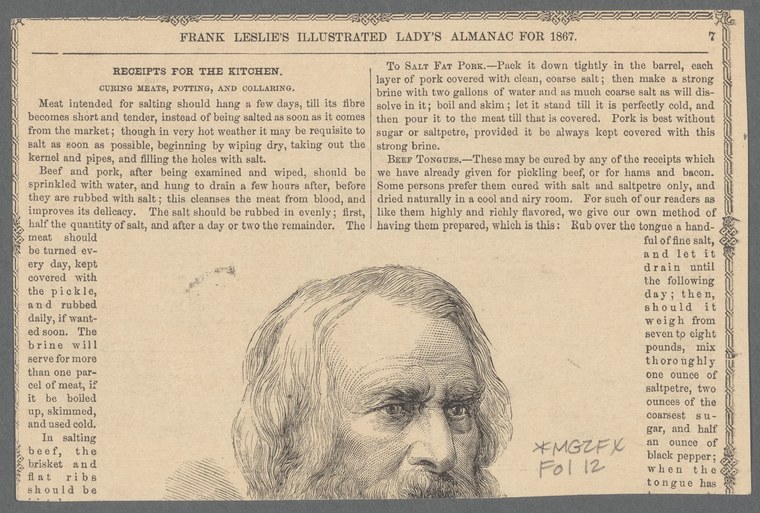
This is a wood engraving from Frank Leslie's Illustrated Lady's Almanac for 1867, occupying the upper right portion of a page on kitchen receipts. The engraving shows a bearded man in three-quarter profile facing left, rendered in fine crosshatching typical of mid-nineteenth-century wood-cut technique. The man appears middle-aged or elderly, with long flowing beard and hair, and is depicted against a plain background. The image is embedded within a dense text block discussing the curing and salting of meats—pork, beef, and collaring—with detailed instructions on preserving food. The engraving is not a dance scene but rather a portrait or generic illustration accompanying household advice. The placement suggests it may be decorative or serve as a generic figure representing a butcher, cook, or tradesman, though nothing in the image itself indicates a profession.
The dancing
A single male figure is shown in profile. No dancing posture, hold, or movement is evident. The figure is static and frontal in presentation, with no weight shift, arm position, or footwork that would suggest any form of dance. The body is rendered in repose.
The dance depicted
This image contains no depiction of dance. It is a portrait or generic illustration of a bearded man accompanying a recipe page, with no relationship to folk, ethnic, or any other form of dance.
How it was made
This is a wood engraving, a relief printing technique in which an image is carved into the end-grain surface of a wooden block. The fine parallel lines and crosshatching visible throughout are characteristic of wood engraving rather than woodcut; the technique allows for greater detail and finer gradations of tone. Such engravings were the standard method for book and periodical illustration in the nineteenth century, allowing for multiple printings and wide circulation in affordable, mass-market publications like the Lady's Almanac.
About this work
This wood engraving from Frank Leslie's Illustrated Lady's Almanac for 1867 is a portrait illustration accompanying a page of kitchen receipts on meat curing and preservation. It is not a dance image. The work exemplifies the mass-market illustrated periodicals and household almanacs that proliferated in Victorian America, combining practical domestic advice with engravings that served both decorative and documentary functions. The catalogue record's description as 'Folk and ethnic dancing in wood engravings' appears to be an error or misclassification.
How to look at it
The viewer should note the fine technique of the wood engraving itself—the delicate crosshatching and tonal gradations that allow for naturalistic rendering of the man's facial features and beard. The image is static and portraiture in function, requiring no interpretation of movement or gesture.
The artist
The engraver is not recorded. The work was published by Frank Leslie's publishing house, which produced illustrated periodicals and almanacs of wide circulation in the United States during the nineteenth century.
The period
This engraving was published in 1867, during the height of the American illustrated press. Frank Leslie's publications were known for combining practical household information with extensive wood-engraved illustrations, reaching middle-class American domestic audiences. The style and content reflect Victorian domestic culture and the professionalization of food preservation.
Where it lives
This is a page from Frank Leslie's Illustrated Lady's Almanac for 1867, held in the New York Public Library's collection of printed materials. It represents the ephemeral, mass-produced illustrated almanac market of the nineteenth century.
Questions about this work
Is this actually a dance image?
No. This is a portrait illustration accompanying kitchen receipts. The catalogue record appears to be mislabeled or misfiled. There is no depiction of dance in any form—neither folk, ethnic, social, nor theatrical.
Who is the man shown?
Unknown. The engraver is not recorded, and the man appears to be a generic illustration rather than a portrait of an identified individual. He may represent a cook, butcher, or simply be a decorative element accompanying the recipe text.
Why is this in a dance collection?
It should not be. This appears to be a cataloguing error. The work belongs in a collection of nineteenth-century kitchen and domestic advice, illustrated periodicals, or food history.
More dance artwork





