49 works in this view — arrow keys or swipe to move between them.
Dance in Art
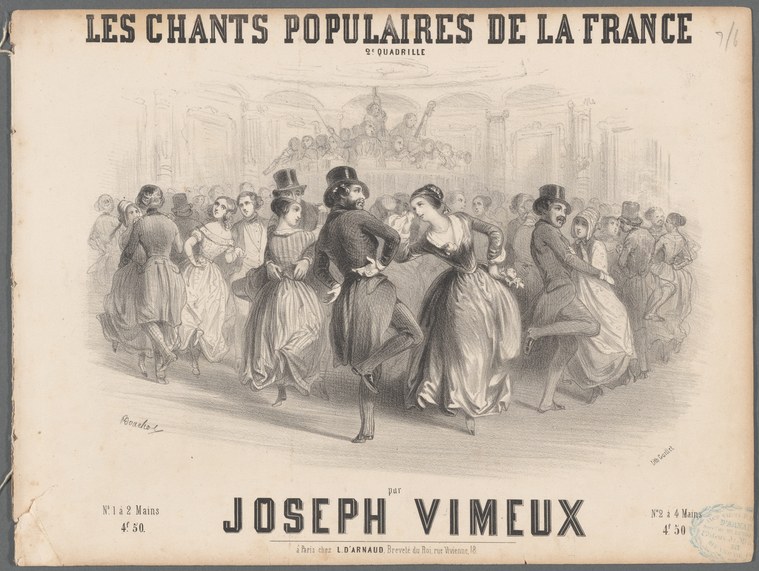
Les chants populaires de la France: 2e quadrille
Unknown artist
- Collection:
- Prints depicting dance
- Source:
- New York Public Library
- Rights:
- Public domain — free to use, share and adapt.
- Recorded as:
- Public Domain
The quadrille was not a spectacle danced for others; it was a social ritual danced by and for the middle class. This print is evidence of that self-representation—how the era chose to visualize itself dancing. For historians of ballroom practice, it documents the hold, spacing, and compositional logic of the quadrille; for social historians, it reveals the gender segregation, dress codes, and mixed-class sociability of the urban salon.
What you are looking at
A crowded interior ballroom or concert hall fills with elegantly dressed figures in the formal attire of the mid-nineteenth century. Women in full skirts of white or pale fabric dominate the foreground, arranged in a loose formation; men in dark coats and top hats stand among them. The composition centers on a group of four or five couples in the middle distance, their bodies angled toward one another in the characteristic closed holds and paired formations of the quadrille. In the background, the crowd deepens into shadowed ranks of onlookers and additional dancers, all contained within an interior space marked by classical architectural features—columns visible at left and right. The engraver has used fine cross-hatching and parallel lines to create volume and atmosphere, with the brightest areas falling on the foreground dancers' skirts and the architectural details, while the background recedes into softer shadow. The overall effect is one of fashionable social spectacle: a large, mixed gathering of the urban middle and upper classes at leisure.
The dancing
The couples visible in the center hold the closed ballroom frame characteristic of nineteenth-century quadrille: women with their right hands in the men's left hands, bodies at a formal distance, the women's left arms resting on or near the men's right arms. The postures are upright and composed rather than energetic; the bodies do not strain or twist, but remain in the disciplined frame expected of respectable dancers. The women's full skirts, which would have been belled by crinolines, dominate visually and suggest the period and social register; men's silhouettes are narrower and more uniform. The crowd behind them suggests multiple simultaneous couples in varied stages of the figure—some appear to turn, others hold still, creating the sense of a coordinated ensemble movement rather than individual expression.
The dance depicted
This is a quadrille, specifically the second quadrille in a suite called *Les chants populaires de la France* (The Popular Songs of France). The quadrille was the most fashionable ballroom dance of the nineteenth century: a figure dance for four couples arranged in a square, performed to classical music with distinct figures—the changes in formation and stepping sequences were named and codified. Unlike the waltz or polka, the quadrille was a social performance piece that required coordination and memory, was taught by dancing masters, and carried significant social prestige. The print documents not the rural *chants populaires* of its title but their ballroom domestication—folk melodies arranged and formalized for urban, bourgeois consumption through the language of elite dance.
How it was made
This is a lithographic print, identifiable by its fine linear texture, tonal gradations created through stone texture and crayon work, and the characteristic soft grain throughout. The artist has signed it at lower left; the publisher's imprint appears at bottom (*L'Artiste, L. Garnaul, Breveté du roi rue de Sein n° 13*). Lithography allowed rapid circulation of images at affordable cost, making this a mass-market commodity—a print to be issued in music publishers' catalogues or as a standalone souvenir of fashionable life. The technique's subtlety captures the textures of fabric and architectural space convincingly while maintaining an illustrative clarity essential to its social function: documenting a recognizable moment of public consumption.
About this work
This lithographic print documents the quadrille—the dominant ballroom dance form of mid-nineteenth-century Europe—as performed in an urban salon to arrangements of French folk songs. It is one of a numbered suite, issued by a Paris music publisher as a commercial product aimed at the same bourgeois audience that danced these figures. The image is valuable not because it records an innovative or transgressive moment, but precisely because it captures the ordinariness of quadrille culture at its height: the formality, the crowd, the gender roles, the space, the dress codes that made this social practice possible. It shows us how the quadrille looked to people who lived in it—not as a museum exhibit, but as the normal performance of taste and status.
How to look at it
Attend to the formation: the four couples arranged roughly in a square (the ground plan of the quadrille) are frozen mid-figure rather than at a climactic moment. The engraver has chosen a moment of transition—some couples turning, others stationary—which conveys the sequential, orderly nature of the dance better than a single pose would. Notice the hierarchy of visual weight: the foreground women's skirts are rendered in brilliant white with dense hatching to show volume, while the background figures fade into shadow. This mimics the actual social space of the ballroom, where position and prominence were matters of social significance. The orderliness and uniformity of the dancers' posture is itself the point—this is discipline made beautiful, not virtuosity or abandon.
The artist
The artist's name is not recorded in the catalogue. The work is attributed to the broader illustrative and lithographic trade of mid-nineteenth-century Paris, specifically the music-publishing and entertainment-print sector. A signature appears on the stone but is not legible in reproduction. The publisher L. Garnaul held a royal privilege (*Breveté du Roi*), indicating an established, licensed operation.
The period
The quadrille reached its peak of fashionability in the 1840s–1860s, the era this print almost certainly documents. It had been imported from France to England and across Europe in the 1810s and 1820s, but by mid-century it was the universal ballroom form of the respectable classes. Meanwhile, the Romantic movement in music and literature had sparked intense interest in folk culture and national song traditions—*Les chants populaires de la France* reflects that taste, turning peasant melodies into ballroom commodities. The combination is characteristic: modernity and nostalgia, urban consumption and rural authenticity, all mediated through the disciplined, collective body of the quadrille.
Where it lives
The print is held by the New York Public Library in their collection of prints depicting dance. It was issued as a commercial music-publishing product by Garnaul's Parisian house, part of a numbered series, and would have been sold as sheet music accompaniment or as a standalone keepsake of fashionable entertainment.
Dance in this work
Questions about this work
What is a quadrille?
A quadrille is a ballroom dance for four couples arranged in a square, popular throughout the nineteenth century. It consists of five named figures (Pantalon, L'Été, Poule, Trénis, Finale), each with prescribed stepping and turning sequences, performed to classical music. It was the most respectable and widely taught ballroom dance of the era, and required a dancing master's instruction.
Why are the songs called 'popular' if this is a formal ballroom dance?
The melodies used for this quadrille were drawn from French folk tradition and rural song, but were arranged and formalized by composers and music publishers for urban ballroom use. This represents nineteenth-century bourgeois taste: the appropriation of folk culture as a source of authenticity and national character, while processing it through elite social forms.
How can you tell this is a lithograph?
The fine linear texture visible throughout, the soft tonal gradations created by stone texture, and the characteristic grain of crayon work on stone all identify this as a lithograph rather than an engraving or etching. Lithography allowed for faster, cheaper production and wider circulation, making it ideal for commercial music publishing.
What does the formal dress tell us?
The women's full skirts (supported by crinolines), the men's dark coats and top hats, and the upright, composed postures all signal middle-to-upper-class respectability. Quadrille was a dance of codes and decorum; the costume was inseparable from the social meaning of participation. This was not entertainment for common people, but performance of belonging to the respectable classes.
More dance artwork





