49 works in this view — arrow keys or swipe to move between them.
Dance in Art
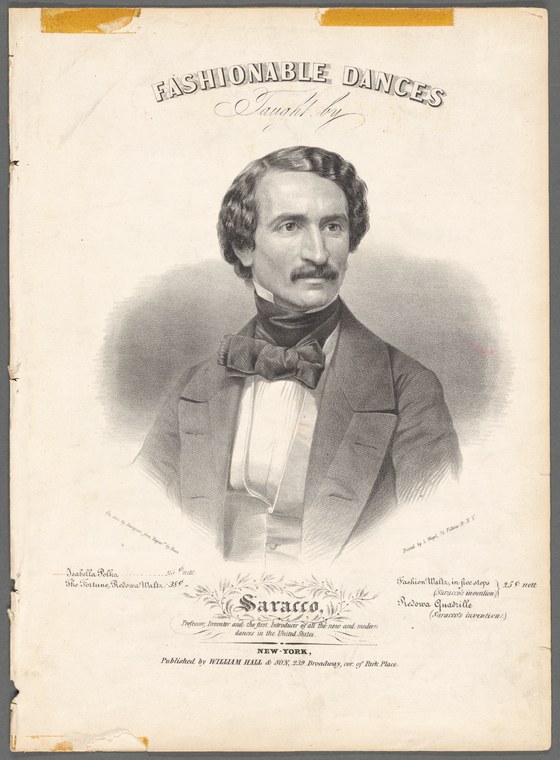
Fashionable dances taught by [Pietro] Saracco
Unknown artist
- Collection:
- Prints depicting dance
- Source:
- New York Public Library
- Rights:
- Public domain — free to use, share and adapt.
- Recorded as:
- Public Domain
This print is evidence of how dance instruction was marketed and professionalized in 19th-century America, and of the social respectability that ballroom dance and its teachers had achieved by that period. It shows the intersection of dance, commerce, and visual culture in a period when printed images of dance masters were a common form of professional promotion.
What you are looking at
A bust-length portrait of a man in formal 19th-century evening dress, facing three-quarter right. He wears a dark coat with a white shirt front and a dark silk bow tie, his hair dark and parted. The print sits within an ornamental border at the bottom that reads "Saracco" in serif capitals, with smaller text identifying him as a dance instructor and the dances he taught. The heading at top reads "FASHIONABLE DANCES Taught by" in an arc of serif capitals. Publication information names William Hall & Co., New York, at the foot. The whole is rendered in fine lithographic tones with careful shading in the face and clothing, typical of mid-19th-century American music and instruction publishing.
The dancing
A single figure shown from the chest up, at rest and facing the viewer slightly to the right. The pose is formal and dignified—the standard presentation format for a dance master's portrait, with no active movement or dance hold visible. The figure presents the authority and respectability expected of a professional dance instructor of the period.
The dance depicted
This is a portrait of Pietro Saracco, an established dance master of the 19th century, not a depiction of dance itself. The inscribed text identifies him as a teacher of fashionable dances but does not specify which forms he taught. Based on the period and context, he likely taught social ballroom forms current in genteel American society—quadrilles, waltzes, and polkas—but the portrait alone does not confirm the specific styles. The image belongs to a genre of trade prints promoting dance instructors and their services to paying students.
How it was made
This is a lithographic print, identifiable by its characteristic fine gradations of tone, the uniform surface, and the style of lettering. The technique allowed mass production of promotional materials for music and dance instruction, making it affordable for circulation to a middle-class audience seeking instruction. The careful rendering of the face and the professional presentation indicate this was a quality commercial product made to establish Saracco's credibility and presence in the New York market.
About this work
A promotional lithographic portrait of the dance master Pietro Saracco, published by William Hall & Co. in New York during the 19th century. The print served as an advertisement for Saracco's teaching services and would have circulated among potential students seeking instruction in fashionable ballroom dances. It is a document of the dance-teaching profession and of the aesthetic conventions by which dance masters presented themselves to the public—as refined, respectable, and authoritative figures worthy of patronage.
How to look at it
Observe the formal presentation and the careful attention to Saracco's clothing and bearing: he is presented as a gentleman and an authority figure rather than as a dancer in motion. Notice the text hierarchy, with his name and profession given equal emphasis to his face. The choice to show him at rest, fully clothed in street dress rather than in the clothing of a performer, signals that this is the merchant face of dance instruction—the respectable businessman rather than the artist. The frame and format belong to the genre of commercial trade cards and advertising prints that made up much of 19th-century visual culture.
The artist
The artist is not recorded in the catalogue. The print was published by William Hall & Co., a prominent New York music and dance instruction publisher of the 19th century. The quality and professionalism of the lithography indicate it was made by an experienced commercial practitioner working within Hall's publishing operation.
The period
In the mid-to-late 19th century, social ballroom dancing was central to respectable middle-class leisure and courtship in America. Dance masters like Saracco were established professionals who offered paid instruction in quadrilles, waltzes, polkas, and other fashionable forms. Publishing houses like Hall & Co. capitalized on this demand by producing instructional materials, sheet music, and promotional imagery. The portrait format adopted here—the dignified bust of a professional—drew on conventions established in earlier centuries for presenting authority figures and adapted them to promote commercial services.
Where it lives
The print is held by the New York Public Library. It belongs to their collection of prints depicting dance, a body of work that documents both dance practices and the visual culture surrounding them.
Dance in this work
Questions about this work
Who was Pietro Saracco?
Pietro Saracco was a 19th-century dance master based in New York. This print is the primary image evidence we have of him and his professional practice. He taught fashionable ballroom dances to paying students, which was a respected profession among the middle class during this period. Beyond what this portrait tells us, details of his biography are not readily available.
What dances did Saracco teach?
The print refers to 'fashionable dances' but does not specify them by name. Based on the period, he likely taught quadrilles, waltzes, polkas, and other social ballroom forms that were standard in genteel American society in the 19th century. Specific details of his curriculum are not documented here.
Why is this print valuable as a historical document?
It shows how dance instruction was marketed and professionalized in 19th-century America, and how dance masters presented themselves to potential clients. The formal, dignified presentation of Saracco reflects the respectability and social status that ballroom dance had achieved. Such prints were mass-produced and widely distributed, making them evidence of both dance practice and commercial visual culture.
More dance artwork





