49 works in this view — arrow keys or swipe to move between them.
Dance in Art
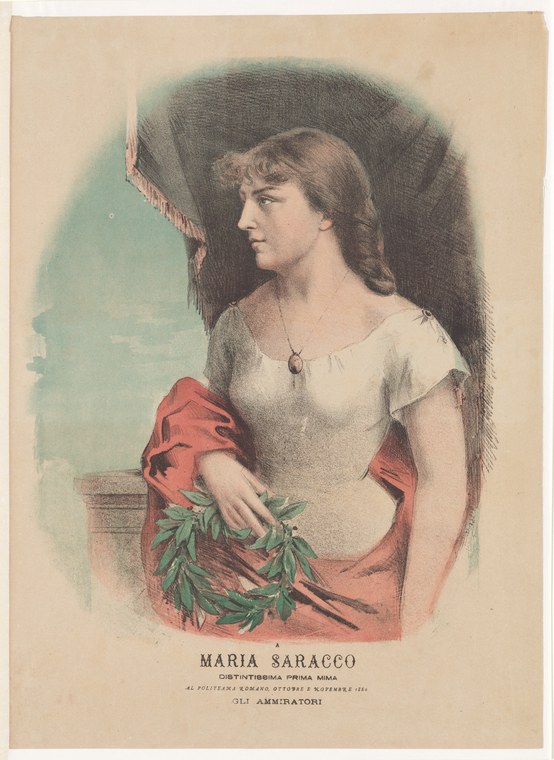
A Maria Saracco, distintissima prima mima al Politeama Romano, ottobre e novembre 1880
Unknown artist
- Collection:
- Prints depicting dance
- Source:
- New York Public Library
- Rights:
- Public domain — free to use, share and adapt.
- Recorded as:
- Public Domain
The image documents a now-obscure but once-central figure in European theater—the *prima mima*—and shows how theatrical performers were commemorated and circulated to audiences in the pre-photographic and early photographic era. For historians of 19th-century dance, mime, and Italian theater, it is evidence of what types of performer commanded prestige and what iconography was used to represent them to the public.
What you are looking at
A three-quarter-length portrait of a young woman positioned in profile, gazing stage-left. She wears a pale, off-shoulder classical or semi-classical dress with short sleeves, and holds a laurel wreath in her right hand at her hip. Behind her, a dark drapery forms a soft halo around her head and shoulders, creating atmospheric depth. The background suggests an interior stage or studio setting with muted blue-grey tones. Her hair is loosely arranged in waves typical of late 19th-century portraiture. The composition is intimate and posed rather than action-based, framing her as a named performer at a specific moment in her career.
The dancing
A single figure, standing in a relaxed contrapposto stance with her weight favoring one leg. Her shoulders are level and calm; there is no dramatic gesture or elevated carriage typical of classical dance performance. The held laurel wreath is the only prop or symbol of achievement. Her gaze is thoughtful and directed away from the viewer, suggesting introspection or the contemplative mien of a celebrated artist rather than the focused energy of active performance.
The dance depicted
This is a portrait of Maria Saracco, a *prima mima* (principal mime actress) performing at the Politeama Romano in Rome in October–November 1880. The image does not depict her dancing but rather commemorates her in a dignified pose associated with theatrical success—the laurel wreath and classical dress signaling her status as a celebrated performer of pantomime and dramatic dance. Pantomime and *mimmi* (mime acting) were central to late 19th-century Italian theatrical dance, often hybrid forms mixing spoken drama, gesture, and stylized movement. This is an honor portrait of a star, not a scene from her actual performance.
How it was made
This is a hand-colored lithograph or chromolithograph, a process that allowed mass production of colored theatrical portraits for circulation to fans and in collections. The soft modeling of the figure, the subtle blending of background tones, and the delicate hand-coloring of the dress and wreath are consistent with mid-to-late 19th-century theatrical portraiture practice. Such prints were affordable souvenirs and promotional materials, distributed widely in European cities and collected by theater enthusiasts and dance aficionados.
About this work
This is a commemorative theatrical portrait of Maria Saracco, a celebrated mime actress and dancer at one of Rome's leading theaters in 1880. Rather than capturing her in action, the print honors her professional status through classical iconography—the laurel wreath, the Greco-Roman inspired dress, the contemplative pose—devices used across 19th-century theatrical culture to elevate performers to the status of artists. It is a document of the end of the pantomime era in Italian theater, when mime and gestural drama were still central to the entertainment of European audiences and when individual stars could command the circulation of their own commissioned portraits.
The work belongs to the Gallery of Dance in Art not because it shows dance technique or movement, but because it records the cultural moment when mime, pantomime, and theatrical gesture dance were serious, celebrated forms practiced by named stars, and because it testifies to the infrastructure of theatrical celebrity—the printing, distribution, and collection of portraits that sustained the popularity of these performers.
How to look at it
This is not an action portrait but an honor portrait. The artist has chosen stillness and dignity rather than movement or gesture—a choice that itself speaks to how Saracco was understood by her audience: as a serious artist worthy of classical representation, not as a spectacular acrobat or dancer in motion. Notice the relationship between the laurel wreath (held, not worn, therefore presented as an achievement rather than an attribute) and her calm bearing. The lack of theatrical exuberance or dynamic pose was itself a statement of artistic status in an era when virtuosity and spectacle were increasingly what drew audiences to theatrical dance.
The period
In the 1870s–1880s, pantomime and mime drama were in transition across Europe. The Romantic ballet had declined; new forms of spectacular theater—operetta, music-hall, and hybrid dance-drama—were rising. Italian theaters, particularly in Rome and Milan, maintained strong traditions of *pantomima*, often performed by trained dancers and actors alongside or instead of ballet. The Politeama Romano, where Saracco performed, was one of Rome's premier venues for such entertainment. At the same time, chromolithography had made theatrical portraiture an accessible and collectible commodity; theaters and performers themselves commissioned prints for sale and circulation, creating a form of theatrical merchandise that sustained and publicized their reputations.
Where it lives
This print is held in the New York Public Library's collection of dance prints. It is one of a genre of theatrical commemorative prints produced and distributed in European cities in the 19th century, typically created by unnamed commercial lithographers and sold as affordable souvenirs and collectibles.
Questions about this work
Was Maria Saracco a ballet dancer?
No. She was a *prima mima*, a principal mime actress. In late 19th-century Italian theater, this was a distinct and prestigious role that combined gestural acting, pantomime, and stylized dramatic movement—often more closely related to dramatic theater than to ballet. Mime performers could be virtuosic and celebrated; Saracco's commissioning of this commemorative portrait shows her standing as a star.
Why is she holding a laurel wreath?
The laurel wreath is a classical symbol of victory and artistic achievement, borrowed from Greco-Roman iconography. It signals her status as a celebrated artist rather than a common entertainer. In 19th-century theatrical portraiture, such classical props and dress were used to elevate performers and connect them to ideals of artistic greatness.
What is the Politeama Romano?
The Politeama Romano was a major theater in Rome, prominent in the late 19th century for spectacle, drama, opera, and theatrical dance. It was one of the leading venues for entertainment in the Italian capital and a place where celebrated performers like Saracco could build substantial reputations.
How was this print made and distributed?
This is a hand-colored lithograph, a process that allowed multiple copies to be produced and hand-finished with color. Such prints were sold as theatrical souvenirs, collected by fans, and used for promotion. They were affordable and widely circulated, making them a key form of theatrical celebrity in the pre-photographic era.
More dance artwork





