49 works in this view — arrow keys or swipe to move between them.
Dance in Art
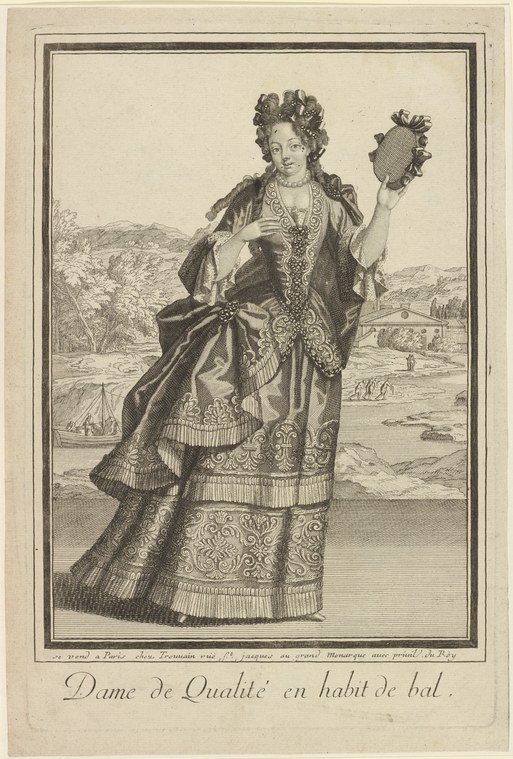
Dame de qualité en habit de bal
Unknown artist
- Collection:
- Prints depicting dance
- Source:
- New York Public Library
- Rights:
- Public domain — free to use, share and adapt.
- Recorded as:
- Public Domain
For a dancer or historian, this image is invaluable evidence of what aristocratic women wore to formal dances and how they were expected to comport themselves. The precision of the engraving allows study of the cut, construction, and ornamentation of the dress in a way that paintings often do not. It also documents the visual language of courtly refinement—the raised fan, the upright posture, the expression—that framed the social dances of the period.
What you are looking at
A single elegantly dressed woman stands in a formal landscape setting, posed as if at a ball or formal gathering. She wears an elaborately patterned dress of the late 17th or early 18th century, with a fitted bodice decorated in ornamental designs and a voluminous skirt with deep pleating at the hem. Over this she wears a long coat or cloak of dark fabric, lined and flowing behind her. Her hair is styled in the curled fashion of the period, and she holds a fan or decorative object aloft in her raised right hand—a gesture of refined display rather than active movement. The background shows a distant landscape with buildings and water, rendered in the delicate lines of period printmaking. The composition presents her in a moment of social presentation, the costume and pose emphasizing status and elegance rather than the physical exertion of dance.
The dancing
The woman's posture is upright and poised, with her weight settled on her feet rather than distributed through active stepping or turning. Her left arm hangs at her side while her right arm is raised to hold the fan at shoulder height—a gesture of courtly deportment rather than a dance movement. There is no apparent weight transfer, no indication of a partner, and no suggestion of the dynamic balance required for social or theatrical dance. The body position reads as static display: the stance of formal presentation.
The dance depicted
This is not a depiction of active dance but rather a fashion plate or costume study of a woman in ball dress (habit de bal). The title explicitly identifies her as a lady of quality (Dame de qualité) in formal dance attire, suggesting the image documents what was worn *to* a ball rather than what occurred during one. The posture and gesture are those of formal courtly presentation—the raised fan and refined stance are marks of social rank and decorum. If any dance is referenced, it is the social context in which such a woman would participate, but the image itself captures her in stillness and display.
How it was made
This is a line engraving or etching, executed with fine parallel lines and careful attention to the play of light across fabric and flesh. The technique allows precise rendering of textile patterns and the delicate folds of the elaborate dress—the ornamental designs on the bodice and the crisp pleating of the skirt are rendered with the clarity and detail that engraving made possible. The composition and technique suggest this is a print from a series documenting fashionable dress, likely intended for circulation among the aristocracy or merchant classes interested in current styles. Such prints served both as fashion documentation and as aspirational images of rank and refinement.
About this work
This is a fashion print documenting the formal dress worn by women of quality at 17th- or early 18th-century balls. Rather than capturing a moment of dance, it presents a stationary figure in court dress, posed to display the cut and ornament of the garment and the deportment expected of a woman of rank. It belongs in a gallery of dance imagery because it records the material and social context in which formal social dance took place—the clothing, the setting, the codes of presentation—and because such prints were central to how dance culture was documented and disseminated before photography. The woman's stillness and formal pose tell us as much about the aesthetics of the period as any active movement could.
How to look at it
Attend to the extraordinary detail of the dress itself: the pattern on the bodice, the construction of the pleats, the way the cloak drapes and moves. Notice the stillness of the pose—there is no suggestion of stepping, turning, or any weight transfer. The raised fan is the primary gesture, and it is one of presentation rather than movement. The formal landscape background situates this woman in a social and architectural context of refinement. This is a document of how a woman of quality looked and stood at a formal event, not a record of how she danced.
The period
This print dates to the late 17th or early 18th century, an era when engraved fashion plates began to circulate widely as a medium for documenting and promoting aristocratic dress. The formal ball dress shown here reflects the silhouettes and ornamental styles of the Baroque period, with its emphasis on rich fabrics, elaborate embroidery or brocade, and the dramatic play of light and shadow across pleated and gathered materials. Such prints were often published in series and distributed to courts and among the wealthy as both fashion instruction and status markers. The image appears to be part of a French or Franco-influenced tradition of fashion documentation.
Where it lives
The work is held in the NYPL collection of prints depicting dance. It is identified as a French print from the collection, though artist and exact date are not recorded. It represents a category of prints—fashion studies and costume documentation—that occupied an important place in early modern visual culture.
Questions about this work
Is this woman actually dancing?
No. The posture is static and posed for display rather than active movement. The raised fan is a gesture of courtly presentation. The print documents the dress and deportment of a woman at a formal ball, not the act of dancing itself.
What can this tell me about 17th-century ball dress?
The engraving shows in precise detail the cut of the bodice, the pleating and construction of the skirt, the ornamentation (likely embroidery or brocade), and the weight and drape of the outer cloak. It is evidence of how women of rank dressed for formal occasions and how they were expected to present themselves—upright, refined, and adorned.
Why is a fashion print in a gallery of dance imagery?
Dance history includes the material and social context in which dance took place. This print documents the clothing, the settings, and the codes of deportment that framed formal social dances. Fashion prints like this were also a primary way that dance culture and courtly aesthetics were documented and circulated before photography.
What does the fan signify?
The fan was a standard accessory for women of rank in formal settings and a prop for courtly gesture and flirtation. Its elevated position here is part of the woman's formal presentation and refinement, not a movement in a dance.
More dance artwork





