49 works in this view — arrow keys or swipe to move between them.
Dance in Art
Happy am I, from care I'm free: aria sung by Mr. Richings in Auber's admired Le dieu et la bayadere
Unknown artist
- Collection:
- Prints depicting dance
- Source:
- New York Public Library
- Rights:
- Public domain — free to use, share and adapt.
- Recorded as:
- Public Domain
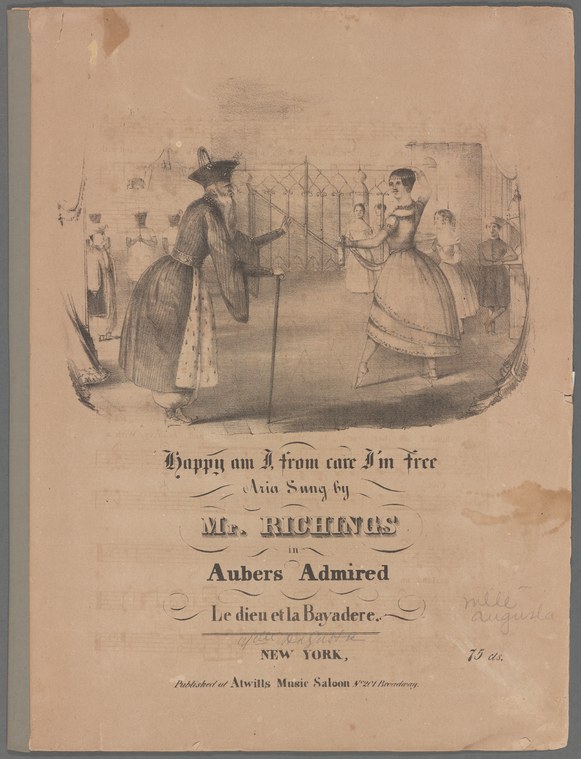
Although the image does not depict actual dance, it documents how bayadere dancing—one of the most potent symbols of exoticized female performance in 19th-century European theater—was consumed and circulated in America. The sheet-music cover reveals the commercial apparatus that made operatic fantasy available to parlor audiences and amateur singers, and the formal, dramatic framing of the female performer suggests how bayadere dance was understood through the codes of European opera rather than through knowledge of actual South Asian dance practice.
What you are looking at
This is a sheet-music cover for a vocal number from a French opéra comique, rendered as an engraving or lithograph on aged paper. The scene depicts an encounter between two figures—a man in a long coat and bicorne hat on the left, and a woman in a full-skirted dress on the right—facing each other across a low fence or railing that runs horizontally through the composition's center. Between them stands a third figure in lighter dress, partially obscured. The background is sketched with minimal detail: a few additional figures in the middle distance and what appear to be architectural elements suggesting a public or theatrical space. The entire scene is rendered in soft grays and blacks with extensive tonal work, typical of early 19th-century theatrical imagery. The composition emphasizes the encounter itself rather than movement; the figures are posed formally, as if caught in a moment of dramatic recognition or greeting.
The dancing
Both main figures stand upright, neither in an obvious dance frame. The man's posture is stiff and formal, his arm raised toward the woman in a gesture of greeting or address rather than in a dance position. The woman faces him with an open, receiving posture, her skirts arranged in full volume around her. A third figure between them, barely articulated, creates a compositional pause. The arrangement suggests dramatic tableau or operatic pantomime rather than the dynamic physicality of social dancing; the bodies are organized for visibility and emotional impact rather than for movement through space.
The dance depicted
This is a vocal number sheet from Auber's opéra comique *Le dieu et la bayadère* (The God and the Bayadere), first performed in Paris in 1830. The aria "Happy am I, from care I'm free" was sung by Mr. Richings, likely a celebrated vocalist of the period. The work blends European theatrical conventions with an orientalist fantasy plot centered on a bayadere—a dancing girl from India—though the image itself depicts a dramatic moment of meeting or encounter rather than dance proper. The scene suggests the narrative and romantic drama of the opera rather than a representation of actual bayadere dance, which would involve different costuming and physical vocabulary.
How it was made
This is a lithographic or engraved print on paper, likely produced in New York by Atwills Music Saloon (as stated on the cover). The technique allows for the soft tonal gradations and detailed costume rendering visible in the work. Such sheet-music covers were mass-produced images—affordable, widely distributed, and designed to sell both the music and the opera itself to domestic consumers and amateur musicians. The presence of the publisher's name and location indicates this was a commercial theatrical product aimed at the American market, reproduced for circulation through music shops and home use.
About this work
This is a theatrical sheet-music cover from circa 1830 for a vocal number from Daniel Auber's popular French opéra comique *Le dieu et la bayadère*. The image depicts a scene of formal encounter between two figures—likely representing the central romantic drama of the opera—rendered as a soft-toned engraving or lithograph. It is both a musical artifact (the vehicle for a famous aria) and a visual document of how European opera and orientalist exoticism were marketed to American audiences in the early 19th century. The work sits at the intersection of theatrical culture, print culture, and music publishing, offering evidence of how opera reached domestic consumers and shaped popular taste.
How to look at it
Attend to the formal, static quality of the pose: neither figure is caught mid-movement or in any recognizable dance frame. The woman's dress is voluminous and ornamental, emphasizing her status as a visual spectacle rather than as an active performer. The composition privileges narrative and emotional recognition—the moment of encounter—over the representation of actual dancing, which suggests that the opera's appeal depended more on romantic drama and orientalist spectacle than on any serious engagement with bayadere dance itself.
The artist
The artist is not recorded. The print was published by Atwills Music Saloon in New York, a commercial music publisher and distributor of theatrical prints. Such covers were often produced by house engravers or commissioned from theatrical illustrators; attribution rarely survives.
The period
Auber's *Le dieu et la bayadère* premiered in Paris in 1830 and was rapidly exported and adapted for American audiences. Orientalism was at its height as an aesthetic and commercial force; the figure of the bayadere—whether understood as a temple dancer or a courtesan—fascinated European and American audiences as a symbol of exotic, sensual, and unrestrained performance. The opera combines French comic-opera conventions with orientalist fantasy, part of the broader 19th-century appetite for non-European dance and music packaged as entertainment. This sheet-music cover represents the tail end of that circulation: the aria reaching the American domestic market as both a vocal vehicle and a visual fantasy.
Where it lives
This sheet-music cover is held in the New York Public Library's collection of prints depicting dance. It is a commercial theatrical artifact—part of the mass-produced visual culture that circulated opera and operatic fantasy to American audiences in the 1830s.
Questions about this work
What is a bayadere, and what does the opera show?
A bayadere was originally a temple dancer in South Asia, but in European imagination it became a symbol of exotic, often sexualized, female performance. Auber's opera is a French fantasy that uses the bayadere as a romantic protagonist; it is not a representation of actual South Asian dance, and this sheet-music cover shows a dramatic moment from the opera's European plot rather than any depiction of bayadere dance itself.
Who was Mr. Richings?
Richings was a celebrated vocalist of the 1830s. He is known to have performed in operatic roles in both London and America. Without further research, his precise biographical details are unclear, but his name on the cover indicates he was famous enough that the publisher used his name as a selling point to American sheet-music buyers.
How does this relate to actual bayadere dance?
It does not. This image documents European opera and theatrical fantasy, not bayadere practice. The formal, static pose and European courtly dress suggest that orientalist opera was consumed as a romantic and visual spectacle rather than as a window onto actual South Asian dance. The sheet-music cover is valuable precisely because it shows how European audiences understood exoticized dance: through the codes of theatrical narrative and female spectacle, not through ethnographic knowledge.
More dance artwork





