49 works in this view — arrow keys or swipe to move between them.
Dance in Art
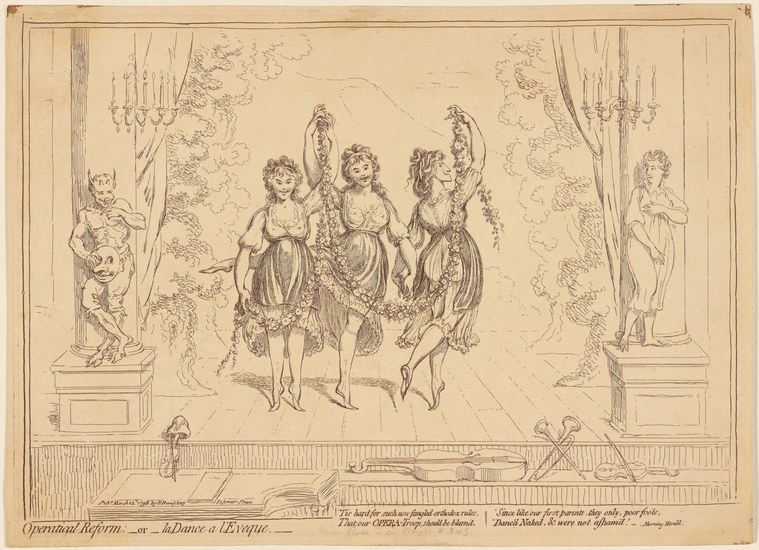
Operatical reform, or La dance à l'évêque
Unknown artist
- Collection:
- Prints depicting dance
- Source:
- New York Public Library
- Rights:
- Public domain — free to use, share and adapt.
- Recorded as:
- Public Domain
This image is evidence of how theatrical dance and narrative spectacle were visualized and distributed to the public in the early 19th century, showing the intersection of neoclassical taste, satire, and commercial entertainment. It demonstrates that dance history includes not only ballroom technique or street movement but also staged tableau, allegorical performance, and the theatrical critique of opera and artifice—forms that left traces primarily through such prints.
What you are looking at
A neoclassical interior scene with three young women at the center, dressed in high-waisted Regency gowns with classical drapery, performing or posing with garlands of flowers or ivy strung between them. They stand on a polished floor before a colonnade, flanked by tall composite columns wrapped in ivy or climbing vines. At each side stand nude male putti or cherubs: on the left, a putto holds what appears to be a small figure or infant; on the right, another putto stands in a contrapposto pose. The scene is lit from above, with classical urns or pedestals visible at the base of the columns. A fourth figure—possibly a small child or servant—appears in the lower left. The composition suggests a staged tableau or theatrical moment rather than spontaneous dance: the women are arranged symmetrically, their bodies upright and formal, their attention directed outward to an implied audience or viewpoint outside the frame.
The dancing
The three principal female figures stand in an almost processional alignment, with bodies held vertically and with minimal spatial interpenetration. Their arms are raised and extended to hold or display the garland strung between them, creating a connected but not closely partnered group. The postures are restrained and dignified rather than dynamic; weight is evenly distributed through the legs, and the figures show no visible flexion, rise, or momentum. This is a display rather than an action. The flanking putti provide a framing device and symbolic decoration rather than participating in the movement; their nudity and classical pose reinforce the theatrical rather than social context.
The dance depicted
This appears to be a representation of a pantomime, processional tableau, or allegorical performance rather than a recognizable ballroom or theatrical dance form. The title 'Operatical reform, or La dance à l'évêque' (The dance for/of the bishop) suggests theatrical satire or critique—possibly mocking ecclesiastical pomp or operatic pretension through a staged female procession. The garlands, classical setting, and antique drapery indicate engagement with Regency-era neoclassicism and the fashion for allegorical tableaux vivants. Without more context, the specific dance form cannot be identified with confidence, but the visual language points to commercial theatrical spectacle rather than ballroom or street dance.
How it was made
This is an engraving or etching on paper, executed in fine line work with cross-hatching for tone and shadow. The technique allowed for precision in rendering architectural detail and drapery folds, and the use of repeated parallel lines conveys volume and spatial recession. The inscription at the bottom of the sheet is legible in period hand, which is typical of popular satirical or theatrical prints. The medium and circulation suggest this was a relatively inexpensive, widely distributed commentary on contemporary theatrical or operatic fashion, likely aimed at a middle-class or theatrical audience familiar with London or Parisian stage spectacle.
About this work
This is a satirical or documentary print recording a theatrical spectacle, likely from the early 19th century, representing a formal processional dance or pantomime tableau performed by three fashionably dressed women in a neoclassical setting. The work documents both the visual idiom of Regency-era commercial theatre and the growing currency of classical allegory in entertainment design. The print belongs to a tradition of theatrical satire and record-making in which engravings documented notable or ridiculous stage moments for public amusement and commentary. It offers insight into how dance and performance were framed, marketed, and critiqued during a period of rapid change in operatic and theatrical convention.
How to look at it
Attend to the formal, symmetrical composition and the vertical alignment of the three female figures: this is not a snapshot of social dancing but a carefully arranged tableau. Notice how the garland functions as both a unifying compositional device and a symbol of classical allegory. The flanking putti and colonnade establish a theatrical frame within a frame, marking this as entertainment designed for viewing rather than participation. The inscription below, if deciphered, will clarify the satirical or documentary intent.
The period
The early 19th century saw a flourishing of theatrical satire and operatic spectacle in London and Paris, with increasing investment in lavish stage design and allegorical tableau vivant performance. The fashion for neoclassical aesthetics—driven by Napoleonic taste and the Romantic fascination with antiquity—infiltrated all levels of entertainment, from high opera to popular pantomime. At the same time, satirical prints became a major vehicle for cultural commentary, with theatrical subjects proving popular and profitable. The specific reference to an 'operatical reform' suggests engagement with contemporary debates over operatic excess and artifice, likely mocking rather than celebrating the spectacle depicted.
Where it lives
This print is held by the New York Public Library in its collection of prints depicting dance. It is catalogued as theatrical satire or commentary from the early 19th century, though the specific date, publisher, and artist remain unrecorded in the available metadata. Such prints were typically published as single sheets or in series, distributed through print sellers and theatrical venues.
Questions about this work
What does the title 'La dance à l'évêque' mean?
The phrase translates as 'The Dance for/of the Bishop' or 'The Dance to the Bishop,' suggesting religious or ecclesiastical satire. The full title, 'Operatical reform, or La dance à l'évêque,' implies the print is either mocking operatic excess through comparison to religious spectacle or satirizing both together. Without further documentation, the exact target of the satire remains uncertain, but the pairing of 'operatical reform' with a classical tableau suggests critique of contemporary theatrical fashion.
Is this a depiction of a real dance or an invented one?
The composition appears to be a theatrical tableau or pantomime—a staged, posed arrangement rather than a ballroom or social dance form with established steps or partner holds. It may document an actual performance that took place in a London or Parisian theatre, or it may be an imaginative artistic commentary on theatrical spectacle. The print format and satirical title suggest it is commenting on theatrical fashion rather than recording a dance that existed outside this particular spectacle.
Why are there putti in a dance print?
The putti (nude male cherubs) are a classical and allegorical device, borrowed from Renaissance and Baroque art tradition and repopularized during the neoclassical revival of the Regency era. They serve as decorative symbols of theatrical sophistication and classical taste, framing the female figures as objects of aesthetic display rather than as autonomous agents. Their presence marks the scene as belonging to the realm of allegorical or refined entertainment rather than popular or social dancing.
More dance artwork





