49 works in this view — arrow keys or swipe to move between them.
Dance in Art
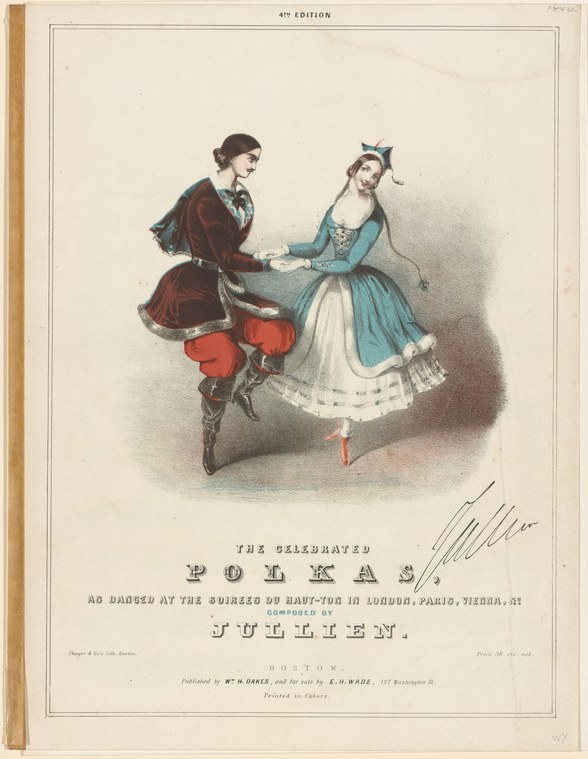
The celebrated polkas, as danced at the soirees du .haut-ton in London, Paris, Vienna, & c.: Composed by Jullien
Unknown artist
- Collection:
- Prints depicting dance
- Source:
- New York Public Library
- Rights:
- Public domain — free to use, share and adapt.
- Recorded as:
- Public Domain
This print documents how the polka—a Bohemian dance that conquered Europe in a single decade—was taught, danced, and imagined in mid-19th-century America. It shows that dance instruction and fashion imagery were intertwined: publishers sold these prints to dancers and musicians who wanted to stay current with European styles. The hand-coloring, the military costume, and the exaggerated courtesy of the male figure tell us that the polka, though energetic and fun, was understood as a dance of social hierarchy and romantic performance—not freedom, but highly coded propriety.
What you are looking at
A hand-colored lithograph showing two dancers in a moment of flirtation or instruction. The male figure, positioned on the left, wears a deep burgundy velvet coat with blue trim, red breeches, and black boots with spurs—the costume of a military officer or nobleman. He kneels or bows in a courtly manner. The female figure, on the right, wears a pale blue dress with a white underskirt trimmed with lace or scalloped detail, and a blue ribbon or bonnet in her hair. She leans toward him with a coy, engaged expression. Both figures are depicted against a neutral background with subtle shading that creates depth. The composition captures a moment of social interaction rather than active steps—the male in a posture of deference or proposal, the female responsive and pleased. The hand-coloring is delicate, emphasizing the luxurious fabrics of their dress.
The dancing
The male dancer's body is folded into a deep bow or kneel, his upper torso inclined toward the female figure in a gesture of courtship or respect. The female stands upright with her weight on both feet, her body angled toward him, her arms relaxed and open. Neither figure is caught mid-step; instead, both are frozen in a moment of social exchange. The spacing between them—close but not touching—and the direction of their gaze suggest the psychological content of the dance: invitation, acceptance, and flirtation rather than technical display.
The dance depicted
This is a polka, as explicitly stated in the title. The polka was a fashionable social dance of the mid-19th century, originating in Bohemia and rapidly adopted across Europe and America by the 1840s. The image depicts not the active turning and bouncing characteristic of the dance itself, but rather the moment of courtship before or between figures—a common subject in dance instruction prints and social dance imagery of the period. The composition emphasizes the social and romantic nature of the polka as a couples' dance performed in ballrooms and at 'soirées du haut-ton' (high-society evening parties), where it was a vehicle for flirtation within strict codes of propriety.
How it was made
This is a hand-colored lithograph, recognizable by its soft tonal gradations and the characteristic crayon marks typical of lithographic stone. The printing would have been achieved by drawing on a prepared stone with a greasy lithographic crayon, then processing the stone with acid and gum to create ink-receptive and ink-repellent areas. Hand-coloring was then applied by brush to individual impressions. This technique allowed rapid, affordable production of fashionable imagery for the middle-class market. The inscription indicates publication in Boston by W. M. Dakes, with distribution through E. H. Wade in New York—suggesting this was circulated as a commercial print, likely among dance enthusiasts, musicians, and ballroom dancers seeking both instruction and fashionable reference.
About this work
This lithograph documents the polka at the height of its social fashion in the 1840s–1850s, presenting not a moment of active dancing but rather the courtship dynamic embedded in the dance form. The image comes from a series titled 'The Celebrated Polkas,' composed by Jullien (Louis Antoine Jullien), the celebrated conductor and composer whose orchestral arrangements of popular dances and quadrilles were performed across London, Paris, Vienna, and America. The print served both as a record of how fashionable people danced and as a tool for instruction and imitation—the gentleman's posture of deference and the lady's receptive stance model the social choreography of elite ballroom culture.
As a hand-colored lithograph circulated in Boston, this work belongs to the vast but little-studied archive of 19th-century dance prints—ephemeral commercial objects that shaped how people learned to move and how they imagined themselves as dancers. It is valuable precisely because it captures dance not as technical spectacle but as social practice, and because it records a moment when the polka was new enough to require explanation and prestigious enough to merit publication.
How to look at it
Notice the kneeling posture of the man and the upright, receptive stance of the woman. This is not a moment of active dancing but of proposal and acceptance—the social frame within which the polka was danced. The careful symmetry of the composition, with both figures centered and facing each other, emphasizes the balanced partnership that the polka claimed to offer. The military costume and the woman's fashionable dress tell you that this is a ballroom dance of the elite, not a folk dance. Look at the empty space between the figures: it suggests the momentary pause between figures of the dance, or the moment before the music begins—a visual convention of dance prints that shows the step or the frame rather than continuous motion.
The artist
The composer Louis Antoine Jullien (1812–1860) was the dominant figure in ballroom and orchestral music of the 1840s and 1850s. A Parisian conductor and impresario, he made his career arranging and composing dance music—quadrilles, polkas, waltzes—for the ballrooms of London, Paris, and Vienna, and later for performances and dances in America. He was celebrated for his theatrical orchestrations and for his ability to capture and amplify the fashionable dances of the moment. These prints, published under his name, were marketing objects that promoted both the dances themselves and the sheet music from which orchestras would perform them. The artist of this particular print is not recorded.
The period
The polka arrived in Prague in the early 1830s and had conquered European ballrooms by the early 1840s. It was faster, bouncier, and more openly enjoyable than the minuet, gavotte, or even the waltz—a dance of pleasure rather than ceremony, yet still performed in ballrooms under strict social rules. By the 1840s, no fashionable dance band was complete without polka arrangements, and every ballroom instruction manual included polka steps. The period saw an explosion of lithographed dance prints, instruction manuals, and sheet music covers depicting the new dances, aimed at the rapidly expanding middle class who aspired to ballroom competence. Jullien's work was at the center of this commercial dance culture, and his name on these prints was a guarantee of fashion and propriety.
Where it lives
This print is held in the New York Public Library's collection of prints depicting dance. It was published in Boston by W. M. Dakes and distributed by E. H. Wade of New York, identifying it as a commercial print intended for the American market. The inscription 'Published by W M Dakes and for sale by E. H. Wade, 125 Washington St' and the notation 'Printed in Colors' confirm its status as a hand-colored lithograph produced for sale.
Dance in this work
Questions about this work
What was the polka and why was it so fashionable?
The polka was a sprightly couples' dance in 2/4 time, originating in Bohemia (modern Czechia) in the early 1830s. It arrived in Paris in 1840 and swept across Europe and America within a few years. It was faster and more playful than the waltz, requiring less training, and it explicitly paired men and women in close proximity—making it a vehicle for flirtation and social advancement. By the 1850s, no ballroom was complete without polka music.
Who was Jullien?
Louis Antoine Jullien (1812–1860) was a Parisian conductor and composer who dominated ballroom music in the 1840s–1850s. He was famous for orchestrating the fashionable dances of the day—quadrilles, polkas, waltzes—and for promoting them through concerts, balls, and printed materials. His name on a piece of sheet music or a print guaranteed that it captured the latest European fashion.
What does this print tell us about how people danced the polka?
This image captures the social choreography of the polka: the man's deep bow or kneel shows deference and courtship; the woman's upright, receptive stance shows acceptance. The moment frozen here is not the active bouncing steps of the polka itself, but the pause between figures—the social frame in which the dance was performed. It reveals that even 'fun' dances were governed by strict codes of gender, rank, and propriety.
How did people learn to dance in the 19th century?
Through a combination of dance masters, instruction manuals, and visual reference materials like these prints. A young person of the middle or upper class would attend a dance master or receive instruction from a family member, and would also study prints and instruction books showing the proper posture, frame, and costume. These prints were essential tools: they showed not only the steps but how a fashionable dancer should look and behave.
More dance artwork





