49 works in this view — arrow keys or swipe to move between them.
Dance in Art
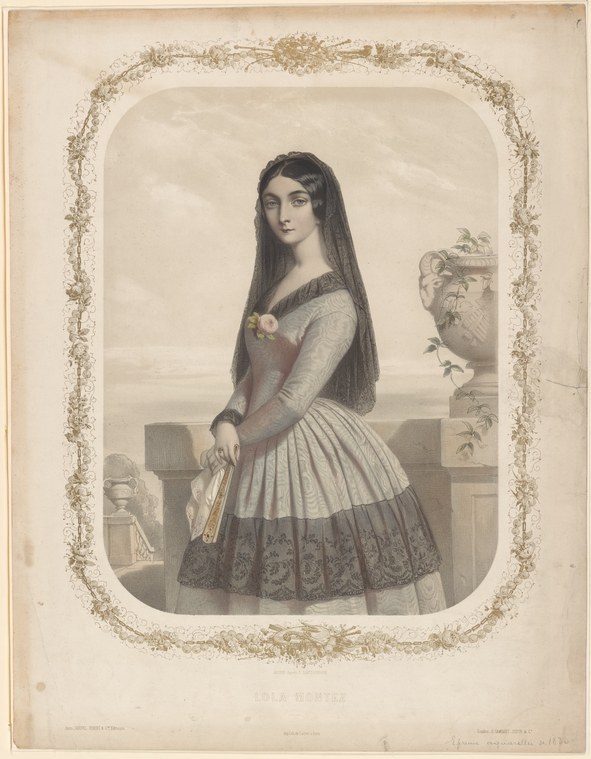
Lola Montez
Unknown artist
- Collection:
- Prints depicting dance
- Source:
- New York Public Library
- Rights:
- Public domain — free to use, share and adapt.
- Recorded as:
- Public Domain
Montez was a polarizing figure whose career reveals the precarious social status of women dancers in the nineteenth century—celebrated for their bodies and stage presence, but often subject to scandal, gossip, and moral judgment. This portrait, in its studied elegance and romantic presentation, shows how a performer's public image was carefully constructed and merchandised, a practice that remains central to dance and theater stardom today.
What you are looking at
A young woman in mid-nineteenth-century dress stands alone on a neoclassical terrace, posed in a moment of theatrical repose. She wears a white muslin bodice with short sleeves and a bell skirt of white gauze over a dark patterned hem, her abundant dark hair falling unbound to her waist—a striking departure from the bound styles of her era. In her right hand she holds a fan; her left rests at her side. Behind her, a stone balustrade and classical urn with ivy suggest an aristocratic garden or palace setting. The composition is framed by an ornate border of scrollwork and flowers, in the manner of a theatrical portrait or celebrity print. Her expression is pensive, turned slightly away from the viewer, her posture upright but relaxed. The overall effect is one of studied elegance and romantic melancholy—the pose and costume suggest a performance or a moment between acts.
The dancing
A solitary female figure occupies the center of the composition, standing in an upright but naturalistic posture—no theatrical arabesque or balletic extension, but rather the weighted stance of a performer at rest. Her arms are loose and unforced; her right hand holds a fan in a gesture of refined leisure. The posture is that of a woman posed for a portrait or a dramatic tableau, not captured mid-movement. There is no partner, no group, no formation—the dancer is isolated and contemplative.
The dance depicted
This is a portrait of Lola Montez, a famous dancer and courtesan of the 1840s–1850s who performed across Europe and America. Montez was celebrated for her 'Spider Dance,' a short theatrical number in which she would appear to discover a spider in her skirts and brush it away with increasingly frantic gestures—a novelty act pitched between burlesque and theatrical performance. The costume and setting here suggest a moment of theatrical presentation rather than active dance; the unbound hair and flowing muslin recall the Romantic aesthetic of the era, and the isolated, pensive posture is consistent with mid-nineteenth-century theatrical portraiture. The image presents Montez as a performer and public figure rather than documenting an actual dance in progress.
How it was made
This is a hand-colored engraving or lithograph, a reproductive print made for mass circulation—typical of the 1840s–1850s celebrity print industry. The ornate floral border and careful rendering of fabric and features indicate skilled reproductive work, possibly after a painting or photograph. Such prints were sold in theaters, collected by fans, and distributed as souvenirs, making them a primary vehicle for the circulation of celebrity images in the nineteenth century. The technique allowed for wide distribution and accessibility, marking Montez as a figure of significant public interest.
About this work
This is a celebrity portrait print of Lola Montez, a controversial dancer and performer of the mid-nineteenth century, rendered in the refined theatrical style of her era. The image captures not a moment of dance but a constructed moment of repose—Montez posed as a fashionable woman of taste and refinement, her costume and setting designed to flatter and mystify. It belongs in a dance history collection not because it documents movement, but because it documents the theatricality, celebrity, and cultural presence of a dancer whose notoriety shaped public understanding of women performers in the nineteenth century. Montez's 'Spider Dance' was more novelty than art, but her fame was real and her image was endlessly reproduced and consumed.
How to look at it
Attend to the artifice of the pose: this is not a candid moment but a carefully constructed presentation of Montez as a fashionable woman and refined performer. Notice the unbound hair—a deliberate romantic affectation that would have read as daring or bohemian to a Victorian viewer. The fan in her hand, the classical setting, and the pensive gaze all work together to present her as a woman of taste and mystery rather than as a comic or lewd performer, even though her public reputation often centered on scandal. The ornate border frames her as a commodity and a collectible, a product of the nineteenth-century celebrity industry.
The artist
The artist is not recorded. The print is a work of commercial reproductive art—engraving or lithography—typical of the theater and celebrity print industry of the 1840s–1850s. Such prints were often created by skilled reproductive artists who worked from paintings, photographs, or theatrical sketches, and were rarely signed or credited individually. The quality and finish suggest work by a professional house, possibly a London or Paris publisher, but attribution without documentation is speculative.
The period
The 1840s–1850s saw the rise of mass-produced celebrity imagery and the modern phenomenon of the theatrical star. Photography was emerging but not yet dominant; hand-colored lithographs and engravings were the primary medium for distributing images of famous performers. The Romantic era had valorized the female dancer—Taglioni, Elssler, and others became international celebrities whose images were collected and displayed. Montez emerged in this context as a more scandalous and controversial figure, her novelty dances and affairs with powerful men making her simultaneously famous and disreputable. Her portrait prints were part of a broader culture of fan consumption and theatrical celebrity.
Where it lives
This is a print from the NYPL's collection of prints depicting dance. Such prints were produced commercially in the mid-nineteenth century and distributed through theater lobbies, print shops, and fan networks. No publication date, publisher, or engraver is recorded.
Questions about this work
Who was Lola Montez?
Lola Montez (c. 1821–1861) was an Irish-born dancer and courtesan famous across Europe and America for her novelty 'Spider Dance' and her affairs with powerful men, including Ludwig I of Bavaria. She was a controversial figure whose notoriety exceeded her actual achievements as a dancer, though her fame was undeniable and her image was widely reproduced.
What was the Spider Dance?
The Spider Dance was a short theatrical act in which Montez would discover a spider crawling on her skirts and perform increasingly frantic gestures to brush it away. It was a novelty act, more burlesque than ballet, but it became her signature and made her famous and wealthy.
Does this image show her actually dancing?
No. This is a portrait in her theatrical costume, posed as a refined performer and woman of fashion. It presents the image Montez wanted to project—romantic, elegant, and mysterious—rather than documenting an actual performance or moment of dance.
How is this different from a painting?
This is a printed image—likely an engraving or lithograph hand-colored after the fact. It could be reproduced many times and sold cheaply, making it a mass-market celebrity product rather than a unique artwork. Hundreds or thousands of copies of this image would have been sold and collected.
More dance artwork





